Jakobuskirche (Tübingen): A Historic Protestant Church and Pilgrimage Station


Site at a Glance
- Rating
- 4.5
- Popularity
- Very Low
- Country
- Germany
- Primary era
- Medieval
- External website
- Open
- Eras represented
- Medieval, Early Modern
- Civilizations
- Duchy of Württemberg, Holy Roman Empire
- Site type
- Religious
- Remains
- Church
On this page8 sections
History
Jakobuskirche (Tübingen) is a historic church in Germany, probably built around 1200 as a Romanesque chapel dedicated to Saint James the Greater. It was first mentioned in 1377 and is regarded as Tübingen’s oldest building that remains inhabited.
From Chapel to Hospital Church
The church and the surrounding Ammertal were repeatedly affected by spring floods. In 1500, the building and its surroundings were raised by about 2.5 metres, while the chapel was remodeled into the form that largely defines it today. The building became known as the Spitalkirche, or hospital church, and served as a branch church dependent on the Collegiate Church of Saint George in the Oberstadt.
Its religious role extended beyond the hospital. Jakobuskirche served residents of the Unterstadt, or Lower Town, including winegrowers, farmers, and tradespeople. The nearby Konrad Chapel was later used as an anatomy building before being abandoned in 1853.
Shared Worship and Parish Development
Secularization in 1806 transferred ecclesiastical institutions and property to secular authority and brought a change to the church’s use. On 8 February 1807, Catholic parish priest Johann Georg Dürlewanger and Lutheran pastor Dr. Müller agreed that the hospital church would be shared by both confessions according to a fixed schedule. On 15 February 1807, it hosted the first Catholic Mass held in Tübingen since the Reformation.
After the Wilhelmskirche was built, the two Catholic churches became part of a single Catholic parish. Growing congregations eventually made both churches too small, and Saint John’s Church was constructed between 1875 and 1878 with Protestant support. Jakobuskirche then returned to exclusively Protestant use.
Modern Protestant Use
In 1918, after the First World War, Jakobuskirche became an independent parish church. It now belongs to Tübingen’s united Protestant parish and is used by the Protestant Jakobusgemeinde. In 1975, the relatively dark Neo-Gothic choir glazing, produced during the nineteenth-century revival of Gothic architectural forms, was replaced with substantially lighter windows designed by Gisela Dreher-Richels.
The church is also a station on the European Way of Saint James, a network of Christian pilgrimage routes leading to the shrine of Saint James at Santiago de Compostela in northwestern Spain.
Remains
Jakobuskirche and the neighboring Salzstadel form the historical center of Tübingen’s Unterstadt, locally known as the Gôgei. The church combines the surviving elements of its early Romanesque construction with the eastern choir added during the 1500 remodeling.
Romanesque Structure
The original chapel was founded on oak piles approximately 14 metres long. Several small, round-arched windows remain as visible reminders of the earlier Romanesque building, a medieval style characterized by heavy masonry, rounded arches, and relatively small windows.
Choir and Pilgrimage Imagery
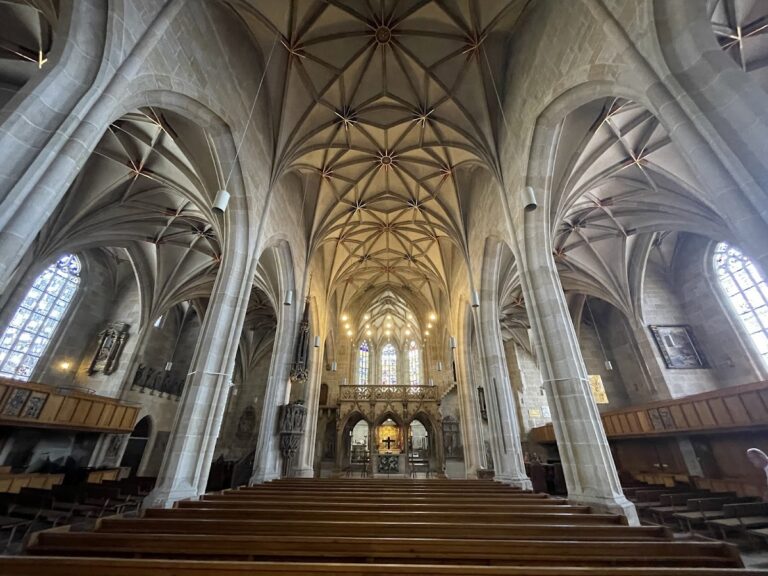
The eastern choir was added in 1500. An inscription on the outer choir wall beneath a window states that its first stone was laid on 10 June that year. The choir’s rib vault has a keystone, the central stone where the vault ribs meet, depicting Saint James with a cloak, scallop shell, staff, and hat. These attributes reflect the church’s connection with pilgrimage.
The choir windows installed in 1975 are substantially lighter than the earlier Neo-Gothic glazing and incorporate rose ornament. The church also contains notable keystones, epitaphs, and funerary monuments, including inscriptions and monuments commemorating the dead.
Stone Reliefs
Regularly cut ashlar blocks in the church bear reliefs of concentric circles, sometimes accompanied by bent, raised arms. These motifs are sometimes called sun discs, but their interpretation remains unresolved.