Kirche Hähnichen: A Fourteenth-Century Parish Church in Germany


Site at a Glance
- Rating
- 4.4
- Popularity
- Very Low
- Country
- Germany
- Primary era
- Medieval
- Eras represented
- Medieval, Early Modern, Modern
- Civilizations
- Electorate of Saxony, Holy Roman Empire, Kingdom of Bohemia
- Site type
- Religious
- Remains
- Church
On this page10 sections
History
Kirche Hähnichen is a fourteenth-century parish church in Germany, first mentioned in an ecclesiastical register of the medieval Diocese of Meissen. It remains part of the Hähnichen parish and is protected as a historically significant building associated with the local history of Hähnichen.
Medieval parish and Reformation
Before the Reformation, the sixteenth-century movement that established Protestant churches across much of Europe, the Hähnichen parish belonged to the Görlitz deanery, an administrative grouping of parishes under shared supervision. Protestant worship and church organization had been introduced in the parish by 1579 at the latest.
Changing parish administration
The parish includes Hähnichen, Quolsdorf, Spree, and Trebus. Spree moved from the Rothenburg parish to Hähnichen in 1967. Neuhof, Neu-Särichen, and part of Niesky remained within Hähnichen until 1895, when they were transferred to the newly established Niesky parish.
Until 1945, Hähnichen belonged to the Evangelical State Church of the Older Provinces of Prussia. After that church disintegrated, the parish joined the Evangelical Church in Silesia and entered the Rothenburg II church district, which was renamed the Weißwasser church district in 1949. The Evangelical Church in Silesia later became the Evangelical Church of Silesian Upper Lusatia. On 1 January 2004, it merged with the Evangelical Church in Berlin-Brandenburg to form the present regional church.
In January 2007, the Weißwasser, Görlitz, and Niesky church districts were combined into the Lower Silesian Upper Lusatian Church District. Since 2014, Hähnichen has belonged to the Silesian Upper Lusatian Church District. Together with Daubitz, Kosel, and Rietschen, it forms the pastoral district on the White Schöps, a grouping of parishes served through a common pastoral structure.
Restoration and preservation
The altar underwent restoration between 1988 and 1993. In 2002, the Soldan organ-building company of Niesky renovated the organ. These interventions form part of the church’s continuing preservation as a building connected with Hähnichen’s local history.
Remains
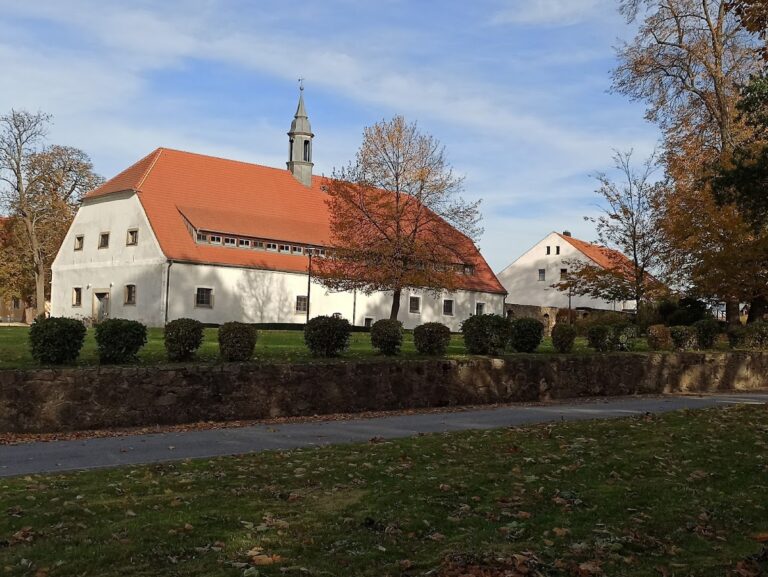
Kirche Hähnichen is an elongated hall church constructed from rubble masonry. Its eastern end is straight, and the building is covered by a half-hipped gable roof. Irregularly placed segmental-arched windows light the nave, while a small pointed-arched window appears in the east wall.
Exterior and roof structure
A wooden roof turret, a small tower built onto a roof rather than rising from the ground, was added over the western part of the roof in 1783. It consists of a cap, an open lantern, and an octagonal spire. A weather vane at the top indicates the year of its construction.
Interior arrangement
Ceiling, pews, and galleries
The interior has a flat ceiling. Two wooden box pews with segmental-arched openings are attached to the north and south sides. Wooden galleries occupy the east and west sides, while the sacristy beneath the northern box has a barrel-vaulted interior.
Altar and furnishings
The richly carved altar was made by Theodor Pausewein in 1709. Its retable, the decorated backing behind an altar, presents the Trinity, the Christian doctrine of God as Father, Son, and Holy Spirit. Christ holding a victory banner appears in an oval field, with the Holy Spirit above him and God the Father holding a globe. Foliage around the composition incorporates the coats of arms of the von Gablenz, Mutschelwitz, Schönberg, and Dieskau families.
A plain wooden pulpit dates from 1710, as does a kneeling baptismal angel. The oldest church bell was cast in 1482. The organ has twelve stops and was made by an unknown builder.
Tombs and memorials
A very poorly preserved Late Gothic wall painting remains visible on the south wall. Numerous inscribed tombstones from the sixteenth to the nineteenth centuries are fixed inside the church and on its exterior walls. On the north side of the choir stands the tomb monument of Hans von Deupold, who died in 1590.
The exterior walls carry monuments to a namesake of Hans von Deupold, who died in 1597, and to Helene von Nostitz, who died around 1625. They also commemorate Hieronymus von Deupold the Younger, Hans Heinrich von Nostitz, who died in 1654, and Hans Christoph von Schurtz, who died in 1670. All of these individuals died in childhood. Their monuments bear reliefs of the deceased and the coats of arms of various patronage families, whose established rights included responsibility for church patronage.