Maro Tower: A Byzantine Defensive Tower in Greece


Site at a Glance
- Rating
- 4.6
- Popularity
- Very Low
- Country
- Greece
- Primary era
- Medieval
- Eras represented
- Medieval
- Civilizations
- Byzantine
- Site type
- Military
- Remains
- Castle
On this page6 sections
History
Maro Tower is a medieval Byzantine defensive tower in Greece, standing at Dafni in the Vissaltia area of Central Macedonia. Built in 1374, it formed the surviving remnant of a Byzantine castle and served both residential and defensive purposes. Its traditional association with Mara Branković, a Serbian princess who became the consort of Ottoman sultan Murad II, gives the tower an important place in the history of the region.
Mara Branković and Dafni
After Murad II died, Mara inherited Dafni as a large landed estate and settled there. She retained considerable diplomatic influence and intervened in political and religious affairs. She also supported the Christian community and helped preserve religious relics, which were often sent to monasteries on Mount Athos, a monastic peninsula in northern Greece known for its Orthodox Christian monasteries.
Mara was also the adoptive mother of Mehmed II, later known as Mehmed the Conqueror. Tradition identifies Maro Tower as her residence, although the surviving structure was part of a wider fortified complex. Mara survived an attempted assassination by agents sent to Dafni and escaped to a nearby village. She died in 1487.
A medieval codex belonging to the Cathedral of Saints Theodore in Serres records an icon associated with Mara. The icon, made from the Sacred Wood and depicting the Virgin Mary, was donated by Mara to the cathedral.
Destruction and protection
The tower was destroyed in 1753. Residents of Dafni later removed some of its stones during the 1940s for reuse as building material. Stavronikita Monastery retained ownership until the middle of the 1930s. The Greek state placed the tower under protection as a cultural monument in the late 1950s.
The 1978 earthquakes caused substantial damage, and the structure was repaired to some extent afterward. These later interventions form part of the tower’s modern history, while its ruined condition continues to reveal the remains of the medieval fortification.
Remains
Layout and construction
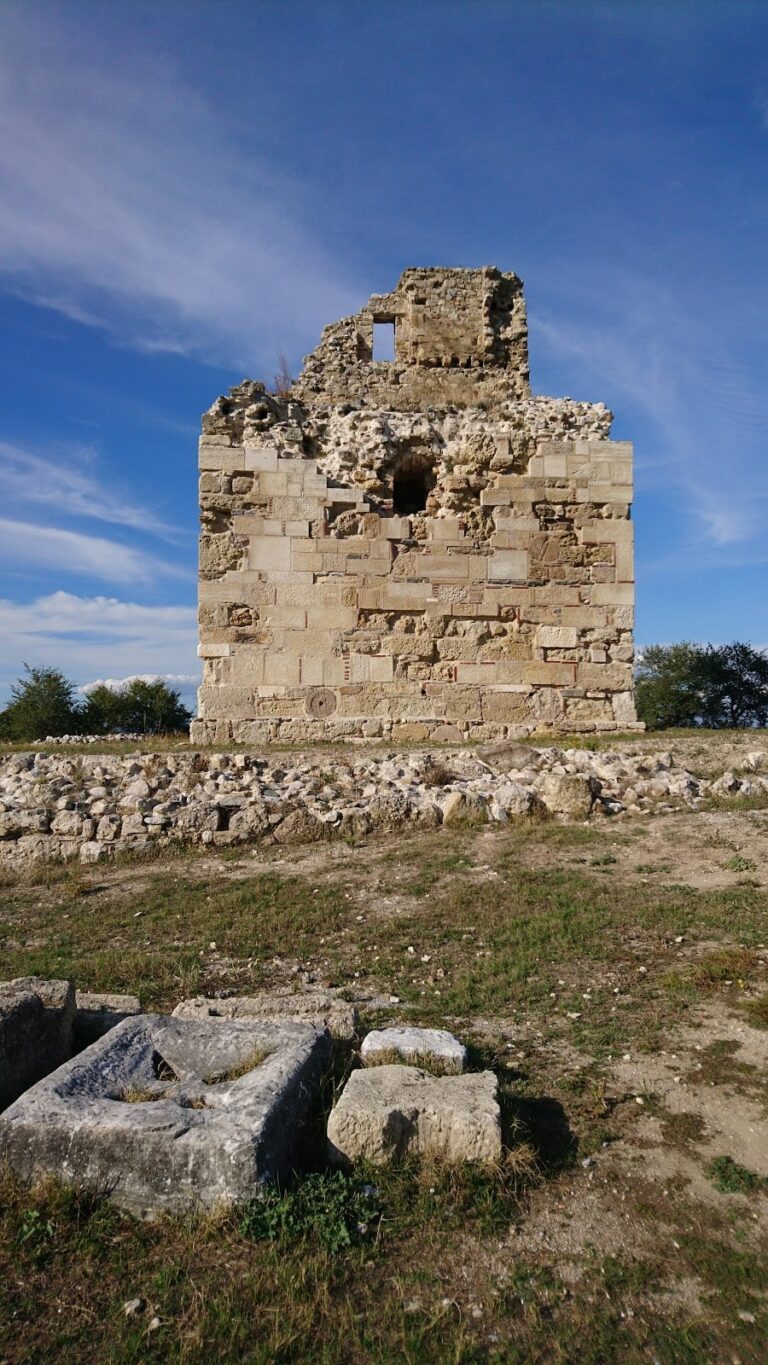
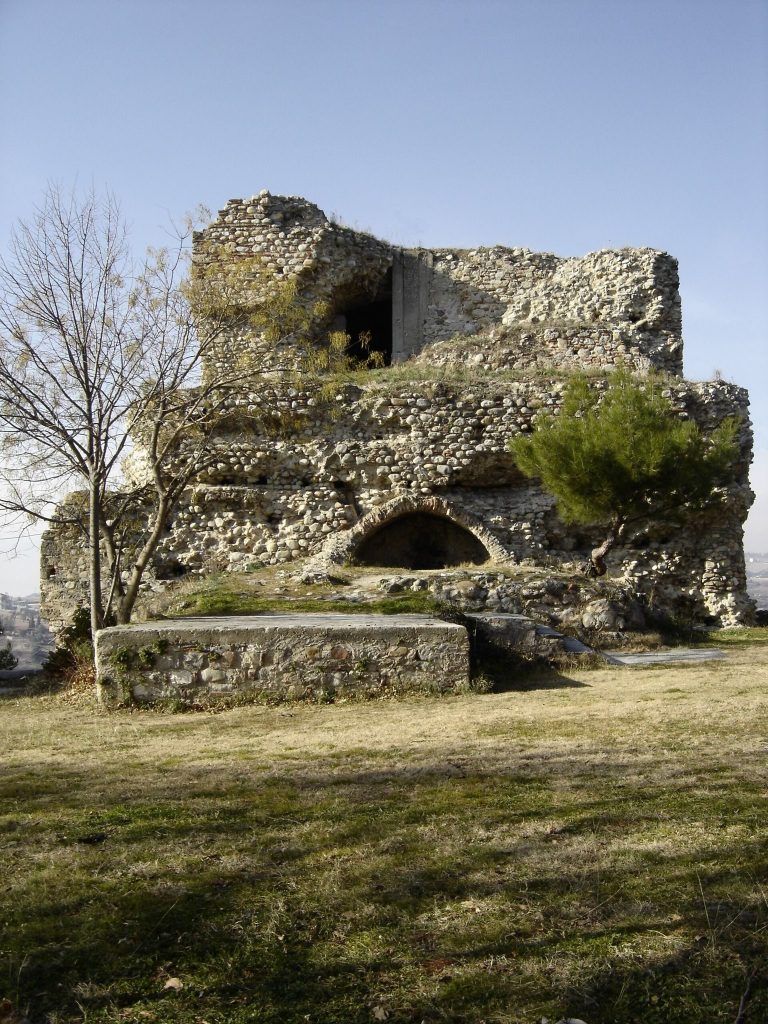
Maro Tower stands at the northwestern edge of Dafni as an independent square-plan structure. Each external side measures 12.41 metres, while the shorter internal dimension is 7.65 metres. The surviving masonry reaches approximately 14.30 metres at the western corner, although the tower is now ruined.
The walls are made of strong, plain mud-brick masonry containing irregularly arranged brick fragments. Stones from the nearby Ejovitsa River were also used, together with dressed porolite corner stones quarried at the foot of Orsova Mountain. Wooden beams reinforced the masonry. The construction follows the tower tradition of Mount Athos and resembles Kuchos Tower and the contemporary Marmara Tower, dated to 1367.
Storeys, entrance, and windows
The tower originally had three storeys. The first was covered by a masonry dome, while the second had a tiled roof. By the sixteenth or seventeenth century, the uppermost storey had collapsed, although the tower remained in use during that period.
The original entrance was positioned in the middle of the northeastern wall, beneath an arch and approximately 1.90 metres above ground level. A wooden ladder provided access, and a similar internal staircase probably connected the entrance with the floor of the first storey. A vaulted window stood above the entrance, while comparable windows probably opened on the other sides through the thickness of the upper-storey walls.
A reported underground passage was traditionally said to have connected Maro Tower with Svetamarinska Tower, several hundred metres west of the village. The passage remains an unconfirmed element of the tower’s associated traditions.