Santa Maria dell’Itria, Ragusa: A Baroque Church of the Order of Malta


Site at a Glance
- Rating
- 4.5
- Popularity
- Very Low
- Country
- Italy
- Primary era
- Early Modern
- Eras represented
- Medieval, Early Modern
- Civilizations
- Kingdom of Sicily, Knights Hospitaller, Spanish
- Site type
- Religious
- Remains
- Church
On this page18 sections
History
Santa Maria dell’Itria, Ragusa is a Roman Catholic church in Italy, rebuilt in the eighteenth century as a Baroque monument in the historic district of Ibla. Dedicated to Our Lady of Odigitria, a Christian image type whose name means “She Who Shows the Way,” it stands in the former Jewish quarter of Cartellone and is historically connected with the Knights of Malta.
Fourteenth-century origins
The church began in the fourteenth century under the patronage of the Chiaramonte counts, who held a local fief. Its original dedication was to Saint Julian the Hospitaller, a saint associated with hospitality and care for travelers. An adjoining hospice or hospital formed part of the early foundation.
The first recorded presence of the Sovereign Military Order of Malta in Ragusa dates to 1391. The order, a religious and military institution traditionally associated with Saint John of Jerusalem, administered Santa Maria dell’Itria as a suffragan church of its Hospitaller priory. The related institution included the “old hospital,” which sheltered poor travelers.
The Maltese commandery and rebuilding
A later commandery, the administrative center of an order estate, was probably established by the baron Blandano Arezzo in 1626. The Knights of Malta rebuilt the church between 1629 and 1639, strengthening its association with the order and its charitable work in Ragusa.
The church’s decoration continued to recall the Maltese connection through the use of the order’s octagonal-cross symbolism and other references to the Maltese period. Its name, Itria, has also been linked by some local historians to hydria, a jar or vessel, perhaps because a spring once stood nearby. That explanation remains uncertain.
Post-earthquake Baroque transformation
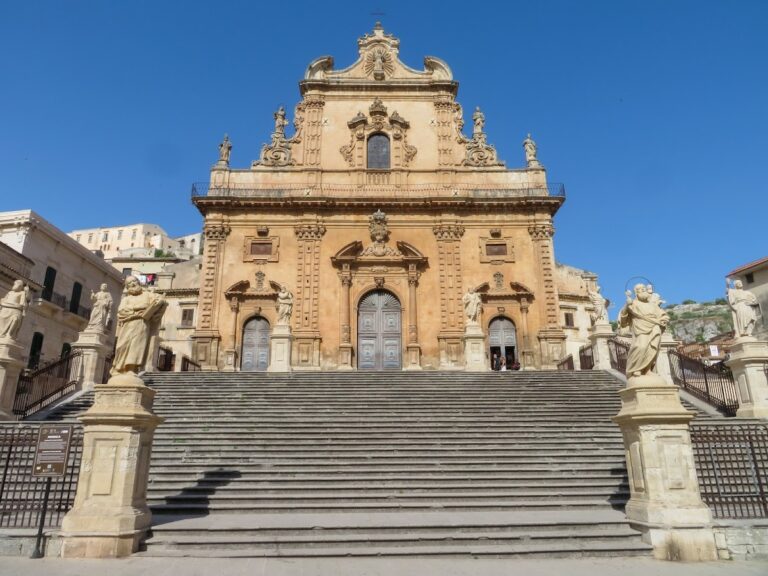
The earthquake of 1693 caused relatively limited damage to Santa Maria dell’Itria. During Ragusa’s wider reconstruction after the disaster, however, the church was rebuilt and enlarged in the first half of the eighteenth century. This work gave it the Baroque character visible today. The presbytery arch was completed in 1739, followed by the facade in 1740.
The church forms part of the UNESCO World Heritage property Late Baroque Towns of the Val di Noto, which was inscribed in 2002 under criteria (i), (ii), (iv), and (v). Its present form therefore belongs both to Ragusa’s post-earthquake rebuilding and to the historical landscape recognized through that designation.
Remains
Santa Maria dell’Itria is a Baroque church positioned along the Commendatore ascent. Its surviving architecture combines a two-order facade, an octagonal bell tower, a nave with two aisles, and a series of richly decorated chapels and altars. White limestone columns, painted canvases, stucco, ceramics, and carved stonework create a unified eighteenth-century interior while preserving selected elements from the earlier church.
Facade and bell tower
Baroque facade
The facade is arranged in two architectural orders divided by a large cornice. Its central portal carries intertwined foliage and is surmounted by a large window, while the side sections contain two large oval windows. From the staircase, the facade appears oblique, a feature that forms part of its presentation along the ascent.
Octagonal bell tower
The octagonal bell tower is decorated with polychrome Caltagirone ceramics made in 1757. The terracotta work represents flowers and pots in typically Sicilian colors, adding a vivid ceramic element to the church’s stone and plaster architecture.
Nave, aisles, and general decoration
The interior has a central nave and two aisles separated by two rows of ten white limestone columns. Their Corinthian capitals, a classical form traditionally ornamented with vegetal motifs, replace the usual acanthus leaves with almond leaves. The counterfacade contains the choir loft and organ.
Five monumental Baroque stone altars and a deep chapel occupy the church. Members of the Cultraro family produced the altars during the eighteenth century, with individual works dated between 1736 and 1758. Floral decoration covers the columns and wall surfaces, while the side walls display refined Rococo motifs, characterized by delicate, asymmetrical, and highly ornamental forms. Two pitch-stone holy-water stoups also survive from the church’s earlier decoration.
Chapels and paintings
Chapel of the Addolorata
In the right aisle, the Chapel of the Addolorata has stucco decoration and painted drapery along the arches. A statue of the Sorrowful Virgin occupies the central niche. Beneath the altar, a crystal urn contains the dead Christ.
Chapel of the Holy Family
Also in the right aisle, the Chapel of the Holy Family is a Baroque work dated 1758 and enriched with Rococo motifs. Its columns have elaborate bases and relief decoration on the upper shafts. The broken pediment features offset volutes, an intermediate stele with a coat of arms, and a canopy. Its altarpiece depicts the Flight into Egypt.
Chapel of Saint Blaise
The Chapel of Saint Blaise occupies the left aisle. Its convex design includes columns with helically developed bases and rich Rococo decoration along their shafts. An offset broken-arched pediment contains an intermediate lunette with an inscription and an upper frieze. The altarpiece, the Miracle of Saint Blaise, shows the miraculous healing of a child with a fishbone lodged in his throat.
Chapel of Saint Julian
In the left transept apse, the Chapel of Saint Julian has an altar with twisted columns whose spiral grooves carry floral garlands. The columns stand on high plinths decorated with putti, while the pediment has curled volutes, an intermediate stele, and a lunette. Its altarpiece depicts Saint Julian the Hospitaller and Saint John the Baptist and is attributed to Mattia Preti, a prominent seventeenth-century Italian Baroque painter active in Italy and Malta.
Chapel of the Most Holy Crucifix
The Chapel of the Most Holy Crucifix fills the right transept apse. Its altar repeats the use of twisted columns with floral garlands, set on high plinths bearing putti with the Instruments of the Passion. A crucifix from the Spanish school dominates the arch, accompanied by statues of the Sorrowful Virgin and Saint John the Evangelist. The Cosentini family held the chapel’s patronage.
The left aisle also contains a documented painting of Saint Philomena and Ignazio Scacco’s 1699 painting of the Madonna of the Seven Swords, also known as the Virgin of the Seven Sorrows, with Saint Eligius and Saint Lawrence. Another canvas depicts Saint Corrado of Piacenza and Blessed William of Scicli holding a painting of the Madonna.
High altar
Cultraro tribune
The high altar is surmounted by an elaborate tribune made by the Cultraro family in 1743. Paired fluted columns frame a large, slightly concave, arched structure. The lower parts of the columns carry plant-like decoration, extending the church’s floral vocabulary into the principal altar ensemble.
Madonna Odigitria
A statue of the Madonna stands in the high-altar niche beneath an eighteenth-century painting of the Madonna Odigitria. The painting includes a period view of the port of Valletta beneath the feet of the Christ Child, linking the central Marian image to the church’s longstanding Maltese associations.