Basilica Santuario della Beata Vergine delle Grazie: A Marian Sanctuary in Udine


Site at a Glance
- Rating
- 4.6
- Popularity
- Low
- Country
- Italy
- Primary era
- Early Modern
- External website
- Open
- Eras represented
- Early Modern, Modern
- Civilizations
- Habsburg, Venetian
- Site type
- Religious
- Remains
- Basilica
On this page12 sections
History
The Basilica Santuario della Beata Vergine delle Grazie is a Roman Catholic church in Udine, Italy, dedicated to the Madonna delle Grazie. Its present sanctuary was begun in 1495 and developed in Renaissance style, while later enlargements gave the church a richly Baroque interior and a Neoclassical entrance front. The church grew from an earlier building dedicated to Saints Gervasius and Protasius and became closely associated with devotion to a revered image of the Virgin Mary.
The Madonna delle Grazie and the Servites
In 1479, Giovanni Emo, the Venetian lieutenant in Friuli, brought an icon of the Madonna to Udine. Tradition held that he had received it from Mehmed II, the Ottoman sultan who conquered Constantinople in 1453 and ruled until 1481. Emo kept the image in Udine Castle, where he lived. There, local tradition connected it with the miraculous healing of a castle cook who had badly injured her hand.
Emo later transferred the icon from the castle to the nearby church, which had recently been taken over by the Servites, or Order of the Servants of Mary. This Catholic religious order was especially associated with devotion to the Virgin Mary and administered the sanctuary and its convent. Tradition places the procession on 8 September 1479 and explains the transfer by saying that an image believed to perform miracles could not properly remain in a secular residence.
Construction and consecration
Construction of the present sanctuary began when its foundation stone was laid on 12 April 1495. The first service in the new church took place in 1513. On 12 May 1520, Bishop Daniele De Rubeis of Caorle consecrated the building while acting in pontifical functions for the Patriarch of Aquileia, the major ecclesiastical jurisdiction whose representative took part in the ceremony.
The sanctuary was enlarged in successive phases and acquired an adjoining convent. The Servite friars were expelled after the French invasion of 1797, but returned to the sanctuary in 1923. The sixteenth-century convent itself was expanded and decorated with frescoes over the centuries.
Eighteenth- and nineteenth-century changes
In 1730, the Venetian architect Giorgio Massari lengthened and raised the nave, remodelled the presbytery and apse, and heightened the bell tower. His plan repeated that of the Jesuit church of Santa Maria Assunta in Venice. During the first half of the nineteenth century, a porch was added before the façade, while the staircase and the bridge over the canal connecting the church with the square were restored.
The sanctuary’s association with popular devotion to the Madonna is reflected in its numerous votive offerings. The Madonna icon was ceremonially crowned on 6 September 1870 by decree of the Vatican Chapter. On 21 June 1922, the church was elevated to the status of a minor basilica, a special title granted by the Catholic Church to churches of particular ecclesiastical or devotional importance.
Remains
The surviving church is a single-nave hall in Renaissance form, later reshaped by Baroque decoration and a Neoclassical entrance front. The nave forms one side of the convent cloister on the southwest, while the Chapel of the Madonna stands at the centre of the nave opposite the cloister. The bell tower rises on the right side of the choir, and a shallow dome with a lantern lights the roof in front of the choir.
Façade and approach
The entrance front is formed by a pronaos, or columned porch, with four massive columns supporting a triangular pediment. A broad staircase dating from the seventeenth century leads up to the porch. Two statues by Orazio Marinali were installed beside the staircase in 1711. The porch was added during the first half of the nineteenth century, when the staircase and the bridge over the canal leading to the square were also restored.
Chapels and devotional features
Chapel of the Madonna
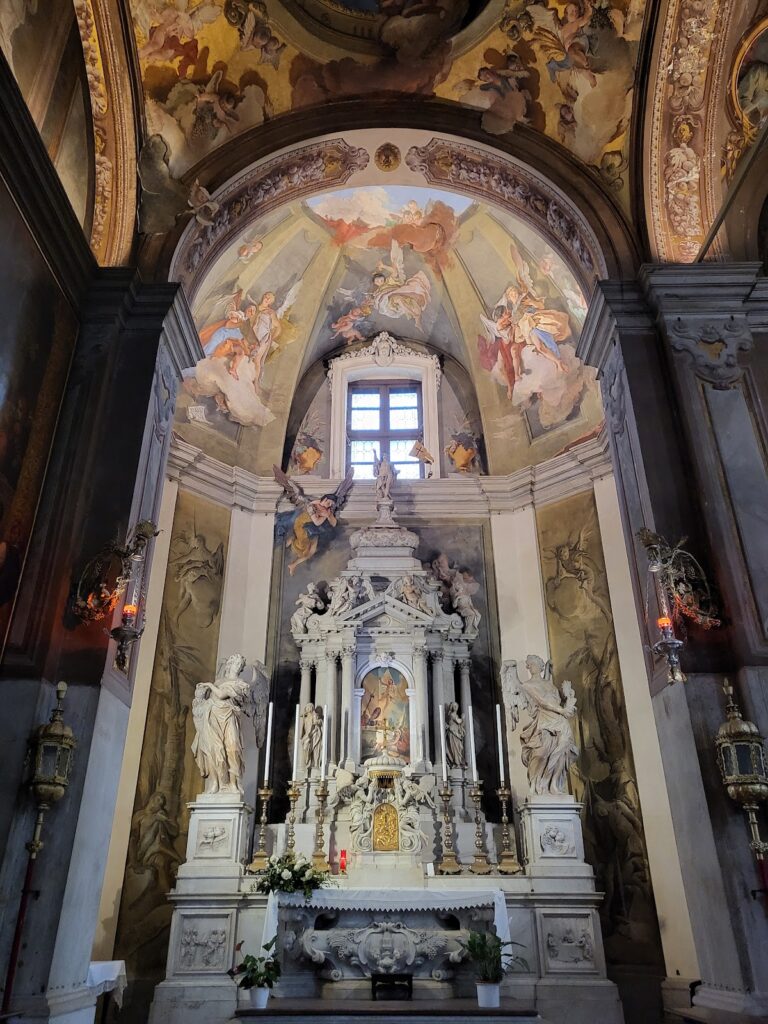
Rebuilt in 1769, the Chapel of the Madonna contains the Massari altar and the panel bearing the image of the Madonna delle Grazie. The panel is traditionally regarded as a fourteenth-century work in the Byzantine style. It shows the Virgin with her face slightly inclined toward the infant Jesus, who is nursing at her breast. Two letters above the figures signify “Mother of God.” Sculptures of angels attributed to Tommaso Rues accompany the chapel, which also contains the tomb of Tommaso Porcacchi. His friend Ottaviano Manin placed the memorial inscription and probably arranged Porcacchi’s burial there after his death in Udine in October 1576.
Votive offerings
The chapel preserves numerous ex votos, objects offered in fulfilment of a vow or in thanksgiving for a favour believed to have been received. One of the oldest is the so-called Devil’s Mask, described as a valuable fifteenth-century piece of armour.
Chapel of the Blessed Bonaventure
The Chapel of the Blessed Bonaventure contains a fourteenth-century wooden crucifix.
Paintings and interior decoration
The ceiling is covered with nineteenth-century frescoes by Lorenzo Bianchini. Their subjects include the Marian Virtues, episodes connected with the miraculous icon, and other sacred themes. The decorative work is attributed to Ferdinando Simoni.
Paintings attributed to Domenico Tintoretto include the Assumption of the Virgin, the Martyrdom of Saint Ursula, the Nativity of Jesus, the Nativity of Mary, and the Adoration of the Shepherds. These works are associated with four named side altars: the Altar of Our Lady of Sorrows, the Altar of the Relics, the Altar of the Seven Holy Founders, and the Altar of Saint Peregrine Laziosi. The sanctuary also preserves the only known painting by the Renaissance painter Luca Monverde.
Convent and later commemorative work
The adjoining convent, whose origins are sixteenth-century, forms part of the sanctuary complex and was enlarged and decorated with frescoes over the centuries. Beside the sanctuary, a decorative green area contains a fountain made in 1961 by Giovanni Patat. Its design reproduces the face of David Maria Turoldo, a Catholic priest, poet, and religious writer who was at the Udine convent during that period.