Church of the Visitation in Ostrołęka: A Historic Roman Catholic Parish Church
Site at a Glance
- Rating
- 4.5
- Popularity
- Very Low
- Country
- Poland
- Primary era
- Early Modern
- External website
- Open
- Eras represented
- Early Modern, Modern
- Civilizations
- Polish–Lithuanian Commonwealth
- Site type
- Religious
- Remains
- Church
On this page11 sections
History
The Church of the Visitation in Ostrołęka, Poland, is a Roman Catholic parish church founded in 1399 by Janusz I the Elder, Duke of Masovia, with its present character shaped by a Baroque nave built in 1785. Dedicated to the Visitation of the Blessed Virgin Mary and Saint Nicholas, it began as the city’s urban parish church and is traditionally distinguished as the fara, a parish church contrasted with monastic churches.
Foundation and early development
The parish was established in 1339, before the church itself was founded. Janusz I the Elder established the church in 1399, and the first building was made of wood. Its role as Ostrołęka’s parish church placed it at the center of the city’s Roman Catholic religious life.
A major building phase followed in the seventeenth century. The presbytery, the area around the main altar traditionally reserved for the clergy, and the adjoining sacristy, a room used to prepare and store liturgical equipment, were built between 1641 and 1658. Their post-Gothic form continued and reinterpreted Gothic architectural traditions after the medieval period. The work was funded by Jan Ostrołęcki and the Zejdlic family.
Baroque transformation and wartime damage
The church acquired its general present form when a Baroque nave was constructed in 1785. Baroque architecture was an ornate European style that developed during the seventeenth and eighteenth centuries. The presbytery was subsequently rebuilt, completing the main transformation of the earlier church complex.
During the First World War, artillery shells damaged the church’s roof and walls. An expansion begun in 1938 added side aisles and a front section, but the project remained unfinished. During the Second World War, the building was successively used as a prison, a warehouse for grain and artificial fertilizers, and a repair warehouse for tanks. German forces demolished the side aisles and the front section that had extended the church.
Postwar restoration and protection
Permanent religious services resumed in 1957. A square bell tower was built in 1958, while the demolished side aisles were rebuilt between 1997 and 1999. Further expansion work took place between 1996 and 2000. The Church of the Visitation is regarded as Ostrołęka’s oldest sacred building and one of the city’s most valuable historic monuments. It has been entered in the register of historic monuments under number A-388 since 20 January 1958.
Remains
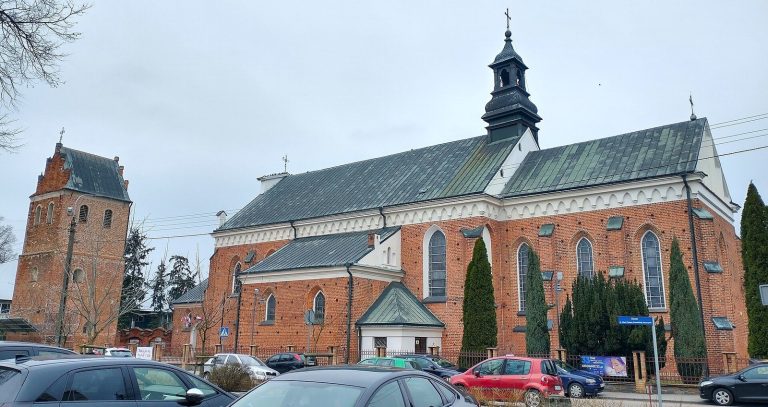
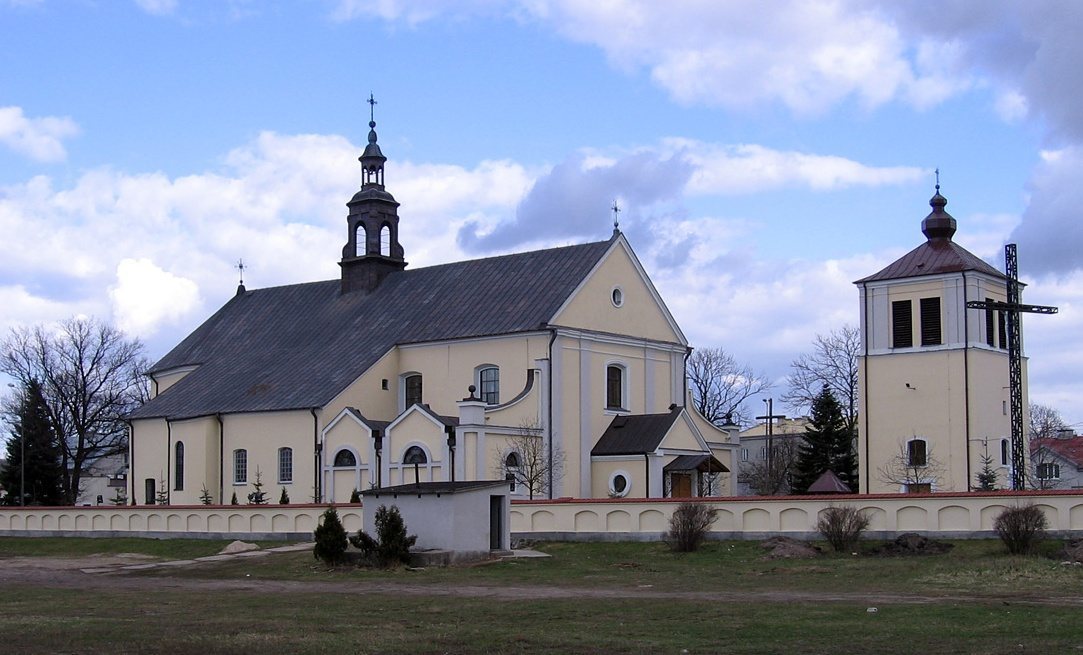
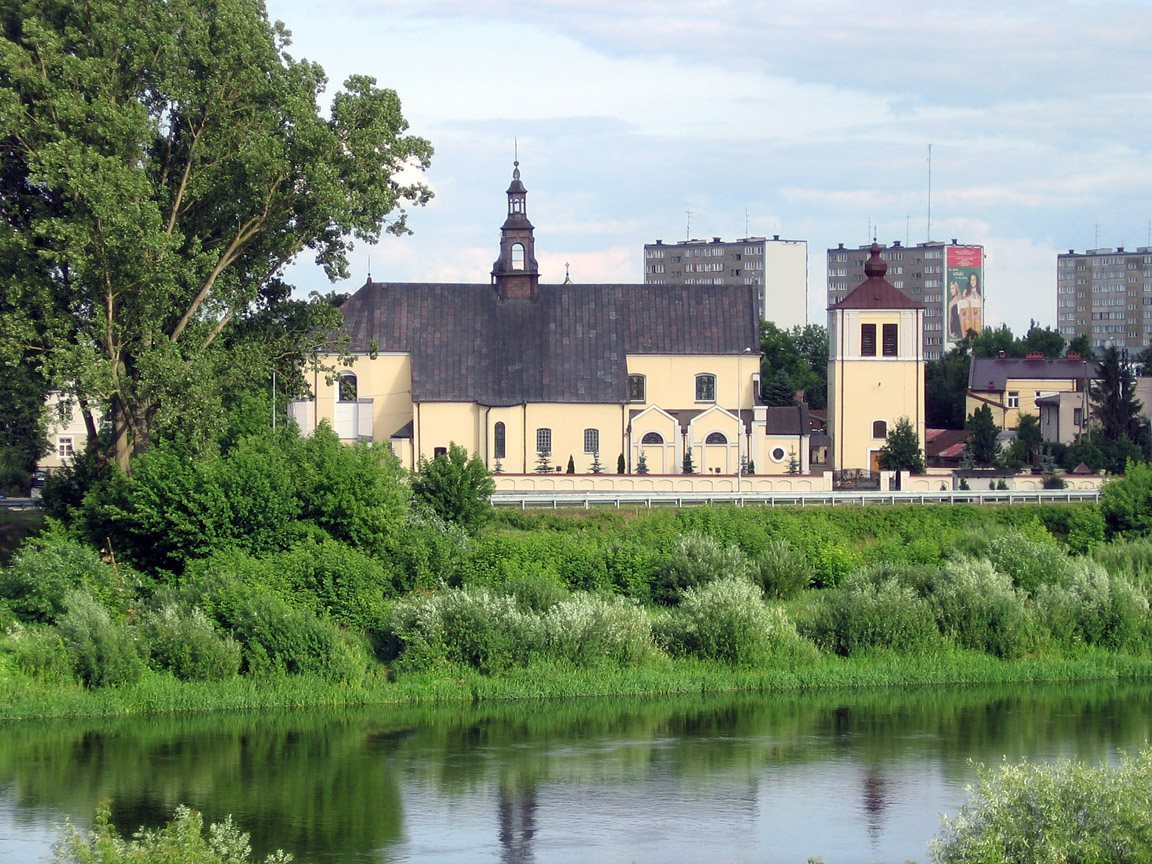
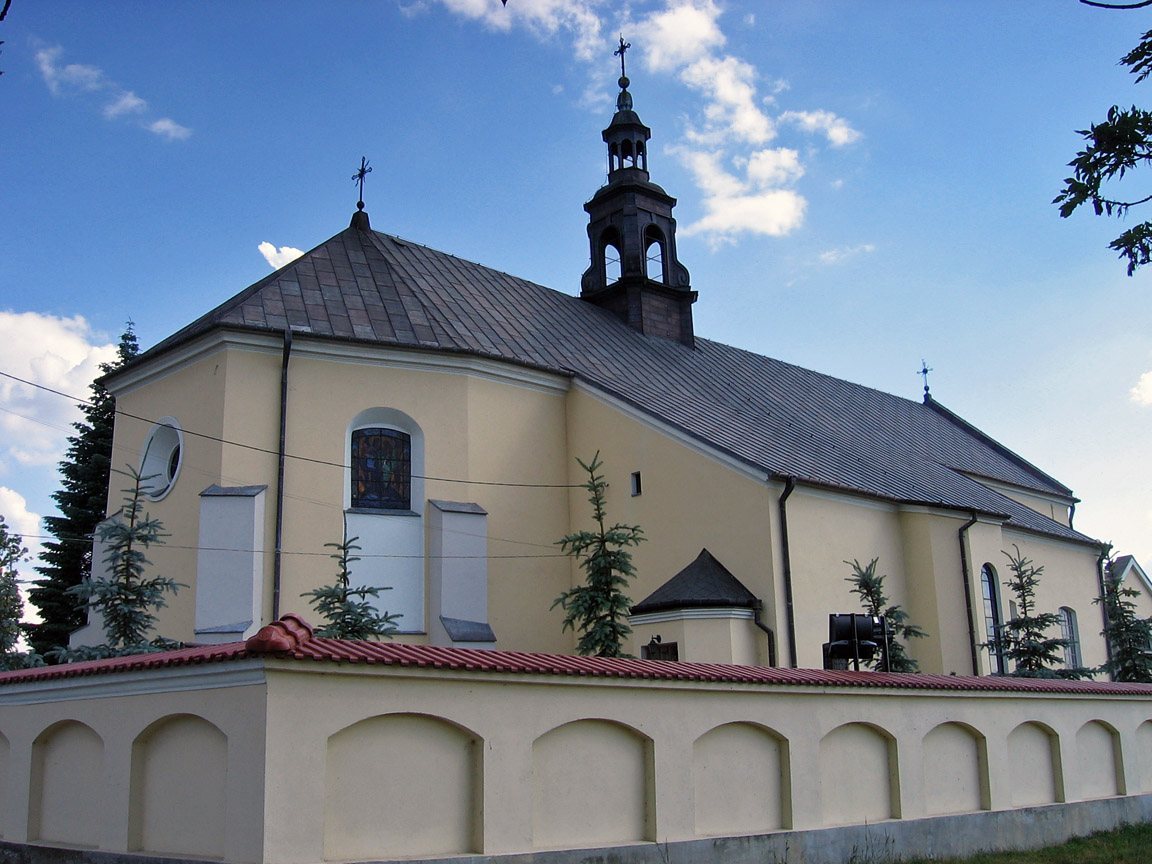
The surviving church is a brick building with a Baroque character. Its main body combines the eighteenth-century nave with the mid-seventeenth-century presbytery and sacristy. The roof has a gabled form and is covered with sheet metal, replacing an earlier covering of ceramic tiles. A brick wall encloses the church grounds.
Interior furnishings
Main altar
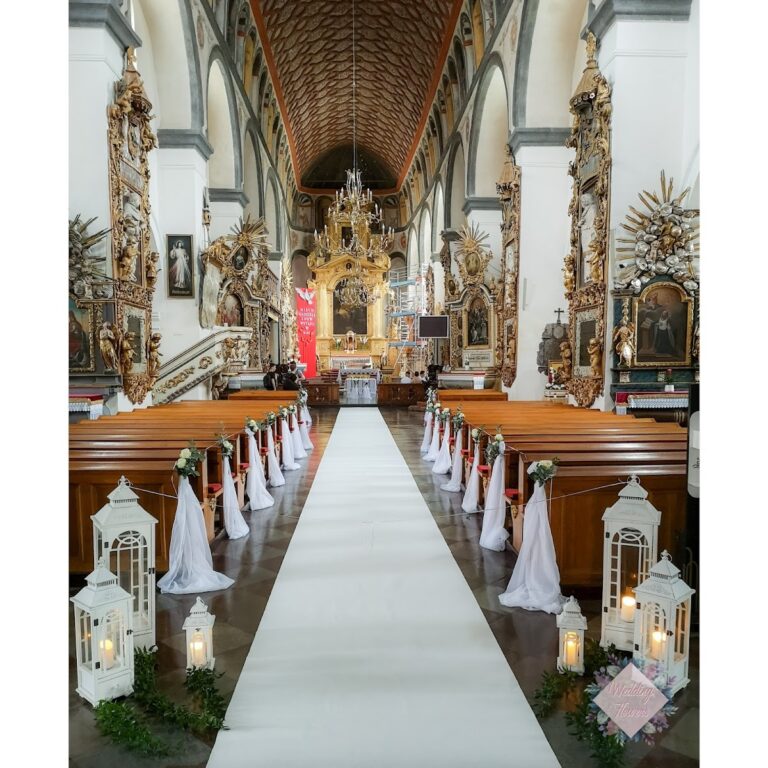
The eighteenth-century main altar is Baroque and contains an eighteenth-century painting of the Transfiguration of Christ in its central field. A painting of Saint Nicholas from the mid-nineteenth century occupies the upper section. Sculptures of Saint Peter and Saint Paul stand below, while angels are placed at both the top and bottom of the composition. Other surviving altar paintings show Saint Barbara, the miracle of Saint Valentine, and Saint Joseph with the Christ Child.
Side altars and pulpit
The church originally had seven altars. The interior retains one main altar and two side altars, along with paintings from the other altars. An eighteenth-century Rococo pulpit also survives. Rococo was a lighter decorative style associated with delicate ornament and curved forms, and the pulpit’s preaching desk has a swelling shape resembling a flower chalice.
Church grounds and surrounding buildings
Bell tower and rectory
The square-plan bell tower was built in 1958. A masonry rectory dating from around 1900 stands within the surrounding area and is itself entered in the register of historic monuments.
Religious monuments
The church grounds also contain a statue of the Immaculate Conception of the Virgin Mary made in 1863, the Cross of the Martyrdom of the Polish Nation, and a monument to Pope John Paul II erected in 2006. John Paul II led the Catholic Church from 1978 to 2005.