Łomża Fortress: A Tsarist Russian Defensive System in Poland


Site at a Glance
- Rating
- 4.5
- Popularity
- Low
- Country
- Poland
- Primary era
- Modern
- Eras represented
- Modern
- Civilizations
- Russian
- Site type
- Military
- Remains
- Fort
On this page9 sections
History
Łomża Fortress is a tsarist Russian fortress in Poland, built to protect the Narew River crossings and access to Łomża, then the capital of a governorate, a major administrative province of the Russian Empire. Constructed as part of a late nineteenth-century defensive system, it was developed in the period 1897–1909 and designed to guard territory bordering East Prussia, the eastern German border province of the time.
Construction and expansion
The fortress formed part of a planned forward-operating area, a military zone organized to support movement and operations near a potential front. This wider system was bounded by several defensive lines linking Modlin, Warsaw, Dęblin, Płock, Włodawa, Zegrze, Pułtusk, Różan, Ostrołęka, Łomża, and Osowiec.
Five forts were begun in 1887 as an encircling fortress. Forts IV and V stood on the left bank of the Narew near Łomża, while Forts I, II, and III were placed on the right bank around Piątnica. General Aleksei Shoshin, a Russian military engineer, directed the initial construction. The three Piątnica forts were later enlarged according to a design associated with General Velichko and dated to 1897.
Five further advanced forts were planned in front of the main position at Kalinowo, Rządkowo, Czarnocin, Jeziorko, and Budy. Their expansion probably did not move beyond the planning stage. In 1909 the fortress was ordered to be decommissioned. The existing fortifications were not demolished, but further development was stopped.
Wartime use
The fortifications were used during the Polish defensive fighting of 1920, when Soviet forces advanced toward Warsaw. From 28 July to 1 August, the position blocked their passage. The defenders withdrew on 2 August after defeats among volunteer units near Miastkowo and Nowogród threatened Łomża with encirclement. Their several-day delay helped Polish forces prepare the counterattack near Radzymin.
In summer 1939, the right-bank forts were prepared for an expected German attack. Rifle trenches, anti-personnel obstacles, and twelve small reinforced-concrete combat shelters were added. During the September Campaign, the fortifications defended Łomża against German units advancing from East Prussia between 7 and 10 September 1939. The defense ended when the troops withdrew after a controversial retreat order issued by the commander of the 18th Infantry Division.
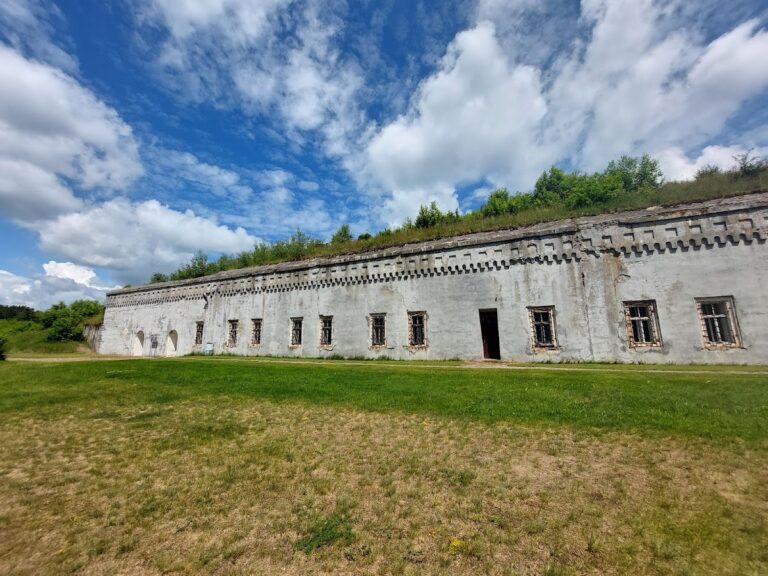
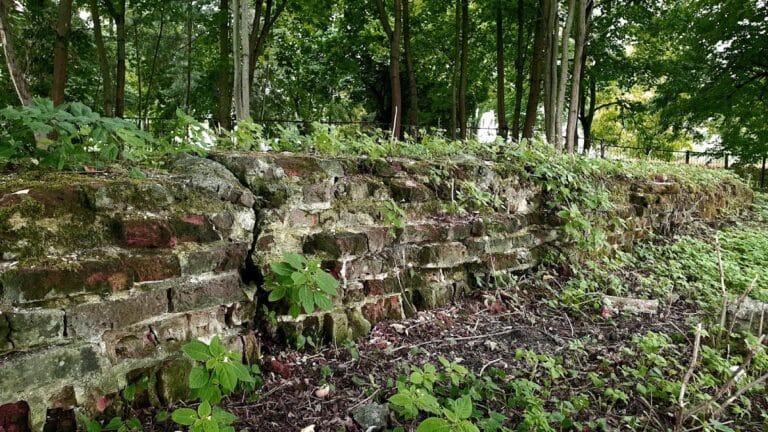
Forts I–III in Piątnica and Fort IV on the road toward Ostrołęka survive. A memorial plaque commemorating the victims of the Katyn massacre and the crash of the Polish Tu-154 at Smolensk was unveiled at Fort II in Piątnica Poduchowna on 14 September 2010.
Remains
The defensive belt
The original works were earthen redoubts, fortified enclosures built mainly from earth, arranged around the Narew crossings. The Piątnica position differed from a system of isolated forts because its works formed a continuous defensive belt. Ramparts and moats were linked by a protected road for moving troops and supplies, together with passive shelters for personnel and equipment and combat shelters intended for active defense.
The belt lay about 1.5 kilometers from the river crossing. Its right end rested on riverside marshes and wetlands, while its left end reached the river directly. Later construction introduced concrete gorge barracks, combat-readiness shelters, and caponiers, protected works projecting into a moat so defenders could fire along it. Poterns, covered passages usually built underground, allowed movement between positions.
Surviving forts
Forts I and II
Fort I, the eastern Piątnica fort, survives as a privately owned site whose grounds remain undeveloped. Fort II, the central fort, is also privately owned but has been adapted for organized events. The Piątnica forts were originally numbered 1, 2, and 3 according to their positions as the eastern, central, and western works. They were later renamed A, B, and V in accordance with the Russian alphabet.
Fort III and Fort IV
Fort III, the western Piątnica fort, survives beside a sports shooting range and a museum room devoted partly to the history of Łomża Fortress. Fort IV, positioned near the road toward Ostrołęka, is also preserved. Together with Forts I and II, these remains show the surviving parts of the fortress on both sides of the Narew.
Twentieth-century additions
The right-bank position retains the defensive measures added in preparation for the 1939 campaign, including twelve small reinforced-concrete combat shelters, rifle trenches, and anti-personnel obstacles. These additions supplemented the earlier earthworks, concrete structures, moats, protected roads, and underground passages that made the Piątnica works a connected defensive system rather than a group of separate forts.