Peribleptos Monastery: A Late Byzantine Monastery at Mystras


Site at a Glance
- Rating
- 4.8
- Popularity
- Low
- Country
- Greece
- Primary era
- Medieval
- External website
- Open
- Eras represented
- Medieval
- Civilizations
- Byzantine
- Site type
- Religious
- Remains
- Monastery
On this page6 sections
History
Foundation and religious role
Peribleptos Monastery is a late Byzantine monastery at Mystras in Greece, built in the mid-fourteenth century under Manuel Kantakouzenos, the first ruler of the Despotate of the Morea, the Byzantine state centered on the Peloponnese. Dedicated to the Virgin Mary under the title Peribleptos, meaning “celebrated,” “admired,” or “distinguished,” it was one of Mystras’s principal religious institutions.
The monastery took its name from the Monastery of the Theotokos Peribleptos in Constantinople. Theotokos, a title meaning “Bearer of God,” refers to the Virgin Mary. The Constantinopolitan monastery was built by Emperor Romanos III between 1030 and 1034, while another foundation with the same name existed in Thessaloniki. At Mystras, Peribleptos belonged to a group of major religious complexes that also included the Brontochion, Hagia Sophia, and Pantanassa. Their extensive surrounding properties provided substantial revenues.
Ottoman rule and artistic continuity
Mystras came under Ottoman control in 1460. Political authority therefore changed, but Byzantine artistic and architectural traditions continued in Greece, and Byzantine artists continued to receive commissions. Peribleptos preserves one of the rare surviving examples of late Byzantine monumental painting, making the monastery important for understanding the art of the final centuries of the Byzantine Empire. Its artistic character has also been understood as retaining a monastic appearance derived directly from Constantinople.
The monastery remains dedicated to Orthodox Christian worship and to the Virgin Mary. Its religious importance is also reflected in its relics, which include remains associated with Saint John the Baptist and the skull of Saint Gregory of Nazianzus, a fourth-century Christian theologian and archbishop of Constantinople.
Remains
Hillside church and surviving complex
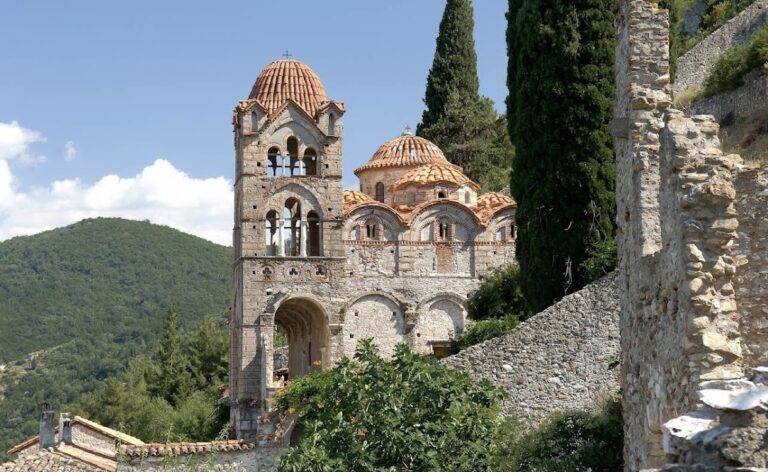
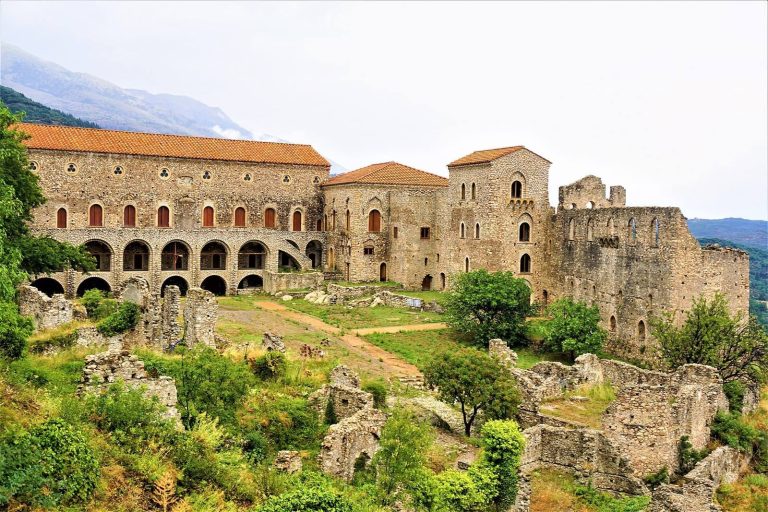
Peribleptos was constructed on a cliff or hillside near the southeastern corner of Mystras’s medieval walls. A cave supports part of the building, while another portion is built directly into the slope. The surviving complex consists of the katholikon, the principal church of an Orthodox monastery, and a second structure thought to have been the refectory, or communal dining building. The church follows an approximately southeast-northwest axis, although the hillside prevented a regular plan.
The church has three apses and is built in the regional Mystras style. This late Byzantine form uses cloisonné masonry, combining squared stones with regularly interposed or inlaid tiles. The dome follows the same construction method and rises on an octagonal drum. Varied exterior forms give the building a castle-like appearance characteristic of the style, while the irregularity of the outside continues through the interior. Almost no windows interrupt the walls, leaving broad surfaces for painted decoration. A small door between the apses opens onto a long corridor, through which the church is entered from the north.
Fresco cycle
Extensive frescoes cover the interior of the church. Painted during the second half of the fourteenth century, the cycle includes episodes from the life of the Virgin Mary, the Dodecaorton, or twelve major feasts of the Orthodox liturgical year, the Passion of Christ, and scenes connected with the Eucharist, the Christian sacrament commemorating Christ’s Last Supper. New Testament scenes flow from one painted surface into another across the apse and other irregular parts of the interior.
The artists are unidentified. Their work has been associated with the Cretan and Macedonian schools, regional traditions of Byzantine painting, and shows a Western-influenced treatment of space and movement. The paintings are characterized by a delicate, subdued style. Among them is a depiction of Saint John the Baptist within the Baptism of Christ. The church also preserves numerous relics, including those associated with Saint John the Baptist and the skull of Saint Gregory of Nazianzus.