Sanctuary of Artemis Orthia: A Major Religious Center of Sparta
Site at a Glance
- Popularity
- Very High
- Country
- Greece
- Primary era
- Iron Age
- Eras represented
- Iron Age, Classical
- Civilizations
- Ancient Greek, Roman
- Site type
- Religious
- Remains
- Sanctuary
On this page16 sections
History
The Sanctuary of Artemis Orthia was one of ancient Sparta’s major religious centers, in present-day Sparti, Greece. Its worship was shared by the four settlements that formed early Sparta: Limnas, Pitane, Cynosura, and Mesoa.
Origins and early sanctuary
The cult may have begun in the tenth century BCE as a local tradition connected with wild nature, fertility, and plant growth. Pottery shows activity at the sanctuary by the ninth century BCE. This early worship preceded the cult’s later association with Artemis, the Greek goddess linked with wild places, animals, and hunting. The Orthia cult probably developed after Sparta’s worship of Athena as a protector of the city.
The sanctuary is thought to have been established around 700 BCE. Its earliest focus was an altar made of earth. In the early eighth century BCE, the sacred precinct was paved and enclosed by a wall; a stone-and-wood altar and temple followed. The first temple dates to the seventh century BCE. Sparta’s military successes later provided resources for further building.
Rebuilding and the cult image
A second temple was built around 570 BCE, probably during the joint reign of the Spartan kings Leon and Agasicles. Their military successes helped finance the work. Severe flooding or erosion from the Eurotas damaged the sanctuary, so its ground was raised and consolidated. The second temple was rebuilt in the second century BCE. Its altar remained in use until Roman authorities replaced it in the third century CE.
The cult centered on a wooden image of the goddess. Pausanias, a Greek travel writer, related a tradition that Orestes and Iphigenia had brought it from Taurica, the ancient name for the Crimean region. He also recounted beliefs that the image could cause madness and that disputes at sacrifices had led to bloodshed. The image was known by the epithet Lygodesma, or “willow-bound.” In Pausanias’s account, willow branches had wound around it and kept it upright when it was found.
Rituals and religious observances
Pausanias said an oracle had required human blood at the altar and that Lycurgus, the traditional lawgiver associated with Sparta, replaced human sacrifice with the ritual flogging of young men. Plutarch, a Greek biographer, offered a different interpretation, connecting the ceremony with an episode from the wars between Greece and Persia.
During the flogging, young men tried to seize cheeses piled on the altar while adult men guarded them with whips. The ordeal was understood as preparation for adult and military life, and successful participants were called “altar-victors.” The punishment could be severe, and teams of floggers may have taken part. Pausanias described a priestess carrying the wooden image during the ceremony. If the floggers softened their blows for a youth because of his appearance or status, the image was said to grow heavy, prompting the priestess to urge them to strike harder.
Other observances included individual dances by young men and choral dances by girls. A sickle awarded to the young men suggests an agricultural connection. A girls’ procession may have accompanied the sanctuary’s opening, with offerings and songs for the goddess, and inscriptions are associated with the observance. The cult also included games thought to involve musical contests and a hunting game for ten young men. During girls’ dances the cult image was temporarily taken from the sanctuary, and young female devotees are thought to have observed celibacy. Animal masks also featured in cult practice; a feast associated with Artemis may have involved animals circling, including a female lion.
Roman period and end of worship
Under Roman rule, the flogging became a public spectacle that could end in a young man’s death. Spectators came from across the empire. Cicero described the more violent form of the ceremony, while the fourth-century Greek rhetorician Libanius indicates that it still drew curious onlookers in his time.
The sanctuary continued to be used into the fourth century CE. Roman authorities’ late-imperial prohibition of non-Christian worship brought its religious use to an end.
Excavation
The British School at Athens excavated the sanctuary from 1906 to 1910 under archaeologist Richard MacGillivray Dawkins. The work followed the discovery of small figurines and other objects in ground near the river. The Roman theatre was then the most visible ruin; it had been heavily pillaged after modern Sparta was founded in 1834 and was threatened by the river. The excavation revealed a long, continuous sequence of archaeological layers. Dawkins published his report in 1929 after five seasons of work that made intensive use of stratigraphy, the study of layers of deposited material. A later Sparta campaign, conducted from 1924 to 1928, included cleaning at the sanctuary in 1928.
Remains
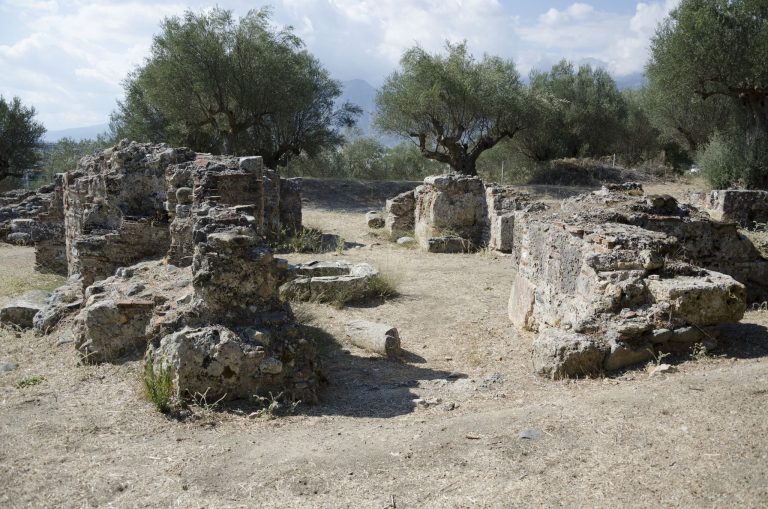
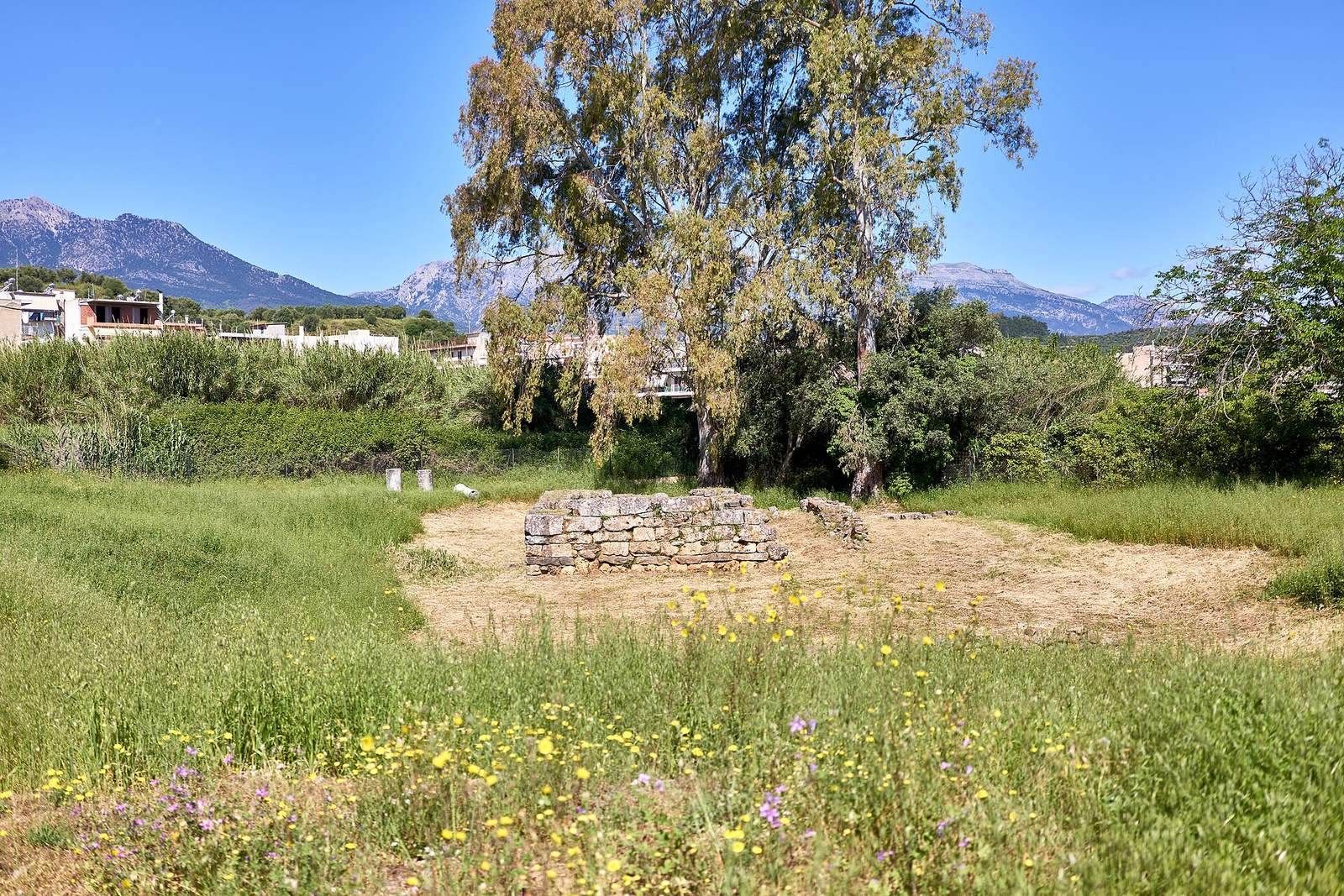
The sanctuary occupied a natural hollow between Limnas and the western bank of the Eurotas. Its layout brought a walled, paved precinct, temples, and an altar together, with a Roman theatre immediately to the south. The ground was vulnerable to river floods, and layers of sand were used to raise and protect it, covering and separating earlier objects. A sanctuary of Eileithyia, the Greek goddess associated with childbirth, stood nearby.
Precinct and principal buildings
Sacred enclosure
In the early eighth century BCE, paving made from river stones and a surrounding trapezoidal wall defined the sacred enclosure. The precinct was later enlarged and reshaped to a rectangular plan. Stone paving and a perimeter wall enclosed the temple area.
Temples
The first temple, built in the seventh century BCE, was a simple structure measuring about 12.5 by 4.5 metres. The later temple, built around 570 BCE, stood farther north and partly overlaid its predecessor. Made of limestone, it measured about 16.8 by 7.5 metres and used the Doric style, one of the principal forms of ancient Greek architecture. Its southeast-facing porch had two columns between projecting side walls and opened into the main chamber. Lions decorated the pediment, the triangular upper section at the front of the roof. The later building followed the alignment of the earlier structures.
Altar
The altar stood east of the temple. It began as a rectangular earth structure and was later faced with stone. The earliest activity at the sanctuary was found in dark soil directly beneath the temple altar, where objects were especially abundant. Animal bones in these deposits came from animals sacrificed to Orthia.
Roman theatre
A semicircular seating area immediately south of the temple measured about 54 metres in diameter and opened toward the altar. Excavation trench A crossed the seating area and yielded many objects, including masks.
Excavated deposits and objects
Two excavation trenches lay in the southern part of the sanctuary. Trench B was about ten metres from trench A. Its smaller number of finds suggested that it lay too far from the main area of activity. The trenches yielded pottery, vessels decorated in geometric patterns, figurines, and sculptures.
Lead, bronze, and pottery offerings
The sanctuary yielded more than 100,000 lead offerings, including figurines and wreaths. Some wreaths remained joined by surplus lead from their manufacture. The offerings varied widely, and their selection has been interpreted as reflecting personal choice and generosity rather than a required match between each object and the goddess. A sharp decline in recovered lead offerings after about 500 BCE coincided with a change at Laurion in Attica, a probable source of the figurines, from using lead ores to producing silver.
Other finds included bronze animal figurines and additional bronze objects. Deer were common animal offerings. Small vases appeared in the early Archaic period, an early phase of Greek history before the Classical period. Some were handmade and others made on a potter’s wheel; some had handles. They were usually unglazed, although a few had a black glaze.
Terracotta figures and masks
Terracotta offerings were made by hand or in moulds and came in varied forms and sizes. The figures depicted warriors, women, Greek gods, musicians, and dancers. Some showed people playing flutes, lyres, or cymbals, while others portrayed riders on horseback. Clay masks representing old people or heavily armed soldiers were among the distinctive finds. Some were small enough that they could not have been worn over a person’s face.
Images of Artemis and carved ivories
Small figures of winged Artemis made between the eighth and late sixth centuries BCE repeatedly show the goddess as a winged figure rather than holding or standing beside an animal. Their wings and tall headdresses vary. Over time, details became fewer, wings changed, heads disappeared, feet lengthened, and some figures acquired a triangular frame. Some examples made around 600 BCE carry dedications to Artemis Orthia.
Carved ivories show the winged goddess holding an animal or bird in each hand, in the role known as the “Mistress of Animals.” Partly finished pieces indicate that ivory carving took place locally. Many objects from the sanctuary are held by the National Archaeological Museum in Athens. The British Museum and the World Museum in Liverpool also hold substantial groups; Liverpool’s collection includes more than 100,000 lead offerings and objects from several periods of the sanctuary’s use.