Peter-und-Paul-Kirche: A Late Gothic Lutheran Church in Germany
Site at a Glance
- Rating
- 4.7
- Popularity
- Very Low
- Country
- Germany
- Primary era
- Medieval
- Eras represented
- Medieval, Early Modern, Modern
- Civilizations
- German, Holy Roman Empire
- Site type
- Religious
- Remains
- Church
On this page15 sections
History
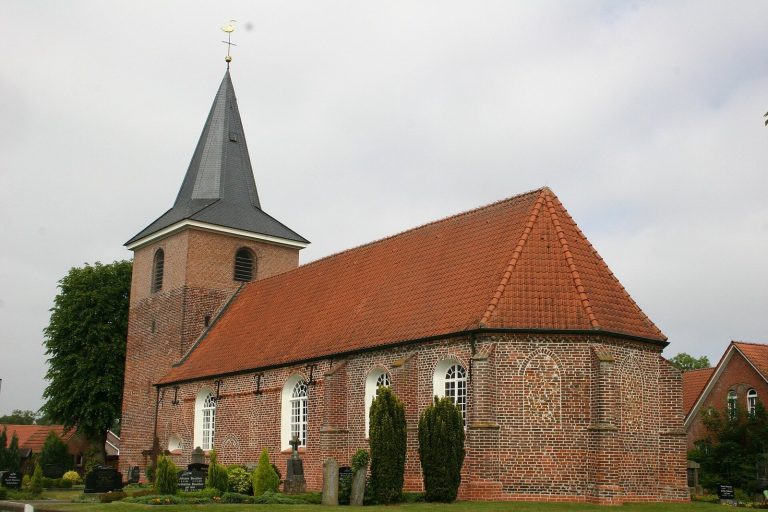
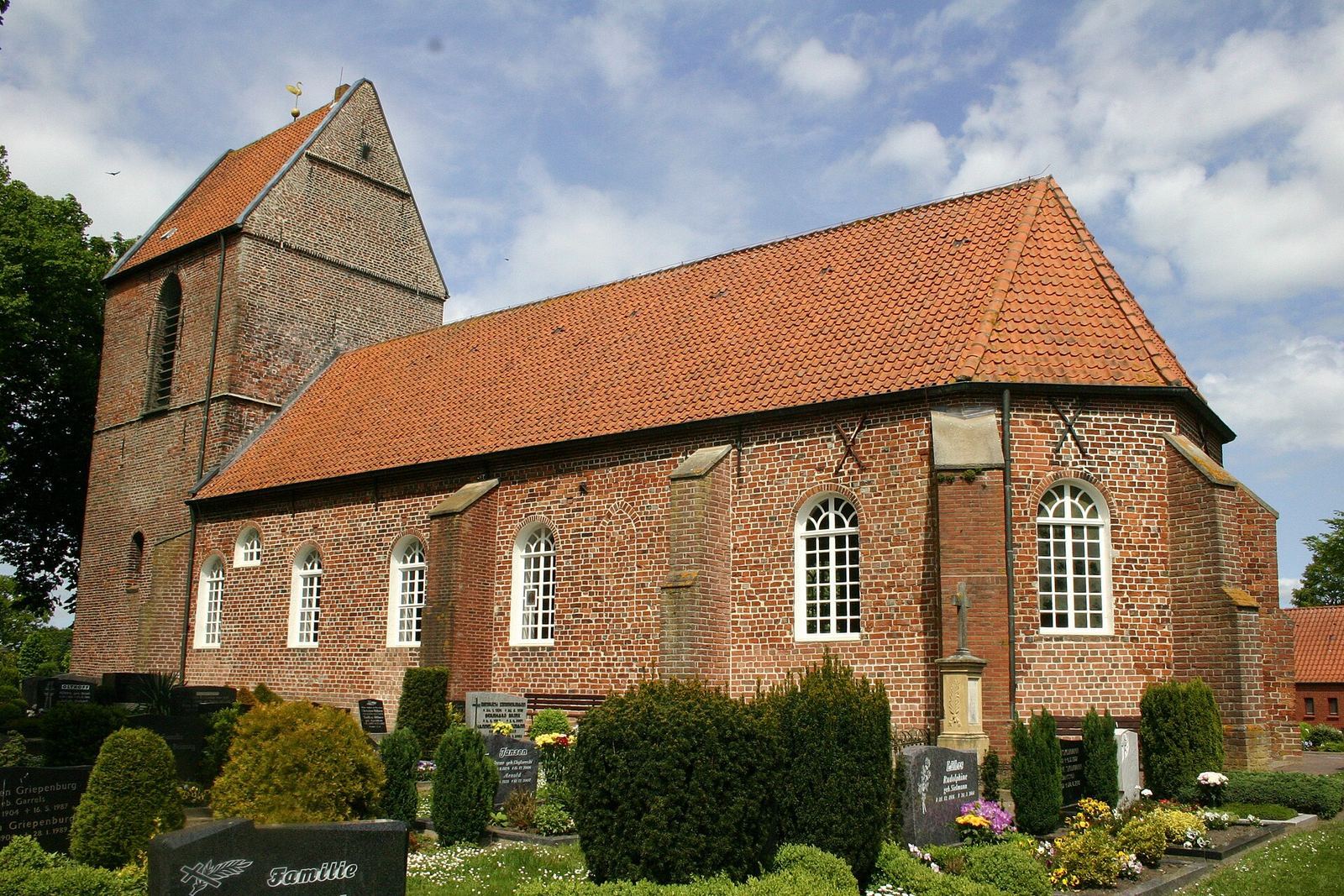
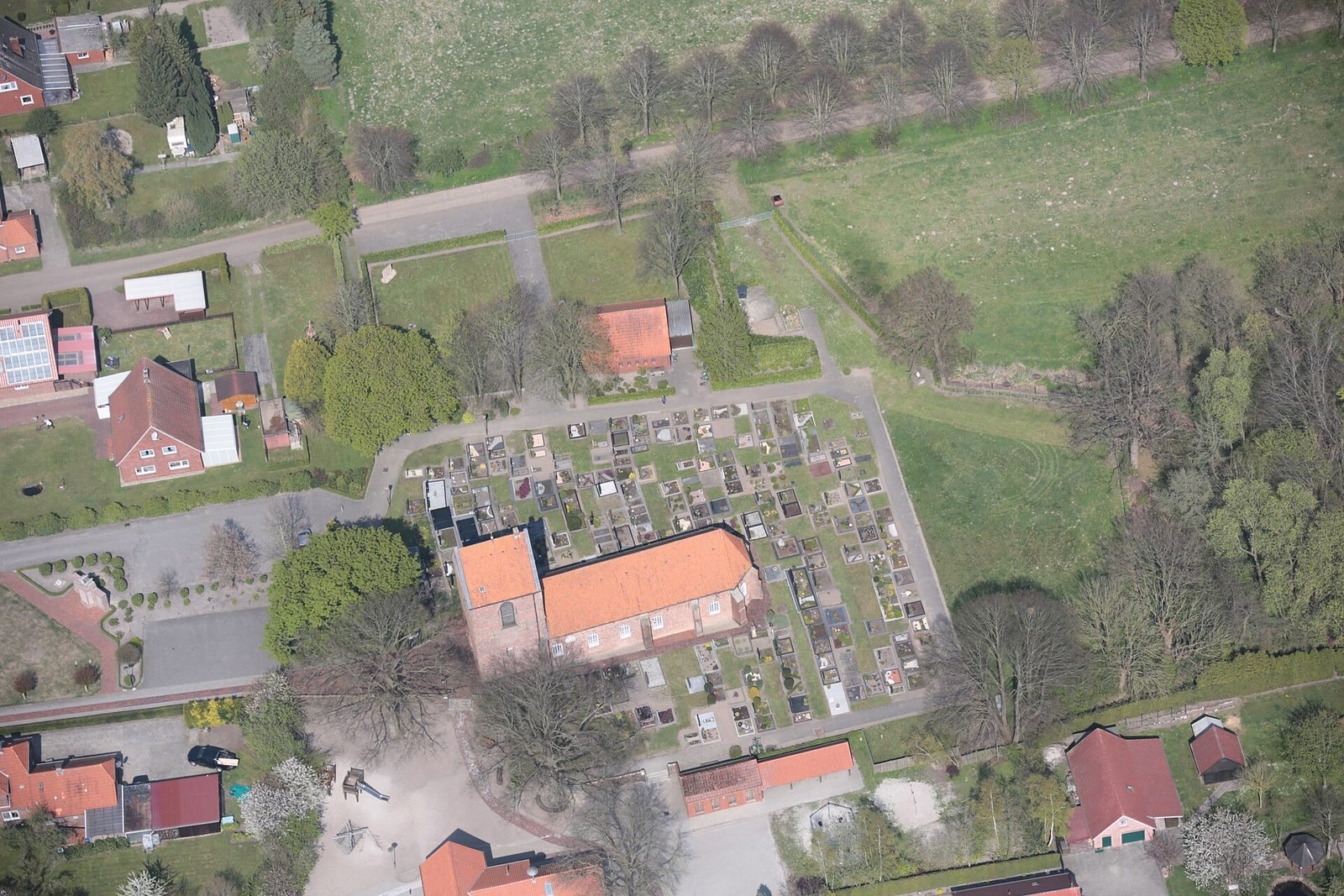
Peter-und-Paul-Kirche is a Lutheran church in Völlen, Germany, built by the local Christian community as a Late Gothic brick church at the beginning of the fifteenth century. It stands on an elevated site at the northern edge of the village and incorporates bricks reused from an earlier church.
Medieval origins and rebuilding
A predecessor church stood on the southern edge of Völlen in the twelfth century. At the beginning of the fifteenth century, a new building was erected on higher ground at the village’s northern edge. Bricks from the earlier church were used in its construction, although the predecessor remained standing until 1556.
After the older building was demolished in 1556, its materials were used to enlarge the nave of the newer church. A chronicle records that the inhabitants were allowed to reuse the bricks to improve the other church. In 1559, a square west tower was added, also incorporating bricks from the demolished predecessor.
Confessional change
During the Middle Ages, Völlen was subordinate to the Send Church of Aschendorf in the Diocese of Osnabrück. A Send Church served as the setting for a medieval ecclesiastical visitation and court concerned with religious discipline and administration.
The congregation adopted the Reformed confession in 1521. After Pastor Gerhard Vietor died in 1652, following fifty years of service, a dispute over the appointment of his successor continued for several years. In 1657, governmental assistance enabled the Lutheran majority to secure the congregation’s return to the Lutheran confession.
Congregational development
The congregation of Völlenerkönigsfehn became independent in 1905. Since 1964, the Völlen congregation has maintained a second pastoral post at the Martin Luther House in Völlenerfehn, dedicated in 1963. Peatland colonization and drainage led many members to settle in Völlenerfehn, where about two-thirds of the congregation’s approximately 2,100 members now live.
A bell cast in 1749, formerly placed in the church’s roof turret, now hangs in the bell tower of the Martin Luther House. Peter-und-Paul-Kirche is recognized as a protected architectural monument in Lower Saxony and is included in the list of historic churches in East Frisia.
Remains
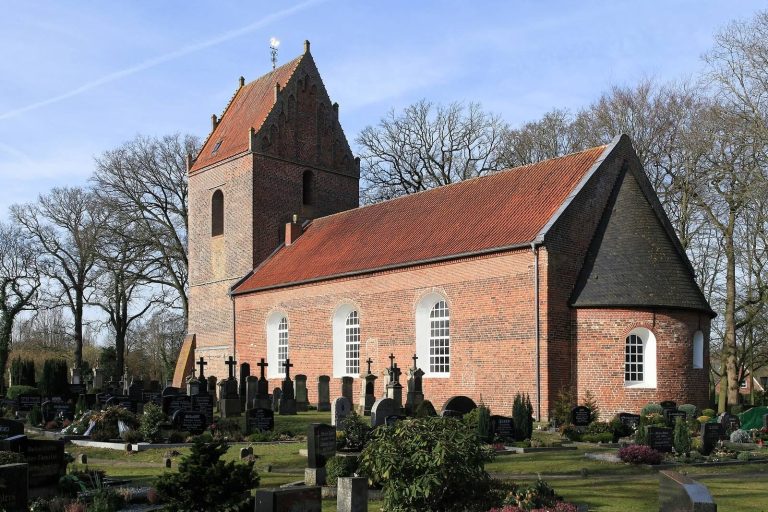
The church is a brick Late Gothic building with a long nave, a choir bay, and an eastern polygonal choir. Buttresses support the long sides of both the nave and the choir. The eastern spaces have cross-rib vaults, which are Gothic vaults carried by intersecting ribs, while the nave is covered by a flat wooden barrel vault.
Church structure
Nave and choir
The nave has no entrances in its long side walls. Its original windows, together with those in the choir, were later bricked up or enlarged. Beneath the gallery lies a red-sandstone tomb slab that probably came from the predecessor church. The eastern polygonal choir and its adjoining bay retain their cross-rib vaults, while the nave preserves its wooden barrel-vaulted ceiling.
West tower
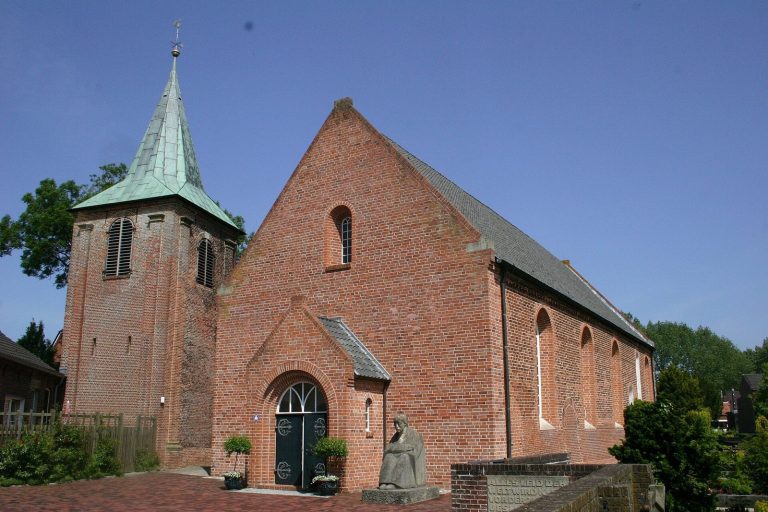
The west tower has a square plan and a gabled roof. It also forms the entrance to the church. Built in 1559, it contains bricks reclaimed from the twelfth-century predecessor, linking the present structure physically with the earlier building.
Altarpiece and liturgical furnishings
Medieval altar
The principal furnishing is the medieval altar. Its mensa, or altar table, dates from the medieval period. The retable, an ornamental altarpiece placed behind the altar, was made in the second half of the fifteenth century and includes a canopy over a predella, the altar’s base. Surviving medieval parts include the mensa, the rear of the predella, the canopy, and the rear of the central section.
The original shrine and paintings were replaced in 1676 by a painted Protestant winged altarpiece. Its central image represents the Last Supper, while the side panels show scenes from the childhood of Jesus. Panels depicting the four Evangelists also belong to this later work.
Canopy and upper section
Wood carvings on the canopy depict the Ascension of Christ. The Baroque upper section shows Christ as Salvator Mundi, or “Saviour of the World,” holding a globe. Nautical motifs carved on the rear of the altar refer to the historical importance of shipping at Völlen. The compartments in the predella appear to have been intended to store relics.
Bells and communion vessels
The Mary Bell dates from 1330 and is among the oldest bells in East Frisia. A larger bell called Peter and Paul was cast in 1520 and installed at Völlen in 1735. It was melted down during the Second World War and replaced by a new bell in 1973.
The communion chalice dates from around 1440 and was donated by the chieftain Koppe Hatten. A silver communion plate was given in 1788 by the Coeler couple of Esens. The simple, chalice-shaped baptismal font probably originated during the Reformation period.
Interior and organ
Pulpit and galleries
The present pulpit, including its soundboard, was made around 1600. The galleries and pews were probably installed at about the same time as the original organ.
Organ
Wilhelm Eilert Schmid built the largely preserved organ in 1822 and 1823. It originally had seven stops on one manual. In 1869, Gerd Sieben Janssen enlarged it by adding an independent pedal division, bringing the total to ten stops. Alfred Führer restored the instrument in 1969 and 1970, and Bartelt Immer carried out a further restoration in 2004.
A large brass chandelier made in Groningen was donated in 1800 and remains part of the church’s historic furnishings.