Fore Priory of Sts Taurin and Fechin: A Medieval Benedictine Monastic Complex in Ireland


Site at a Glance
- Rating
- 4.7
- Popularity
- Medium
- Country
- Ireland
- Primary era
- Medieval
- External website
- Open
- Eras represented
- Medieval, Modern
- Civilizations
- Irish, Norman
- Site type
- Religious
- Remains
- Monastery
On this page15 sections
History
Fore Priory of Sts Taurin and Fechin is a medieval monastic complex in Ireland, beside Fore village in County Westmeath, whose history reaches back to a Gaelic monastery founded by Saint Feichin around AD 630. A later Benedictine priory was established around AD 1200, creating the layered ecclesiastical landscape that survives today north of Lough Lene.
The Gaelic monastery
Saint Feichin established the original Irish Christian community at Fore around AD 630. By his death in AD 665, about 300 monks had gathered around him, and the monastery continued for more than four centuries. The place-name Fore is the anglicized form of Fobhair, meaning “water-springs,” and refers to Saint Feichin’s spring or well beside the old church. The Annals of Inisfallen called the monastery the “Repose of Fechtnach of Fobar.”
The community experienced repeated violence between AD 771 and 1169. Raiders burned the monastery twelve times, among them the Viking lord Turgesius, who was based near Lough Lene, and the O’Reilly lords of Breifne. These attacks took place as Gaelic royal power in Meath weakened, repeatedly disrupting the institution and altering its buildings.
The Benedictine priory
By about AD 1200, the Gaelic abbey had been secularized. Hugh de Lacy, Lord of Meath, then refounded it as a Benedictine priory, a monastery governed by a prior, or as a dependent cell of the Abbey of Évreux in Normandy. Benedictines belonged to the Order of Saint Benedict, a Western Christian monastic order based on communal religious life and the Rule of Saint Benedict. The new institution was dedicated to Saints Feichin and Taurin. Saint Taurin was traditionally regarded as the founder of the monastery at Évreux.
During the thirteenth century, Fore was an “alien” priory, meaning that it depended on a foreign religious house. Its lands and manor could therefore come under English Crown control during conflicts between England and France. The medieval priory was governed by a prior and seems to have housed only a small community, probably including monks from the Anglo-Norman aristocracy or of French origin. Later claims that it supported large numbers of monks and students do not fit this picture. The Ó Cibhleacháin clan were recorded as coarbs, successors or institutional heirs responsible for continuing the authority and traditions of the founder.
Fore’s medieval estates extended across numerous townlands and parishes near Castlepollard. A townland was a traditional small Irish territorial division, while a parish could serve both ecclesiastical and civil purposes. The priory thus formed the centre of a wider ecclesiastical landscape rather than an isolated group of buildings.
Suppression and later change
Fore Priory was disestablished on 27 November 1539. Its appearance had already been shaped by successive additions and fire damage, and later dismantling further changed the arrangement. Many of the buildings that survive belong to the thirteenth and fifteenth centuries. Twentieth-century restoration stabilized and repaired parts of this ruinous complex, preserving the remains of both the earlier Gaelic foundation and the later Benedictine institution.
Local traditions continue to associate Fore with seven “wonders”: a monastery built on a bog, a mill without a visible water race, water that flows uphill, a tree said not to burn, water in Saint Feichin’s well that does not boil, the anchorite’s cell, and a lintel stone raised through the saint’s prayers. Eighteen Fore Crosses are distributed along about seven miles of roads around the site and village. Their association with pilgrims connects the priory and its surrounding landscape with enduring local religious traditions.
Remains
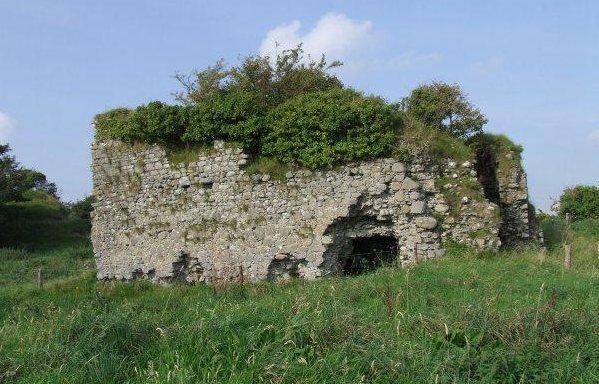
The surviving site is a ruinous monastic landscape set in a valley between two ranges of hills, north of Lough Lene. Its buildings were constructed in stone, including a monastery raised in marshy or boggy ground. The complex brings together the later priory, the earlier Gaelic church, an associated mill, an anchorite’s cell, holy wells, town gates, crosses, and other features linked with Saint Feichin. The core of the abbey has been compared with Mont Saint-Michel, the historic monastery and pilgrimage site on a tidal island in Normandy.
Churches and monastic buildings
The old church
The seventh-century old church stands a short distance from the later monastery. It was an Irish church surrounded by associated cells, and a chancel, the part of a church around the main altar and traditionally reserved for clergy, was added in the thirteenth century. An effigy of a monk, or possibly a Sheela-na-gig, is set into the boundary arch between the original church and its later chancel. A Sheela-na-gig is a medieval carved female figure with an exaggerated display of the genital area; its purpose and meaning remain debated.
The high cross and lintel
A small high cross made of solid masonry stood at the original entrance, possibly from the tenth century. A high cross is a monumental freestanding stone cross associated with the early medieval Christian tradition of Ireland and Britain. The seventh-century church also retains the lintel stone that local tradition connects with Saint Feichin, who was believed to have raised it through prayer.
The priory church and cloister
The thirteenth-century priory church retains fragments of painted plaster decoration and a graceful arcaded cloister. A cloister is a covered walkway, often arranged around an open courtyard beside monastic buildings, while an arcade is a series of arches supported by columns or piers. These remains belong to the Benedictine phase of the site and preserve part of the architectural setting created after the refoundation linked to Évreux.
The towers and living quarters
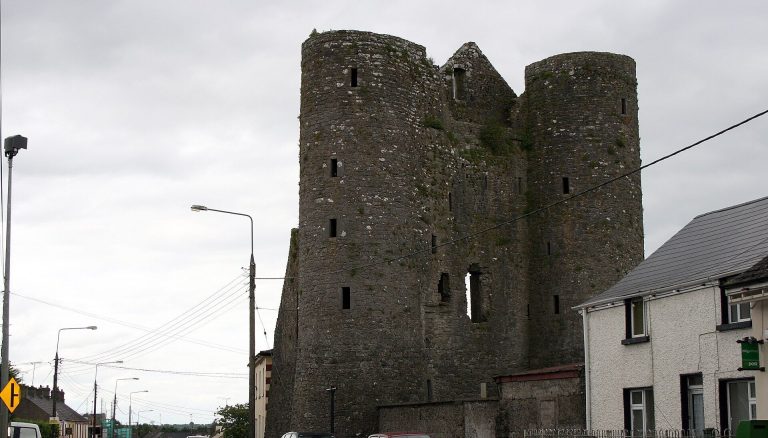
Broken walls of two towers remain attached to the church. The towers contained the monks’ living quarters, and Richard de Tuite, a vassal of Hugh de Lacy, held an apartment within the complex. Their surviving masonry forms part of the later priory buildings, whose present condition reflects fire damage, dismantlement, and restoration over several centuries.
Water, landscape, and associated structures
Saint Feichin’s Mill
Saint Feichin’s Mill is traditionally described as a mill without a race or visible water supply. Local tradition attributes its operation to Saint Feichin’s intervention. Water from Lough Lene flows through the ground, providing the physical explanation associated with the mill and with the wider traditions of unusual water movement at Fore.
The wells and copper tree
Water near the site is reputed to flow uphill, a phenomenon traditionally attributed to Saint Feichin, who was said to have caused it with his staff. Saint Feichin’s holy well is likewise said not to boil. A nearby tree with three branches is traditionally believed not to burn. Pilgrims placed coins in it, giving rise to the name “copper tree.”
The anchorite’s cell
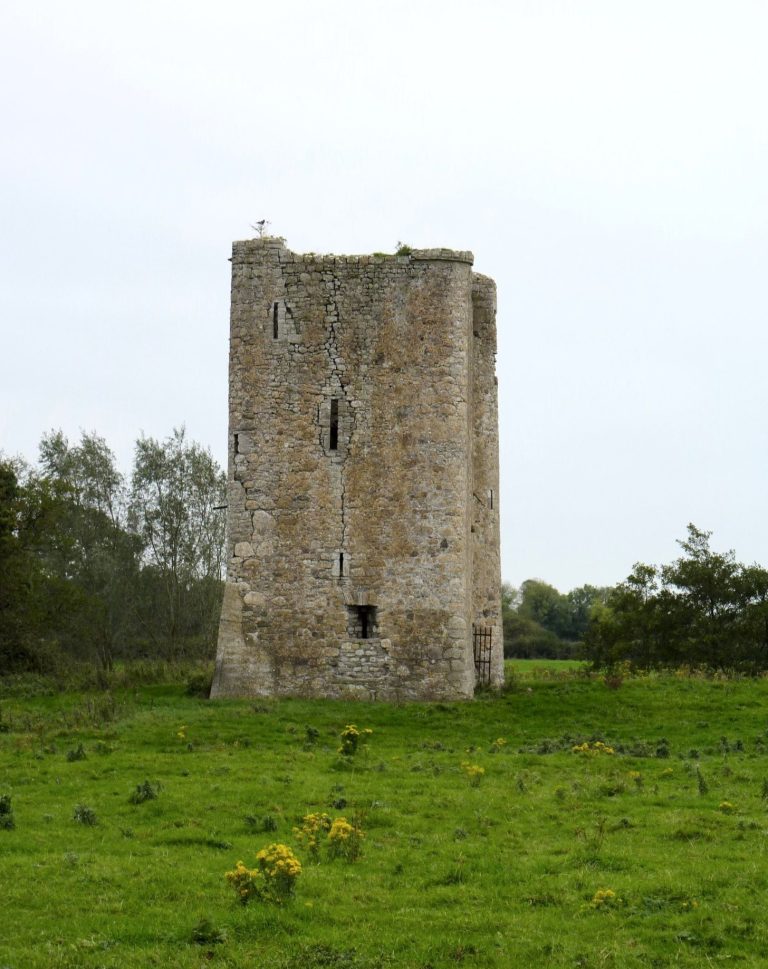
The anchorite’s cell is a small tower house on the slope above the churches. An anchorite was a religious recluse who lived apart from the ordinary monastic community in a purpose-built cell. In the nineteenth century, a mausoleum for the Nugent family was added to the structure, giving the combined building the appearance of a church.
The Fore Crosses
Eighteen Fore Crosses extend through the roads around the village and monastic site, with one standing in Fore village and the others distributed across the surrounding area. They vary in condition: some are plain or heavily eroded, while others retain carved outlines. Their connection with pilgrims makes them part of the wider devotional landscape associated with Fore.