Pfarrkirche Hl. Nikolaus, im Thal: A Historic Parish Church in Austria
Site at a Glance
- Rating
- 4.9
- Popularity
- Very Low
- Country
- Austria
- Primary era
- Modern
- External website
- Open
- Eras represented
- Early Modern, Modern
- Civilizations
- Habsburg, Holy Roman Empire
- Site type
- Religious
- Remains
- Church
On this page10 sections
History
Pfarrkirche Hl. Nikolaus, im Thal is a Roman Catholic parish church in Thal, Austria, dedicated to Saint Nicholas. It is the oldest church in the Laternsertal and developed from a fifteenth-century chapel into a church whose present appearance largely reflects the Gothic Revival restoration of 1892 and 1893.
From chapel to parish church
A small chapel dedicated to Saint Nicholas was consecrated at Thal in 1411 by the vicar general of the Bishop of Chur. An outpost of the Rankweil parish had been established there by 1452. The chapel was later replaced by a larger church, which was inaugurated on 7 May 1502. A stone sacrament house inside the building and other surviving elements preserve material links with this early period.
In 1611, the church became an independent parish and underwent its first enlargement and alteration. Some of its wooden figures were made by Erasmus Kern. A lightning strike severely damaged the tower in 1645 and killed two children. Further enlargement followed in 1673, when the church was given Baroque features.
Gothic Revival transformation
The building was enlarged and comprehensively restored in 1892 and 1893 according to plans by Johann Marggraff. Parish priest Franz Schratz promoted the work, while Fidel Kröner carried out the stonecutting and master-builder work. The intervention removed the church’s Baroque character and remodeled it in the Gothic Revival style.
Further renovation and alteration took place in 1956. During the 1999 renovation, many of those changes were reversed, and the church was largely returned to the condition created in 1892. The church and cemetery are protected as historical monuments. The building stands on the St. Nicholas parcel in the center of Thal and architecturally dominates the locality.
The church also preserves a connection with the Walser, Alpine German-speaking settlers associated with the Valais region whose medieval settlement in valleys beyond their original homeland shaped the identity of the Laternsertal. A fifteenth-century statue of Saint Theodul, a bishop of Valais and an important patron of the Walser and Valais, is placed beside the high altar. The church’s annual patronal feast for Saint Nicholas is celebrated on 5 December.
Remains
Layout and exterior
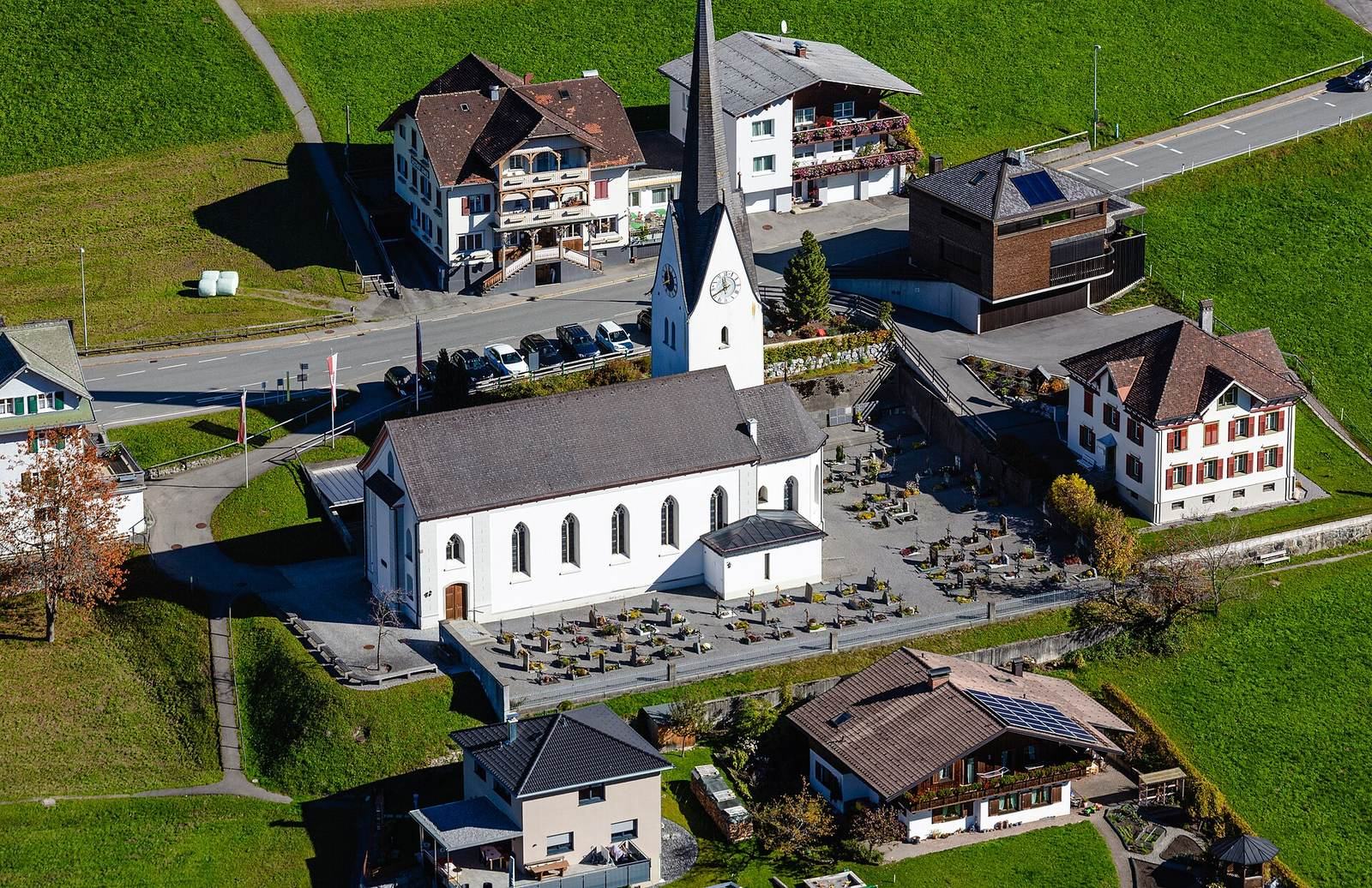
The Neo-Gothic church is oriented from northwest to southeast, with the choir at the southeast end. It consists of a nave with a gabled roof and a set-back Gothic choir ending in a three-eighths polygon, an apse formed from three sides of an imagined eight-sided figure. Together, the nave and choir measure approximately 31 metres in length and 10 metres in width, while the nave rises about 13 metres. A tower approximately 27 metres high is attached to the northeast side of the choir and has a lower gabled roof. Pointed-arch windows are used throughout the nave and choir. The cemetery is directly connected to the church on its southwest and southeast sides.
Two stones from Sitten are incorporated into the exterior. The front façade contains a black serpentine stone dated 1892 and inscribed, “GREETINGS IN GOD’S NAME, FROM THE OLD HOMELAND, VALAIS.”
Altars and sacred furnishings
High altar and Saint Modestus
The high altar was made by Fidelis Rudhardt in 1892 for the enlargement and alteration of the church. Its shrine contains a Late Gothic group showing the Coronation of Mary. The superstructure carries a figure of Saint Mauritius, also by Rudhardt, who made the two tabernacles. A tabernacle is a compact receptacle used for reserving the consecrated Eucharist.
Beneath the high altar’s mensa, or altar table, is a shrine containing the full-body relic of Saint Modestus. The relic was brought from the Roman catacombs to the church in 1820 through the efforts of Johanna Tschannet. It remains visibly housed beneath the Gothic high altar, with a chalice placed near the right hand.
Presbytery altar and sacrament house
A sandstone altar by the sculptor Albrecht Zauner stands at the center of the presbytery, the part of the church surrounding the main altar. Created during the most recent renovation, its slightly curved mensa rests on five columns symbolizing the five wounds of Jesus. Zauner also made the ambo, the reading stand for proclaiming scripture, which stands to the altar’s left. Side altars are installed in front of the chancel arch.
Behind the ambo, on the north wall, is a gray sandstone sacrament house dated 1509. This built receptacle for reserving the consecrated Eucharist is decorated with the Austrian double-headed eagle, the Montfort arms, and mason’s marks.
Statues and baptismal font
A statue of Saint Theodul from the fifteenth century stands to the right of the Neo-Gothic high altar, while a representation of Saint Nicholas is placed on its left. Together, these works commemorate the Walser heritage of the inhabitants of the Laternsertal. The baptismal font also dates from around 1507, while its superstructure was made by Fidelis Rudhardt in 1892.
Windows, ceiling, and organ
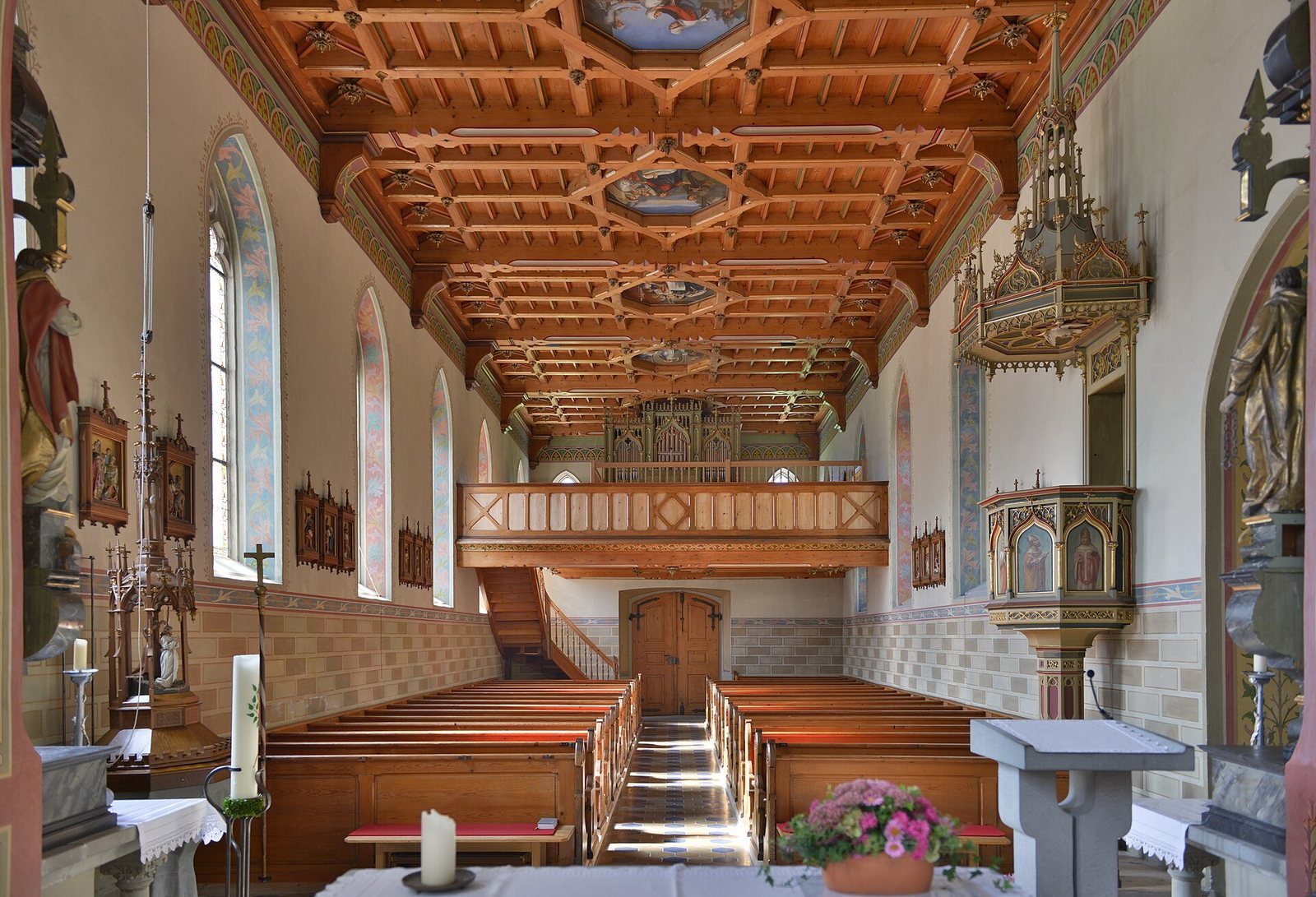
The pointed chancel arch contains a crucifix with rich painted decoration, and the interior floor is tiled. Two choir windows from around 1892 depict Saints Silvester and Aloysius. Their lower strips identify the donors. A small stained-glass panel of the Immaculata, dated 1507, is set into the frontmost window on the right-hand side.
The red wooden coffered ceiling carries painted decoration dating from 1892 and includes five paintings by Alfons Luger from 1901. In 1895, the Mayer brothers of Feldkirch-Altenstadt built the church’s first organ. It was the first organ with pneumatic action constructed in Vorarlberg, using air pressure to operate the valves rather than direct mechanical links between the keys and pipes.