San Francesco, Sansepolcro: A Franciscan Gothic Church and Convent in Italy
Site at a Glance
- Rating
- 4.6
- Popularity
- Very Low
- Country
- Italy
- Primary era
- Medieval
- Eras represented
- Medieval, Early Modern, Modern
- Civilizations
- Grand Duchy of Tuscany, Italian
- Site type
- Religious
- Remains
- Church
On this page11 sections
History
San Francesco, Sansepolcro, is a Roman Catholic church and convent in Italy dedicated to Francis of Assisi, the founder of the Franciscan movement. Constructed between 1258 and 1321, it was the city’s first Gothic building and became an important center of Franciscan religious and cultural life.
Foundation and Franciscan Life
The complex was established on land granted by the Municipality of Sansepolcro to the Franciscan friar Tommaso da Spello. Its Gothic architecture introduced a new medieval building style to the city, characterized here by pointed openings and a strong vertical emphasis. The Franciscan community developed an unusually strong cultural profile. Its members and associates included Luca Pacioli, as well as the master glassmakers Michelangelo di Simone and Francesco d’Asciano.
The church’s influence extended beyond its own walls during the fifteenth century, when it served as a model for liturgical furnishings in other religious buildings. In 1444, Sassetta’s large altarpiece was installed on the high altar, further strengthening the church’s cultural standing. Sassetta was a fifteenth-century painter from Siena whose work included religious panel paintings and large altarpieces.
Changes within the Franciscan Order
In 1517, the Franciscan Order divided into separate branches. After the division, the convent passed to the Friars Minor Conventual, a branch of the Franciscan tradition organized around communal convent life. They continued to officiate in San Francesco until 1987.
Eighteenth-Century Transformation
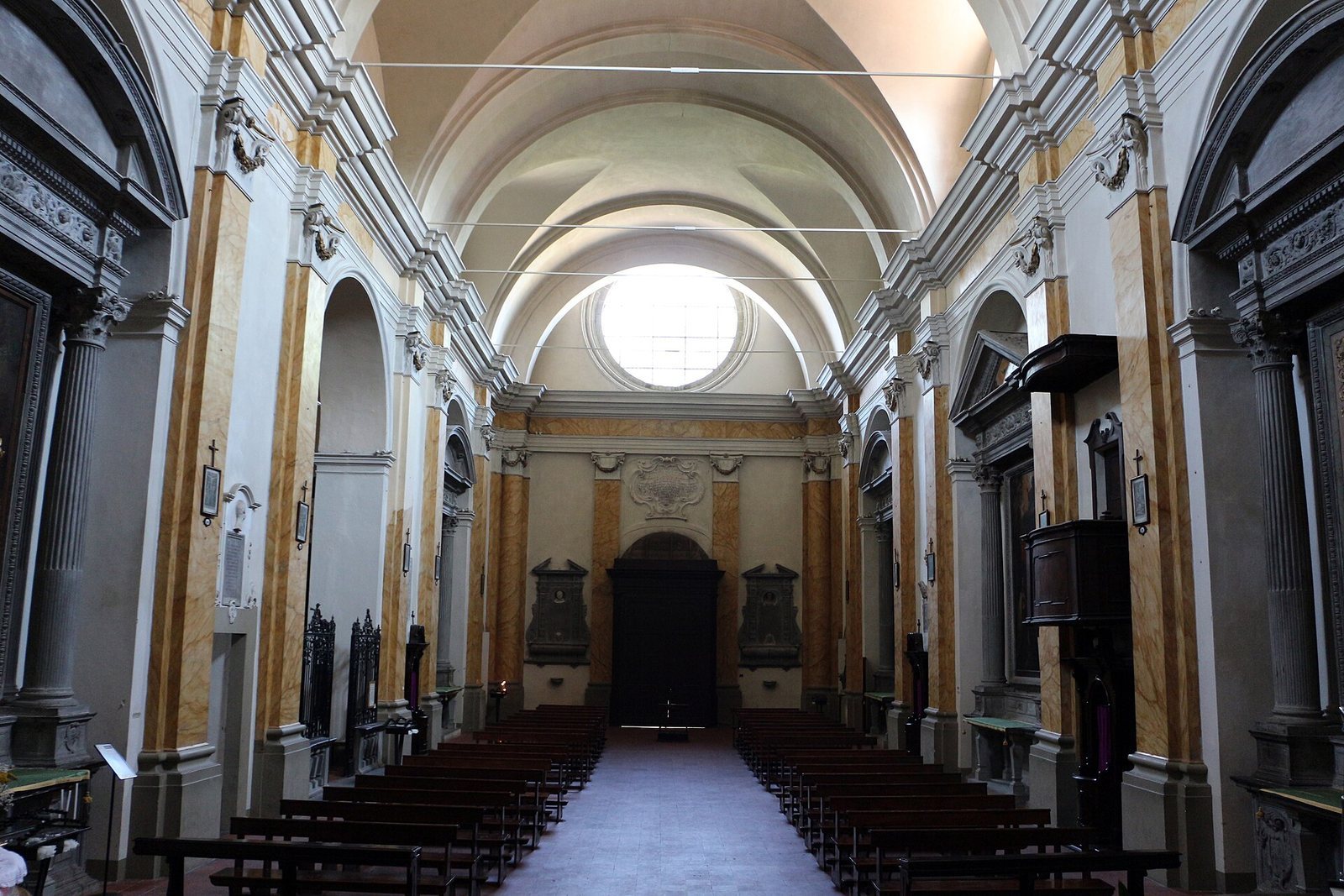
Between 1760 and 1783, the interior was completely reshaped. The work introduced a vault, a semicircular choir, and extensive stucco decoration, while retaining the seventeenth-century stone altars. This restructuring changed the interior’s appearance without removing its original single-nave arrangement, a plan commonly favored by preaching orders.
The church’s artworks and furnishings continued to change. Sassetta’s altarpiece remained above the high altar until 1810, after which it was dismantled and dispersed among museums and private collections. About half of its panels have since been identified. An inventory made in 1843 lists Giovanni de’ Vecchi’s depiction of the Stigmata of Saint Francis as the principal altarpiece. It also mentions Domenico Cresti’s Dispute in the Temple and a Saint Anthony of Padua attributed to Giovanni Battista Mercati.
Earthquake and Later Conservation
The 1948 earthquake at Sansepolcro damaged the church and caused its only recorded fatality, when a woman was killed by the partial collapse of a vault. The bell tower also suffered structural damage. Workers secured it by inserting a reinforced-concrete framework inside the tower and replaced the stone parapet around the terrace at the base of the spire with an iron railing.
Modern interventions also affected the church’s music and bells. In 1972, at the initiative of Commendator Marco Buitoni, the organ was restored, enlarged with a new division, and fitted with an independent console. After ten years of abandonment, it was restored again in 2016 by Lorenzo Tosi and Paolo Fiorucci. A replacement bell known as the “Raniera” was installed in 2004. It replaced a bell of the same name dating from 1623, which had itself been cast from the original bell dedicated to Blessed Ranieri dal Borgo in 1314. The Raniera is rung at parents’ request to announce each birth.
Remains
The surviving complex combines a fourteenth-century exterior with an interior largely shaped by the late eighteenth-century renovation. Its original broad, single-nave plan remains legible, while the facade, bell tower, altars, artworks, organ, bells, and crypt preserve evidence of different stages in the church’s development.
Facade and Bell Tower
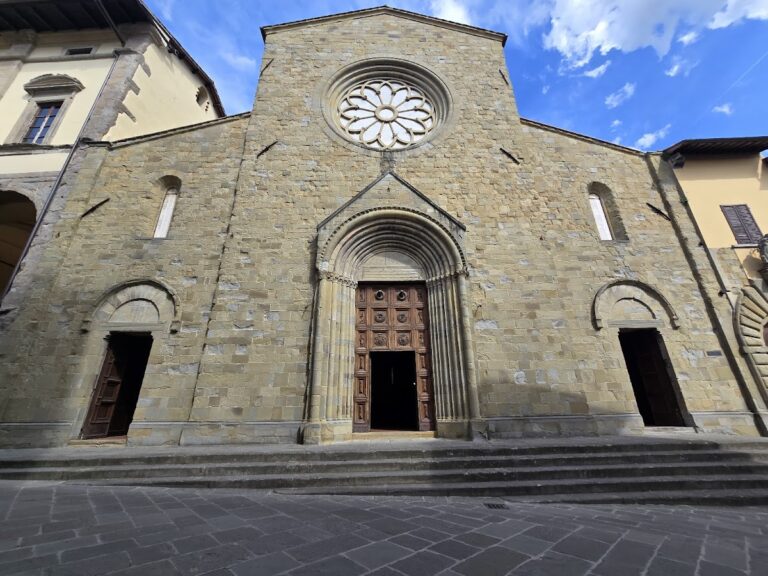
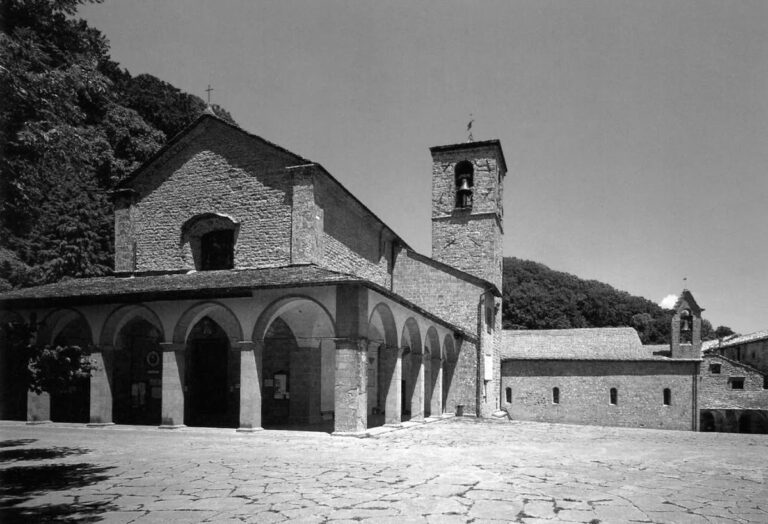
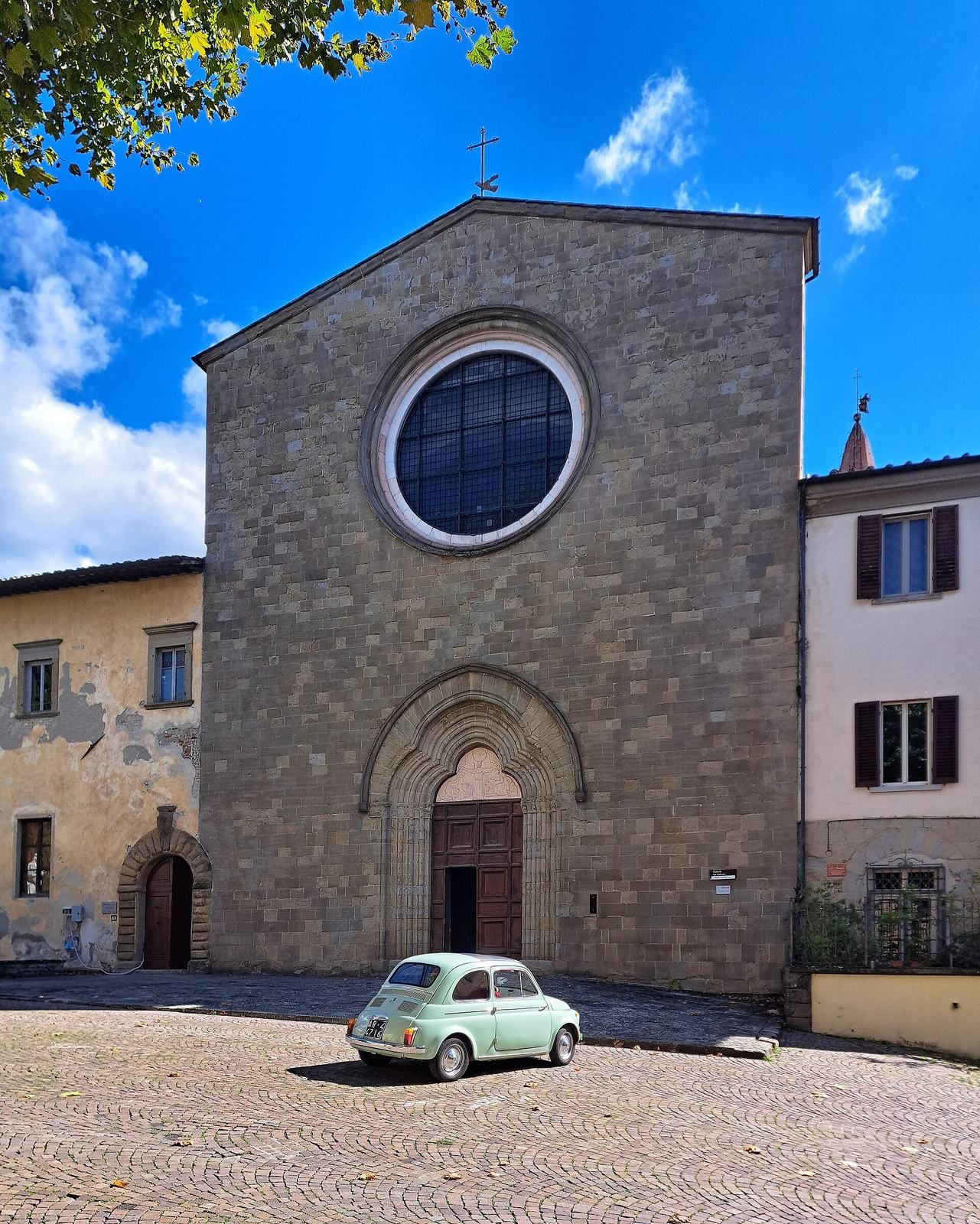
San Francesco retains much of its medieval character on the outside. The stone facade has a Gothic splayed portal with a trefoil arch and a large oculus, a circular opening, above it. Houses along Via Aggiunti conceal most of the building. The visible bell tower has a chamber pierced by narrow, elongated openings and ends in a spire modeled on the tower of the former abbey church, now the cathedral.
Nave and Altars
The late-eighteenth-century interior preserves the mendicant church’s single nave. Its vault and semicircular choir belong to the transformation carried out between 1760 and 1783, while the seventeenth-century stone altars survived the work. A fifteenth-century polychrome terracotta statue of Saint Anthony of Padua occupies a niche in the counterfacade and is among the few works in the church that predate the renovation.
The first altar on the right contains Raffaello Schiaminossi’s Madonna and Child in Glory with Saint Charles Borromeo and Blessed Ranieri dal Borgo. Beside it, the Chapel of the Blessed Sacrament has a seventeenth-century representation of the Dead Christ beneath its altar. The second altar on the right holds Giovanni de’ Vecchi’s painting of the Stigmata of Saint Francis. On the left, the first altar has Domenico Cresti’s Dispute of Jesus among the Doctors, dated 1590, while the second contains Francesco Curradi’s God the Father with Saints Peter and Paul, dated 1628.
High Altar and Crypt
The stone high altar is shaped like a sarcophagus and has twisted columns. It is one of the few surviving works connected with the church’s earliest phases. A Latin inscription states that the Municipality donated it in 1304 in honor of the Franciscan friar Blessed Ranieri dal Borgo, a Catholic honorific for a person recognized as holy but not canonized as a saint. Ranieri died on 1 November 1304, and his body is preserved in the crypt, a chamber beneath the church used for burial or the keeping of holy remains.
The high altar once supported Sassetta’s Borgo San Sepolcro Altarpiece, made between 1437 and 1444. This Gothic polyptych, an altarpiece composed of multiple painted panels, contained 60 images and measured about 6 by 5 meters when assembled. It was painted in Siena, purchased for 510 florins, and carried by cart to Sansepolcro, where it was assembled above Blessed Ranieri’s tomb. Its panels were later separated and dispersed, with approximately half now identified in museums and collections.
Organ
The nineteenth-century organ was made by the Righi family of organ builders from Sansepolcro. Its original mechanically operated section has 13 stops, two pedals, a 56-note keyboard, and a straight 20-note pedalboard. It was probably assembled in part from components of earlier organs and was electrified during the 1950s. The older section stands in the right gallery, while the later division occupies the left gallery. That addition has 10 stops and is controlled by a separate electro-pneumatic console with two 56-note manuals and a concave-radial 32-note pedalboard.
Bell Chamber
Six bells hang in the bell chamber. Electrification required them to be mounted on an iron supporting frame, lower than their former position on wooden beams. Five operate through the electronic system, while the sixth remains outside the control panel and can be rung by its rope. In earlier convent life, that bell marked the daily hours of communal activity.
The great bell was cast in 1765 by Giovanni Battista Donati Aquilano and dedicated to Saint Bonaventure; it is tuned to F. The Raniera, dedicated to Blessed Ranieri dal Borgo, is tuned to A and bears figures of Saint Francis and Blessed Ranieri together with Sansepolcro’s coat of arms. The Ave Maria bell, cast in 1421 and tuned to C, formerly signaled the evening Angelus, a Catholic prayer traditionally announced by bells. The Mezzana is tuned to C-sharp, and the cennino, tuned to F-sharp, gave the final call to Mass.