Sansepolcro Cathedral: A Romanesque-Gothic Co-Cathedral in Italy


Site at a Glance
- Rating
- 4.6
- Popularity
- Low
- Country
- Italy
- Primary era
- Medieval
- External website
- Open
- Eras represented
- Medieval, Early Modern, Modern
- Civilizations
- Grand Duchy of Tuscany, Holy Roman Empire, Italian, Republic of Florence
- Site type
- Religious
- Remains
- Cathedral
On this page28 sections
History
Sansepolcro Cathedral is a Romanesque-Gothic church in Italy that developed from a Benedictine monastery established in the late tenth century. Its church was built or substantially established between 1012 and 1049 and consecrated in 1049. The monastery’s foundation tradition links it to Egidio and Arcano, pilgrims who brought relics from the Holy Land, including a stone associated with the Holy Sepulchre, and created an oratory beside a hospice dedicated to Saint Leonard.
Foundation and early growth
The earliest documents referring to the abbey date from 1012. In 1017 the monastery received imperial protection, and Emperor Henry II described himself in contemporary documents as its founder. Emperor Conrad II granted the settlement market-town status in 1038. The abbey’s relics and its position on pilgrimage routes helped encourage renewed occupation in an area that had previously become sparsely populated.
The early church was dedicated to the Four Evangelists and the Holy Sepulchre. Around 1100, Abbot Rodolfo began enlarging the monastery. Between 1137 and 1180, the abbey entered the Camaldolese congregation, a Benedictine reform movement that combined communal monastic life with an emphasis on solitary religious practice. In 1148 Pope Eugene III granted the abbot pontifical insignia and recognized the abbey’s independence from episcopal authority. Further privileges came in 1163 from Rainald of Dassel and Emperor Frederick Barbarossa.
The Camaldolese abbey
By the time of its incorporation into the Camaldolese congregation, Sansepolcro was an established and wealthy monastic centre. It held extensive properties, rights, dependent priories, and churches in the Upper Tiber Valley, Umbria, Montefeltro-Massa Trabaria, Citta di Castello, Perugia, Assisi, Citerna, and Bagno di Romagna. The abbot exercised jurisdiction over dependent institutions, took part in appointing or confirming their superiors, and presided over a chapter that included rectors of associated churches.
The abbey and church were rebuilt on a grand scale between the late thirteenth and early fourteenth centuries. During the first four decades of the fourteenth century, the church reached substantially its present dimensions. A planned extension to 67 metres and a large polygonal apse were not completed, while a broad internal partition separated the monastic area from the space used by the laity.
An earthquake on 25 December 1352 brought down the bell tower, and another earthquake in 1358 damaged the church. The tower was rebuilt after the collapse. In 1363 the abbot settled a dispute with the bishop of Citta di Castello over jurisdiction of the monastery and the town. Some privileges remained with the abbot, but the settlement strengthened the bishop’s position.
Renaissance renovations and the creation of the diocese
The fifteenth-century community included Giuliano Amidei, a collaborator of Piero della Francesca on the Polyptych of the Misericordia, and Piero’s brother Francesco. Abbot Simone Graziani directed renovations from 1480 to 1509, and his brother Galeotto Graziani continued them from 1509 to 1520. The works introduced Renaissance features, including new portals, sculptures, a glazed terracotta tabernacle, a wooden choir, and Pietro Perugino’s Ascension of Christ for the high altar.
In 1515 Pope Leo X established the Diocese of Sansepolcro, and the former abbey church became its cathedral under the dedication of Saint John the Evangelist, patron of the town and new diocese. Galeotto Graziani, the last abbot, became the first bishop in 1520. The diocese was a suffragan of the Archdiocese of Florence and included territories formerly dependent on the abbey together with areas detached from the Diocese of Citta di Castello.
The cathedral’s altars increased from thirteen in 1524 to twenty in 1563. After the Council of Trent, Bishop Niccolo Tornabuoni directed changes to the liturgical arrangement. The partition between monastic and lay areas was removed in 1568, the choir was moved behind the high altar, and a new high altar and episcopal throne were installed in 1571. The organ received a new case in 1566 and was moved above the cloister entrance in 1583.
Damage, restoration, and later status
In 1619 Bishop Giovanni Gualtieri reported that the cathedral had been closed for three years because of structural ruin. The central nave had collapsed, together with the walls above the columns on the left side. He organized repairs that rebuilt the damaged walls and lateral-aisle arches, renewed the tiled roof, and added iron tie rods.
Between 1934 and 1943, Bishop Pompeo Ghezzi promoted a major restoration intended to recover the church’s medieval Romanesque-Gothic character. Most Baroque additions were removed, earlier wall paintings were uncovered, a new apse was built, and the Chapel of the Blessed Sacrament was created for the Volto Santo, meaning the Holy Face, an Eastern-iconographic wooden crucifix associated with a distinctive tunic-wearing form. By royal decree of 21 November 1940, the cathedral was declared an Italian national monument.
Pope John XXIII elevated the church to the rank of minor basilica in 1962, following a request from Bishop Domenico Bornigia. Bishop Abele Conigli reordered the presbytery in 1966 and 1967 in accordance with the liturgical reforms of the Second Vatican Council. In 1979 the Resurrection Polyptych was placed between the altar and the canons’ choir. In 1986 the Diocese of Sansepolcro was fully united with the dioceses of Arezzo and Cortona, and the church became a co-cathedral while retaining its chapter of canons.
Since 1966, the parish priest has been appointed directly by the diocesan bishop, although he continues to bear the title of archpriest and belongs to the chapter. The chapter constitutions of 2014 made the archpriest its sole dignity and president. The twentieth-century restoration recovered Romanesque-Gothic elements and paintings from the fourteenth and fifteenth centuries by artists of the Rimini school and Bartolomeo della Gatta. The Volto Santo was restored between 1986 and 1989, and its chapel has been devoted exclusively to the image since 1994.
Memory, collections, and continuing connections
The cathedral marked the millennium of its earliest documented foundation in 2012. Conservation and commemorative work associated with the anniversary included the installation of a silver-covered baptismal-font canopy made by Francesco Puletti, the relocation of inscriptions to the cloister, and the placement of marble inscriptions commemorating Pope Benedict XVI’s visit in 2013. Benedict XVI visited the cathedral during the millennium celebrations.
The church remains associated with the Holy Land through its foundation tradition, dedication, relics, and the Volto Santo. Patriarchs of Jerusalem Michel Sabbah and Fouad Twal visited in 2006 and 2010. Other recorded visitors and pilgrims include Francis of Assisi, Pope Gregory XII, the Camaldolese prior general Ambrogio Traversari, Pope Clement VII, Francesco de’ Medici and Joanna of Austria, other grand dukes of Tuscany, and Pope Benedict XVI.
In 2022, Eleonora and Bruno Botticelli and Fabrizio Moretti announced the donation of Durante Alberti’s Trinity with Saints Andrew, Mary Magdalene, and Christina. Painted in 1575-1576 for the Artini family chapel, it returned to the cathedral on 16 April 2024 after the chapter had alienated it in 1859.
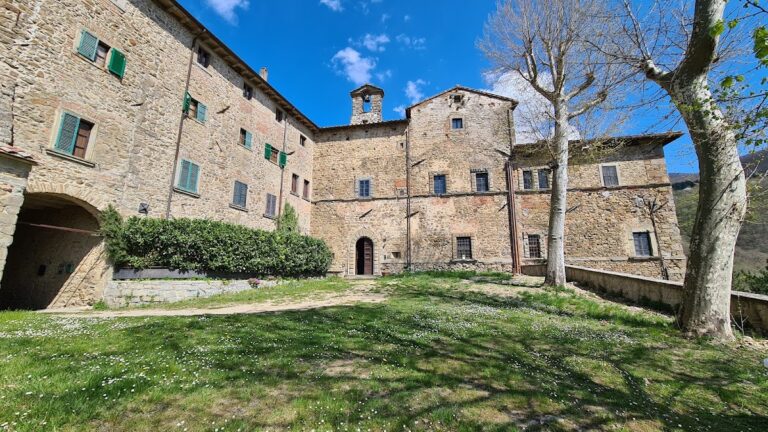
The former abbey complex became the episcopal palace after the diocese was created. It houses the diocesan archive, episcopal library, offices, portraits of bishops, and records of the Camaldolese abbey, the diocese, the cathedral chapter, seminaries, and associated parishes. The archive contains material from 1022 to 2016, while the library holds more than 20,000 volumes.
Remains
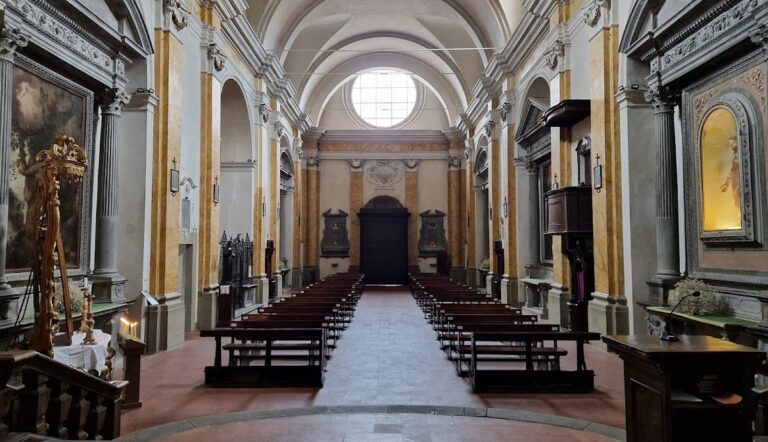
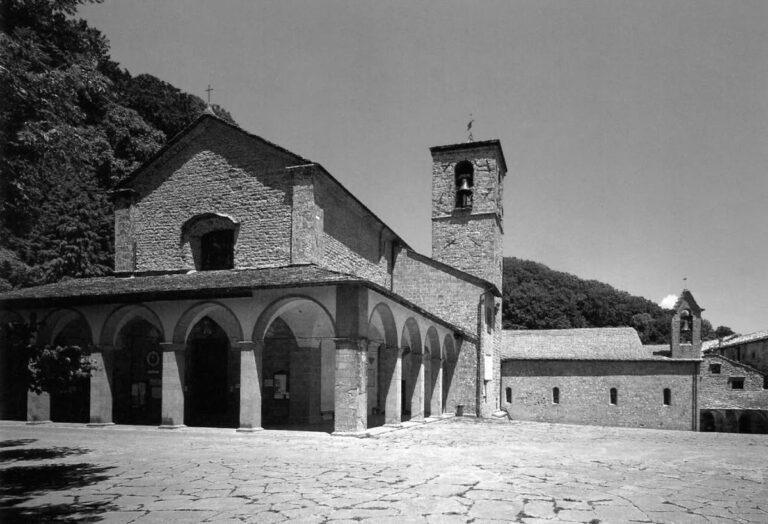
Except for the apse, the cathedral retains the plan and principal form of the fourteenth-century church. It is a three-nave basilica, with a central nave and two aisles divided by columns. Round arches, depressed capitals, vigorous sculpture, and the building’s proportions express its Romanesque character, while the facade and unfinished eastern works preserve Gothic elements. The central nave has a timber-truss ceiling installed during the 1934-1943 restoration, and the aisles have groin-vaulted ceilings.
Facade, tower, and unfinished eastern works
Facade and portals
The facade remains principally Romanesque in appearance. Its Gothic features include the splayed central portal, whose opening widens toward the exterior, its triangular gable, and the circular window above. The present rose window was reconstructed from original fragments found in 1937. The central entrance has an early sixteenth-century carved walnut door made by local craftsmen. Its reliefs portray the Allegory of Fortune, Saints Peter and Paul, Death, Saint Onuphrius, Saint Christopher, Saints Arcano and Egidio, floral rosettes, and the coat of arms of Galeotto Graziani. The two lateral doors bear the emblems of the Camaldolese Order and Galeotto Graziani.
Bell tower and chapter-room space
The bell tower interrupts the projected eastern extension on the right side of the church. Its lower section is the surviving part of the original eleventh-century construction, while its upper section was rebuilt after the fourteenth-century collapse in a form inspired by Umbrian architecture. A room beside the stairway to the bell chamber has a frescoed frieze showing the coats of arms of abbots and the Camaldolese congregation. Dating from the beginning of the sixteenth century, the room may for a period have served as the chapter room.
Apse and planned extension
The interior ends in a concave semicircular apse created in the twentieth century. Behind it are remains of the unfinished fourteenth-century polygonal apse planned for the church’s larger Gothic extension. The modern high altar incorporates the fourteenth-century altar table.
Interior arrangement and furnishings
Presbytery and burials
The presbytery contains the canons’ choir installed in the apse in 1967, with the episcopal throne at its centre. In front of the high altar, a burial area contains the tombs of five bishops who died between 1818 and 2021. The provosts of the chapter are buried separately in the central nave. Four lateral altars stand along the aisles, with two further altars in the side chapels. The surviving Baroque altar, dated 1682, stands at the rear of the right aisle and has a stucco-decorated cupola showing the Glory of Saint Pius V.
Baptismal font and counterfacade sculptures
To the left of the main entrance is a marble baptismal font made in 1553 for Bishop Alfonso Tornabuoni by Amadio da Sangallo. Giovanni di Berto and his son Berto made its original wooden canopy. The present canopy, produced by Francesco Puletti in 2011-2012, is covered with repoussed silver sheets depicting scenes from the Old and New Testaments. Two glazed terracotta sculptures on the counterfacade represent Saints Benedict and Blaise. Attributed to Andrea della Robbia and dating from the early sixteenth century, they came from the Graziani Chapel.
Bell chamber and organ
The bell chamber contains five bells. The Campanone, dedicated to Saint John the Evangelist, was cast in 1455. The Ventitre was recast several times, most recently in 1732. The Mortina, cast in 1695, is used for funerals, while the Ave Maria, cast in 1302, is rung in the evening. The Cennino, cast in 1619, gives the final summons to Mass. Ropes operate the bells, including distinctive ceremonial ringing practices.
The principal organ is the Tamburini opus 241, installed in 1942 on two galleries beside the presbytery. It has electro-pneumatic transmission, two 61-note keyboards, a 32-note concave-radial pedalboard, approximately 2,550 pipes, and 29 stops. After a period of neglect, it was restored in 2015.
Paintings and sculptures in the right aisle
Fourteenth- and fifteenth-century wall paintings
A fresco at the beginning of the right aisle was uncovered during the twentieth-century restoration. Painted around 1350-1360 in an Emilian or Romagnol artistic environment, it shows the Madonna and Child with Saint Catherine and Thomas Becket. An inscription names Carlo di Messer Buono Graziani as the commissioner for an early Graziani family altar.
Bartolomeo della Gatta’s Crucifixion with Saints James the Greater, Philip, Mary, Mary Magdalene, John the Evangelist, Benedict, Francis, and Clare is a late-fifteenth-century fresco, probably painted in the late 1480s. Covered during the nineteenth century, it was uncovered in 1942. It is the surviving part of the chapel built for Jacopo Anastagi in 1453, with fragments of Saints Sebastian and Bernardino of Siena on the inner sides.
Right-aisle altars
The first right-hand altar holds Santi di Tito’s Incredulity of Saint Thomas, painted in 1576-1577 for the Brunetti family chapel. Its background includes a view of Bartolomeo della Gatta’s Crucifixion and Saints. The second right-hand altar has Durante Alberti’s Adoration of the Shepherds, while the rear altar contains Raffaello Schiaminossi’s seventeenth-century Madonna of Mercy.
Federico Zoi’s seventeenth-century Massacre of the Innocents incorporates a sixteenth-century panel of the Madonna and Child with the Infant Saint John. The panel had been transferred from a shrine above the Porta Fiorentina during the War of Castro, a seventeenth-century conflict involving the papal territories and the Farnese duchy of Castro. A twentieth-century copy of Piero della Francesca’s Baptism of Christ is also present. The original reached the cathedral around 1807, was sold in 1859, and later entered the National Gallery in London.
Presbytery and left aisle works
Resurrection Polyptych
Behind the high altar is Niccolo di Segna’s Resurrection Polyptych, made around 1348. A polyptych is an altarpiece formed from several joined panels. Its central panel represents the Resurrection, with Saints Catherine of Alexandria, John the Evangelist, Benedict, and Agnes at the sides, further saints above, and scenes from the Passion of Christ in the predella, the lower horizontal part of an altarpiece. Removed from its original position in the early sixteenth century, it entered the Civic Museum in the nineteenth century, returned to the cathedral between 1943 and 1967, and was permanently reinstalled in 1979. Its Resurrection composition is considered a precedent for Piero della Francesca’s treatment of the subject.
Presbytery images
Below the organ case is a sixteenth-century wooden panel showing the Mysteries of the Rosary. The so-called Madonna della Sollecitudine, a painted stone statue from the early fifteenth century, stands against the pillar between the presbytery and the left chapel. The Chapel of the Blessed Sacrament, on the left side of the presbytery, has housed the Volto Santo since 1943. The chapel also contains Pompeo Ghezzi’s tomb, closed by an artistic marble slab made in 1982.
Left-aisle paintings and monuments
The second altar on the left has Jacopo Palma the Younger’s signed and dated Assumption of the Virgin of 1602, crowned by Raffaellino del Colle’s lunette of God the Father Blessing. Nearby is Pietro Perugino’s Ascension of Christ, commissioned by Abbot Simone Graziani and painted between 1505 and 1510 for the high altar. The painting was later moved and is now displayed on the left side of the church.
The left aisle contains the funerary monument of Abbot Simone Graziani, commissioned by his brother, Bishop Galeotto Graziani, around 1521-1522. Its author is unknown. Raffaellino del Colle’s Resurrection of Christ was commissioned in 1522 for the former Chapel of Saints Egidio and Arcano. The first altar near the entrance has a Crucifixion with Saints attributed to Romano Alberti or Pier Francesco Alberti and dated 1616.
Works near the sacristy
Near the sacristy door is Durante Alberti’s Trinity with Saints Mary Magdalene, Andrew, and Christina, painted in Rome in 1575-1576 for the Artini Chapel and returned to the cathedral in 2024. Nearby stands a late-fifteenth- or early-sixteenth-century Robbian-style tabernacle attributed to Andrea della Robbia, formerly belonging to the Graziani Chapel.
The sacristy contains a sixteenth-century polychrome wooden Crucifix attributed to the Alberti circle of Sansepolcro and a seventeenth-century Saint Romuald attributed to Antonio Zoi. It also has copies of seventeenth-century lunettes showing Saints Egidio and Arcano, made by Corrado Comanducci in 1915. A copy of Rosso Fiorentino’s Deposition is now in the church of San Lorenzo.
Associated works and the Volto Santo
The cathedral’s former holdings and associated works include the Madonna of Priest Martino, a 1199 image of the Sedes Sapientiae once publicly venerated in the church and now in Berlin’s Bode Museum. Vincenzo Chialli’s 1828 Crucifixion is in San Lorenzo, while statuettes of Saints Egidio and Arcano were stolen from the Chapel of Saint Leonard in 1971. A small sixteenth-century local panel of the Madonna and Child with the Infant Saint John, formerly above the Porta Fiorentina, was transferred into the cathedral in 2022. A twelfth-century crucifix found in a private collection in Rome in 2007 has been associated with the monastery of Santa Maria at Rosano.
The Volto Santo is an eighth- or ninth-century Eastern-iconographic wooden crucifix with a tunic. Its refined and almost completely intact polychromy dates from the twelfth century and was revealed during the restoration of 1986-1989. The image has been preserved in its dedicated chapel since 1943.
Cloister and former monastic complex
Cloister frescoes and Lapidary
The former abbey cloister is reached through a lateral church door and a corridor open to the street. Its structure has changed over time, including the blocking of some arches. The corridors retain frescoes depicting scenes from the life of Saint Benedict. Abbot Simone Graziani commissioned the cycle, probably painted by an unknown artist between 1490 and 1509.
The cloister’s Lapidary opened in 2012 and contains stone material gathered over the preceding decades. Its funerary, commemorative, and honorary inscriptions date from the sixteenth to the nineteenth centuries and relate to bishops, local officials, benefactors, clergy, and the transfer of the remains of Ippolito Betti. The collection also includes a fragment of a fourteenth-century baptismal font found in 1980 and architectural fragments dating from the eleventh to the sixteenth centuries.
Chapel of Saint Leonard
The Chapel of Saint Leonard, also called the Monastic Retreat Chapel, opens from the cloister through a fifteenth-century portal. Tradition identifies it as the place where Egidio and Arcano established the original oratory for the relics brought from Jerusalem. The chapel contains the tomb of Piero della Francesca, who died on 12 October 1492, together with other burials.
Episcopal palace and archives
The episcopal palace occupies part of the former abbey and monastery. Three inscriptions at its entrance name the abbots of Sansepolcro from 1013 to 1520, the bishops of Sansepolcro from 1520 to 1986, and the bishops of Arezzo-Cortona-Sansepolcro from 1986 onward. The building also contains the bishop’s residence, diocesan archive, episcopal library, portraits, a twentieth-century plaster-cast collection, and works including a sixteenth-century local Madonna and Child transferred from the Porta Fiorentina in 2022.