Bođani Monastery: A Serbian Orthodox Monastery in Serbia


Site at a Glance
- Rating
- 4.9
- Popularity
- Low
- Country
- Serbia
- Primary era
- Early Modern
- Eras represented
- Medieval, Early Modern
- Civilizations
- Habsburg, Hungarian
- Site type
- Religious
- Remains
- Monastery
On this page8 sections
History
Bođani Monastery is a Serbian Orthodox monastery in Serbia, founded in 1478, with its present church and lodging buildings in the Baroque style. Dedicated to the Presentation of the Blessed Virgin Mary, a Christian feast commemorating Mary’s entry into the Temple, it belongs to the Eparchy of Bačka, the Serbian Orthodox administrative diocese for the region. It is regarded as the oldest of the few Serbian Orthodox monasteries in Bačka.
Foundation and early history
The monastery was established in what was then Hungary by Bogdan, a merchant from Dalmatia. According to the foundation legend, Bogdan recovered his sight after washing his eyes at a spring near the present church and praying to the Virgin Mary. In gratitude, he vowed to build a church. He fulfilled that vow, constructed the monastery cells, acquired land, and secured approval for the building from Matthias Corvinus, the fifteenth-century king of Hungary, through Prince Dimitrije Jakšić. The monastery’s name derives from Bogdan.
Ottoman conquest and rebuilding
Bođani suffered during the Ottoman conquest of 1526. Monastic life resumed in 1578, when returning monks erected a wooden church. That building was destroyed toward the end of the seventeenth century during the reign of Leopold I, the Habsburg ruler who was Holy Roman Emperor from 1658 to 1705.
A replacement church was built in 1698, but flooding damaged it in 1711. The present church, the fourth built on the site, was erected in 1722. An inscription above the western entrance attributes its construction to Mihajlo Temišvarlija of Szeged.
Monastic community and later changes
On 25 January 1756, the community included Abbot Joasaf Stefanović of Senta, Hieromonk Janićije Tomašević of Kragujevac, and Hieromonk Efrem of Szeged. A hieromonk is an Orthodox monk who is also an ordained priest. Tomašević and Efrem had entered monastic life through tonsure at Resava Monastery, a formal rite of reception into the monastic community.
The church was repeatedly damaged by wars and fires, and major Danube floods also affected it. During one major flood, dated uncertainly to either the late eighteenth century or the 1920s, water rose approximately 1.5 metres inside the church. Bođani remained a male monastery from its foundation until 1991. It became a female monastery for a short period in the first half of the 1990s, then returned to the monks in 2002.
After the last major reconstruction, a glass panel was installed before the altar to reveal archaeological remains of earlier churches. In 1990, the monastery was declared a Monument of Culture of Exceptional Importance and placed under the protection of the Republic of Serbia. Objects associated with Manasija Monastery were also transferred to Bođani. A museum in the monastery lodging once held engravings, oil paintings, church vessels, and other objects.
Remains
Monastery complex
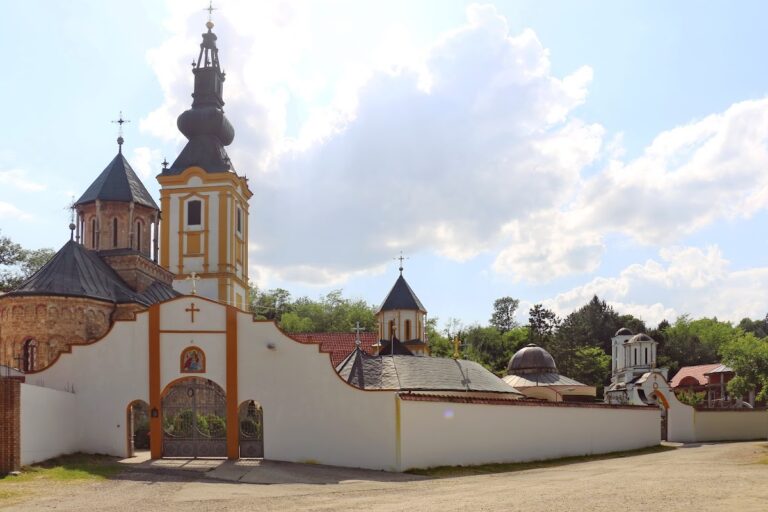
The complex is organized around the Church of the Presentation of the Blessed Virgin Mary. Lodging buildings surround the church on three sides in a P-shaped arrangement. Together with the church, they form the principal architectural group, while a garden and an estate with auxiliary structures extend through the wider grounds. The church and lodging buildings are Baroque, a European style known for elaborate decoration and dynamic forms.
Church and interior decoration
The church contains more than 600 square metres of frescoes painted by Hristofor Žefarović in the 1730s. Although frescoes are wall paintings commonly associated with wet plaster, Žefarović applied these paintings in oil onto dry plaster. Their treatment of biblical themes differs from conventional canonical versions, and the work has consequently been regarded by some as a stimulus for modern Serbian painting.
Semicircular supporting pillars carry scenes from the Book of Genesis. The ceiling paintings portray battles between saints and demons with animal-like heads. One scene shows Saint Margaret the Virgin, known in Serbian tradition as Fiery Mary, striking a winged demon with a tail using a hammer.
The iconostasis, the screen separating the sanctuary from the main worship space in an Eastern Orthodox church, is an independent major artwork. An artisan from Kiev made it in the middle of the eighteenth century. Before the altar, the glass panel provides a view of archaeological remains belonging to the earlier churches on the site.
Grounds and associated collections
The monastery grounds include a landscaped park, several hectares of woodland, and orchards. Its garden contains more than 150 plant species from different parts of the world, including Egyptian cedar and plants from the Americas. An effort to plant sequoias failed because of the climate. The monastery’s associated holdings have also included objects transferred from Manasija Monastery, while the former museum in the lodging preserved engravings, oil paintings, church vessels, and other items.