Chiesetta di Santo Stefano: A Medieval Romanesque Church in Soleto, Italy


Site at a Glance
- Rating
- 4.8
- Popularity
- Low
- Country
- Italy
- Primary era
- Medieval
- External website
- Open
- Eras represented
- Medieval
- Civilizations
- Byzantine
- Site type
- Religious
- Remains
- Church
On this page6 sections
History
The Chiesetta di Santo Stefano is a Catholic church in Soleto, Italy, within the Archdiocese of Otranto. It is a Romanesque building whose foundation date remains uncertain: the French historian Charles Diehl assigned its construction to 1347, while other scholars place its foundation in the final years of the fourteenth century.
Soleto’s Italo-Greek tradition
From the late Middle Ages until the end of the sixteenth century, Soleto was an Italo-Greek religious and cultural center. Greek liturgical traditions shaped local religious life, while a Greek bishop and a protopapas, a senior Greek-rite cleric who supervised local clergy, served the community. The town was also known for copying manuscripts, many of which later entered major European libraries.
Seventeenth-century episcopal visitations refer to the church, also called Santa Sofia, and record twenty Greek books inside it. Greek and Byzantine customs continued to influence liturgy, marriage, and funerary practices in Soleto. In 1598, Antonio Arcudi, the town’s last protopapas, was commissioned to compose the Neon Anthologion, a Byzantine breviary for the Greek clergy of Terra d’Otranto.
Frescoes and later care
The church’s fresco cycles date mainly from the late fourteenth century, with several interventions during the fifteenth century. Their style combines Giottesque elements with features associated with workshops active during the same period at the Basilica of Saint Catherine of Alexandria in Galatina. The paintings present Christian doctrine through scenes of the Trinity, Christ’s Passion, Death and Resurrection, the Last Judgment, Paradise and Hell, and the opposition of good and evil.
The Chiesetta di Santo Stefano is described as the only surviving monument of Soleto’s former Byzantine religious and cultural tradition. Restoration of the interior fresco cycles and the facade has recently been completed. The entrance door is kept closed as an additional protection against vandalism.
Remains
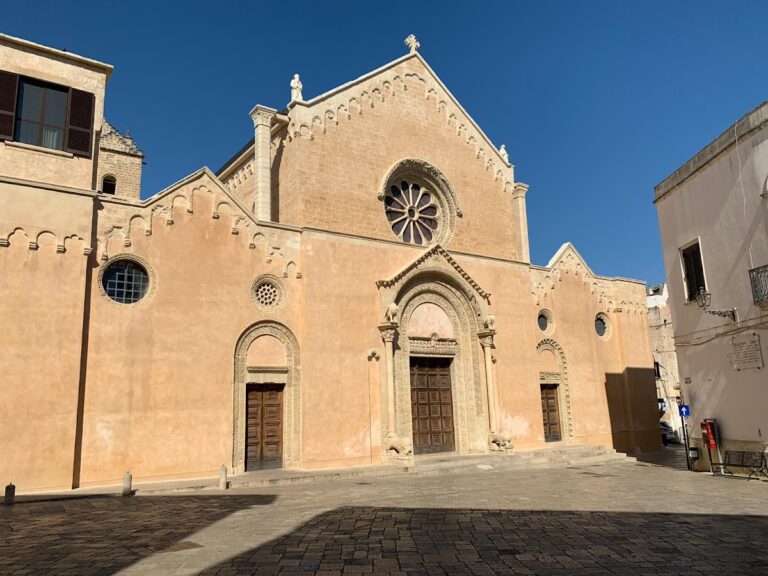
The church is a compact structure measuring approximately 6.61 by 3.90 meters. Its interior is a simple, single-room hall ending in an apse, the curved terminal part of a church, and covered by a timber truss roof supported by triangular wooden frameworks. The facade combines traditional Romanesque features, including round arches and substantial masonry, with Gothic innovations such as pointed forms and stronger vertical emphasis.
Facade and entrance
The facade has a Romanesque portal, a small wheel-shaped oculus with eight spokes, and a single-cusped bell gable with Gothic elements. The bell gable, a wall-mounted structure carrying bells, contains a two-light opening and aligns with the portal, interrupting the apex formed by the adjoining roof slopes. Four blind arches run beneath each roof slope. They vary between pointed, trefoil, and round forms, while the arch interrupting the cusp is trefoiled and flanked by two corbelled arches. This vertical arrangement is an unusual and refined solution in medieval Salento and has architectural parallels with late-medieval work at Saint Catherine in Galatina and with Romanesque and Gothic examples elsewhere in Puglia and Italy.
The porch-type portal is almost completely eroded. Its frames and perforated lintel originally carried floral-geometric ornament, most of which has also been lost. The lunette was probably intended to contain a fresco of Saint Stephen. On the interior face of the facade, a Last Judgment follows an otherwise traditional Byzantine iconographic scheme and includes a projecting demon made from black stucco.
Apse and painted interior
The apse contains the oldest frescoes in the church. They depict the icon of Divine Wisdom, or Holy Wisdom, together with the four Evangelists, Matthew, Mark, Luke, and John. Above them, the Holy Spirit descends upon the Apostles gathered around the praying Virgin Mary before the walls of Jerusalem. The scroll inscriptions held by the saints in both sections are in Greek.
The south wall presents episodes from the life of Saint Stephen, while the north wall illustrates the life of Christ. Although the scenes use a medieval artistic style, the figures wear fifteenth-century clothing. Twenty-two panels are arranged in three longitudinal registers, and the lowest section of the side walls contains life-size standing saints, including female saints.
The upper center of the facade’s oculus contains Christ, with the Virgin Mary and Saint John the Baptist at his feet. The twelve Apostles stand on either side holding the Gospels, while two angels sound trumpets. The Archangel Michael appears as an armed medieval knight. The damned are shown to his left, while Paradise lies to his right, where Saint Peter holds the keys and leads the Good Thief.