Dorfkirche Belitz: A Medieval Village Church in Germany
Site at a Glance
- Rating
- 4.6
- Popularity
- Very Low
- Country
- Germany
- Primary era
- Medieval
- Eras represented
- Medieval, Early Modern, Modern
- Civilizations
- German, Holy Roman Empire
- Site type
- Religious
- Remains
- Church
On this page17 sections
History
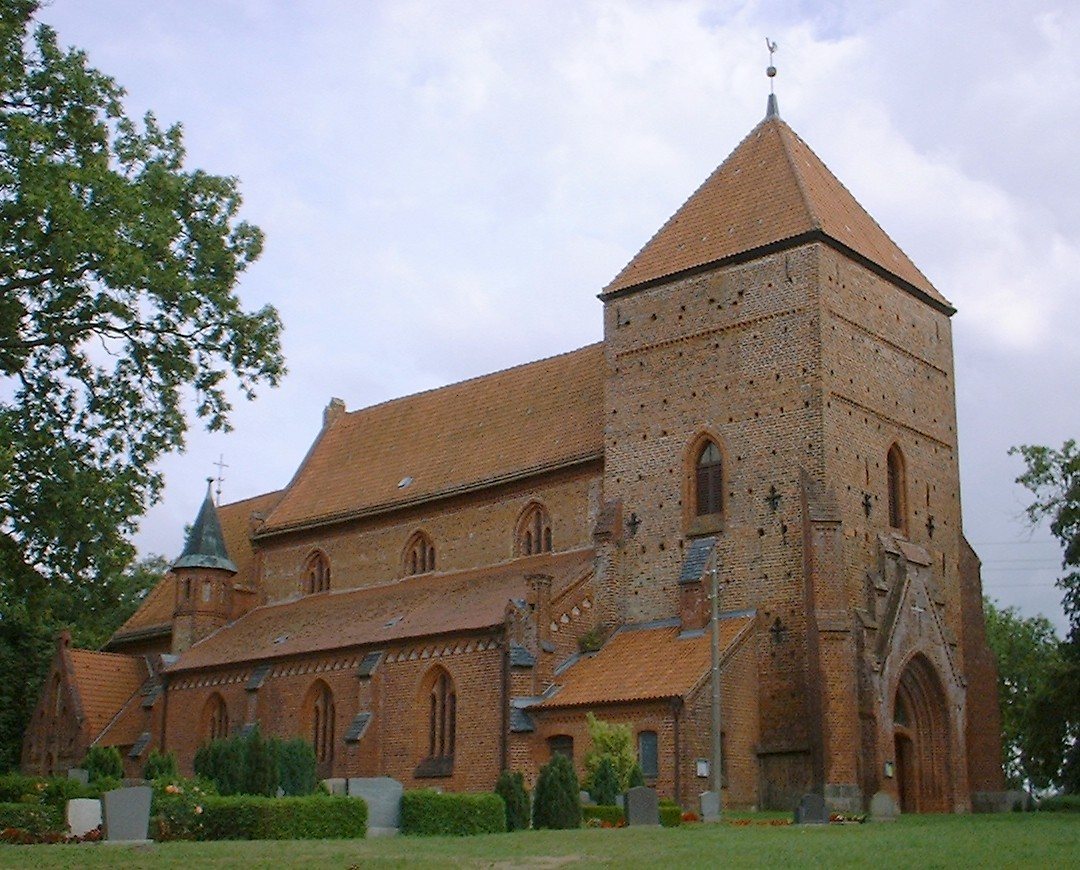
Dorfkirche Belitz is a medieval village church in Germany, located in Belitz, now a district of Prebberede in Mecklenburg-Western Pomerania. Construction of its main building began around 1270, and the church acquired its characteristic neo-Gothic appearance through a comprehensive renovation in the late nineteenth century. Its congregation belongs to the Rostock provostry within the Mecklenburg Church District of the Evangelical Lutheran Church in Northern Germany.
Medieval foundation and later changes
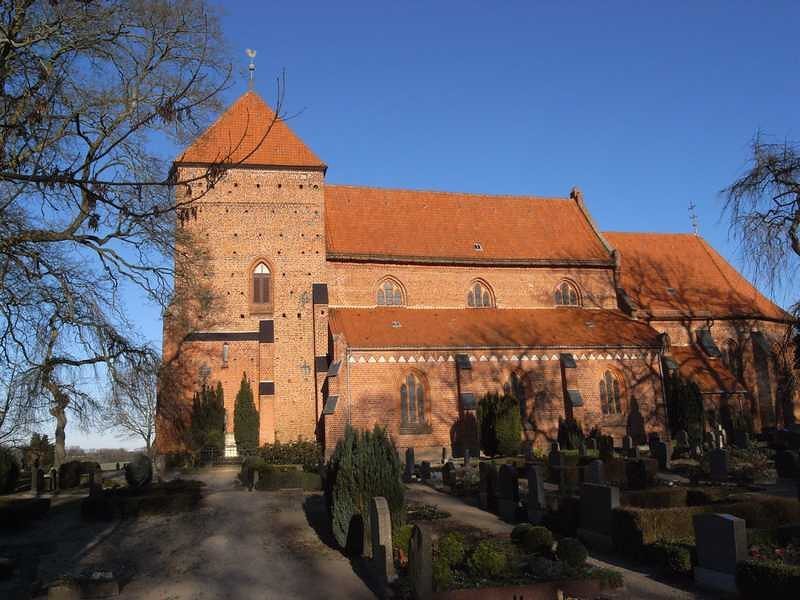
The church was built as a three-aisled brick basilica, a plan in which the central nave rises above lower side aisles. A west tower was added in the fifteenth century. It was originally taller, but its upper section was removed in 1773, after which the shortened tower received a tent roof.
A major rebuilding campaign took place from 1886 to 1888. The side aisles were completely renewed, including their vaults, while the central nave was partly rebuilt. This work established the late-nineteenth-century appearance that defines the church today. The renovation also brought new furnishings, including the pulpit and pews, as well as two wall paintings.
Furnishings and memorial history
The lower western gallery dates from 1670, while a later upper gallery carries the organ. The church also preserves memorials from earlier centuries. Among them is the epitaph of M. Schmeker, who died in 1596. The monument was produced in 1602 in the workshop of Claus Midow and includes alabaster reliefs.
A second epitaph commemorates Jacob Hintze, a staff trumpeter and innkeeper who was murdered in 1677. His trumpet, made during his lifetime, is preserved in the Musical Instrument Department of the Germanisches Nationalmuseum in Nuremberg.
The organ and churchyard
Christian Heinrich Kersten built the church organ in 1784 as a one-manual instrument. He enlarged it in 1786 by adding five pedal stops in two side extensions with prospect fields. Friedrich Wilhelm Winzer expanded it again in 1858, and Friedrich Löbling of Erfurt restored it in 1963. During that restoration, the organ’s action was shifted by two semitones.
The churchyard contains the graves of the agricultural reformer and social economist Johann Heinrich von Thünen, who died in 1850, and the organist and pomologist Franz Hermann Müschen, who died in 1847. It also includes an enclosed Bassewitz burial plot with memorials to members of that family. A wooden cross with a warning inscription marks the grave of a Wehrmacht deserter who was shot in May 1945. The Wehrmacht was the armed forces of Nazi Germany between 1935 and 1945, while a deserter was a soldier who abandoned military service without authorization.
Remains
Dorfkirche Belitz survives as a brick basilica with a west tower, a two-bay eastern choir, a northern sacristy, renewed side aisles, and two western galleries. The mixture of medieval fabric, eighteenth-century fittings, and nineteenth-century rebuilding gives the church its varied architectural character.
Church structure
Choir and sacristy
The eastern end consists of a two-bay choir closed on three sides. It is covered by a cross-rib vault, a vaulted ceiling supported by intersecting ribs. A sacristy adjoins the church on the north. This room, used for clergy, vestments, and liturgical objects, also has a cross-rib vault.
Tower and nave
A square tower stands at the western end. Its upper section was removed in 1773, and the remaining structure is covered by a tent roof. The central nave has a flat wooden ceiling and was partly renewed during the work of 1886 to 1888. The side aisles were rebuilt during the same campaign and received cross-rib vaults.
Western galleries
Two galleries are set one above the other at the west end. The lower gallery was installed in 1670. The later upper gallery serves as the organ gallery, placing the instrument above the western interior of the church.
Interior furnishings and music
Paintings and furnishings
The pulpit and pews belong to the renovation of 1886 to 1888. Two paintings from the same period are especially associated with the interior. Church painter Krause of Wismar painted the raising of Jairus’s daughter on the east wall of the central nave. In the New Testament, Jairus is a figure whose daughter Jesus raises from the dead. On the altar wall, the Dresden painter Karl Christian Andreae created a scene of the Resurrection.
The church also contains historical chalices, wafer boxes, and candlesticks. Its memorial furnishings include the Schmeker epitaph, made in 1602 in Claus Midow’s workshop and decorated with alabaster reliefs.
Organ and bells
The organ is a purely mechanical slider-chest instrument. In this type of organ, sliding wooden strips control the admission of air to the pipes. The present instrument has 18 stops distributed across two manuals and a pedal. Three bells hang in the tower and are still operated by hand.
Churchyard memorials
Thünen grave
Johann Heinrich von Thünen’s grave lies south of the church tower. Its inscription identifies him as the landowner and Doctor Johann Heinrich von Thünen of Tellow and gives his dates as 24 June 1783 to 22 September 1850. It also states that he rests beside his wife, Helene Sophie von Thünen, née Berlin, who lived from 21 March 1785 to 19 January 1845. Von Thünen was a nineteenth-century German agricultural economist whose work applied mathematical analysis to land use and the location of agriculture.
The monument displays his formula, expressed as the square root of a multiplied by p, together with an inscription concerning human goodwill. A plaque on the surrounding railing commemorates Edo Heinrich von Thünen, who lived from 16 June 1808 to 17 August 1873.
Müschen memorials
Several metres southwest of the church tower is the tomb slab of Franz Hermann Müschen. Müschen was an organist and pomologist, a specialist in the cultivation and study of fruit trees. Nearby, an obelisk commemorates Elise Müschen, née Lohr, who lived from 3 September 1782 to 11 September 1816. Its reverse records Betty Müschen, née Lohmann, who lived from 27 July 1784 to 17 January 1844.
Bassewitz burial plot
The enclosed Bassewitz burial plot contains a small stone plaque and several tomb slabs. One commemorates Carl Cristoph Imperial Count von Bassewitz at Reetz, who lived from 26 August 1784 to 17 November 1837. Another marks Henning Friedrich Imperial Count von Bassewitz at Prebberede, who lived from 27 November 1680 to 1 January 1749. Additional Bassewitz names appear within the enclosure.
1945 grave
A wooden cross in the churchyard marks the grave of a Wehrmacht deserter shot in May 1945. The warning inscription on the cross forms part of the memorial’s physical appearance and identifies the circumstances of the burial.