St. Viktor: The Roman Catholic Parish Church of Damme


Site at a Glance
- Rating
- 4.7
- Popularity
- Low
- Country
- Germany
- Primary era
- Modern
- External website
- Open
- Eras represented
- Medieval, Early Modern, Modern
- Civilizations
- German, Holy Roman Empire
- Site type
- Religious
- Remains
- Church
On this page9 sections
History
St. Viktor is a Roman Catholic parish church in Damme, Germany, known locally as the Dammer Dom because of its size and regional importance. The church was founded in the eighth century by Wiho, the first bishop of Osnabrück, as the mother church of the Old Saxon district of Dersi. Its patron is Saint Victor of Xanten, a Christian martyr traditionally associated with Xanten in the Lower Rhine region. The first building was probably wooden.
From Early Foundation to Medieval Parish
A Romanesque church with a tower replaced the early foundation around the turn of the tenth and eleventh centuries. Damme belonged ecclesiastically to the Diocese of Osnabrück. Its original parish district was gradually divided as neighboring communities formed separate parishes: Neuenkirchen with Vörden separated in 1159, Steinfeld in 1187, Holdorf in 1827, Osterfeine in 1901, and Rüschendorf in 1925.
In 1252, Damme became politically part of the Prince-Bishopric of Münster with the lordship of Vechta. A prince-bishop held both ecclesiastical authority and territorial political power in this type of principality. In 1666, Prince-Bishop Christoph Bernhard von Galen also obtained ecclesiastical jurisdiction over the Lower Prince-Bishopric, the southern part of the Münster territory. After the ecclesiastical principalities were abolished and the Congress of Vienna reorganized Europe, papal measures of 1821 and 1824 assigned the Catholic parishes of the Grand Duchy of Oldenburg to the Diocese of Münster, which established an officialate at Vechta.
Medieval Church and Baroque Reconstruction
A Gothic hall church, with a central nave and side aisles of approximately equal height, was built in 1435. A choir was added in 1501. The church suffered damage during the Reformation, the period when western Christianity underwent major religious divisions, and during the Thirty Years’ War, the destructive European conflict of 1618 to 1648. A major fire in Damme led to reconstruction in 1693, when the medieval tower received its Baroque cap.
The Present Neo-Gothic Building
The 1435 church was demolished in 1903 to make way for a new building. After prolonged discussion, the medieval tower was retained, although a new Neo-Gothic tower had also been planned. Heinrich Flügel, a German architect and former building official in Bremen, designed the present church. Damme contractors Heinrich and Josef Römer built it between 1904 and 1906, and Bishop Hermann Jakob Dingelstad of Münster consecrated it on 14 November 1906.
The new church was conceived as a unified Historicist work of art, combining architecture, furnishings, and decoration within a coherent historical style. It was renovated in 1959 and 1960 and underwent another renovation between 2008 and 2012. St. Viktor is listed as a cultural heritage monument in Lower Saxony.
Music and Continuing Use
The present organ was built in 1975 by Alfred Führer of Wilhelmshaven. Fleiter of Münster renovated it in 2013, and a positive organ made in 2004 by Hugo Mayer Orgelbau was acquired in 2018. Gabriel Isenberg has served as church musician at St. Viktor since 2008. These instruments form part of the church’s continuing musical life alongside its older architectural and artistic fabric.
Remains
St. Viktor is a large Neo-Gothic three-aisled hall church with a transept, the crosswise part of a church that projects from its main body. The exterior and interior were designed together as a unified Historicist composition. The building combines the large scale of the 1904 to 1906 church with the surviving medieval tower, while historic furnishings and stained glass preserve elements from different periods of the parish’s development.
Romanesque and Gothic Tower
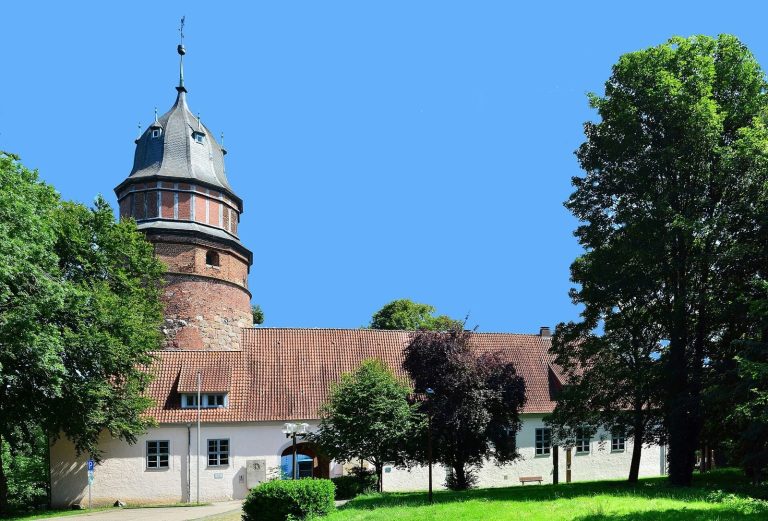
The earlier tower stands beside the present church and is built of fieldstone. Its lower section contains a Romanesque round-arched portal dating from around 1300. This portal once served as the principal entrance to the church. The middle section of the tower is Gothic, while the Baroque cap was added after the major Damme fire of 1693. The tower rises prominently above the town and is regarded as its landmark. By contrast, the towers of the new entrance facade were deliberately designed as slender and low.
Interior Furnishings and Memorial Chapel
Two major furnishings from the predecessor church were transferred into the new building in 1906. They are a High Gothic sacrament house from 1501, a fixed architectural container for reserving the consecrated Eucharist, and a Romanesque baptismal font of the Bentheim type dating from around 1150. The church also contains prominent stained-glass windows, numerous artworks from the nineteenth and early twentieth centuries, and furnishings mostly dating from around 1910.
Fritz Ewertz made the pulpit in 1910, and the Neo-Gothic high altar dates from the same year. The stained-glass windows were produced by the Henning and Andres firm of Hanover. A memorial to those killed in the two world wars is located in a chapel inside the old tower, bringing the church’s older fabric into connection with twentieth-century remembrance.
Organ and Bells
The 1975 organ has 40 stops distributed across three manuals and a pedal. Its key action is mechanical and its stop action electrical. A large French-Romantic swell division provides tonal colors and expressive control associated with nineteenth-century French Romantic organs, while a glockenspiel adds tuned metal bars played through the organ mechanism. The instrument has couplers I/II, III/II, III/I, I/P, II/P, and III/P, together with an electronic combination system offering 4,096 combinations, sequencers, and three keys.
The tower’s four bells were cast by Petit and Gebr. Edelbrock. The small bell dates from 1924, while the other three were cast in 1949. Their notes are c’, e’, g’, and a’, forming the ringing motif known as “Salve Regina.”