Tatar Sinan Bey Mosque, Kumanovo: An Early Ottoman Place of Worship


Site at a Glance
- Rating
- 4.7
- Popularity
- Low
- Country
- North Macedonia
- Primary era
- Early Modern
- Eras represented
- Early Modern
- Civilizations
- Ottoman
- Site type
- Religious
- Remains
- Mosque
On this page7 sections
History
Tatar Sinan Bey Mosque is a Sunni Muslim mosque in Kumanovo, North Macedonia, built under the Ottoman Empire in the sixteenth century in the early Ottoman architectural tradition. Protocol records date its construction to 1532, while another dating places it between 1520 and 1530. Attributed to Tatar Sinan Bey, it is one of the oldest Islamic monuments in the Kumanovo area and remains an active place of worship administered by the Kumanovo Muftiate, an Islamic administrative jurisdiction headed by a mufti. The building is also protected as a cultural monument.
Foundation and Early Records
The mosque’s first recorded mention dates from 1550, when it was described as a large mosque with its own hammam, or public bath. Its staff included an imam, who led communal prayer, two muezzins, who called worshippers to prayer, and a kaim, a mosque servant or attendant. These details place the mosque within a wider religious and social institution rather than as an isolated prayer hall.
In 1660, the travel writer Evliya Çelebi described the mosque as standing in Kumanovo’s bazaar. His account presents the town as a busy settlement with a tekke, a Sufi lodge, a madrasa, an Islamic school, an inn, a hammam, many shops, and watermills. He also recorded about 600 houses with tile roofs and many rivers.
Reconstruction and Continued Use
The mosque was renovated and enlarged several times, changing its original appearance. A reconstruction took place in 1751, followed by further reconstruction or restoration in 2008. During the Second World War, damage affected the minaret and the upper parts of the mosque, and the minaret was rebuilt during the war.
A gravestone in the courtyard identifies Haji Osman Suleiman as the mosque’s first mutawalli, an administrator responsible for managing a Muslim religious foundation, in 1659 and 1660. The inscription connects the surviving courtyard cemetery with the institution’s administration during the Ottoman period.
Remains
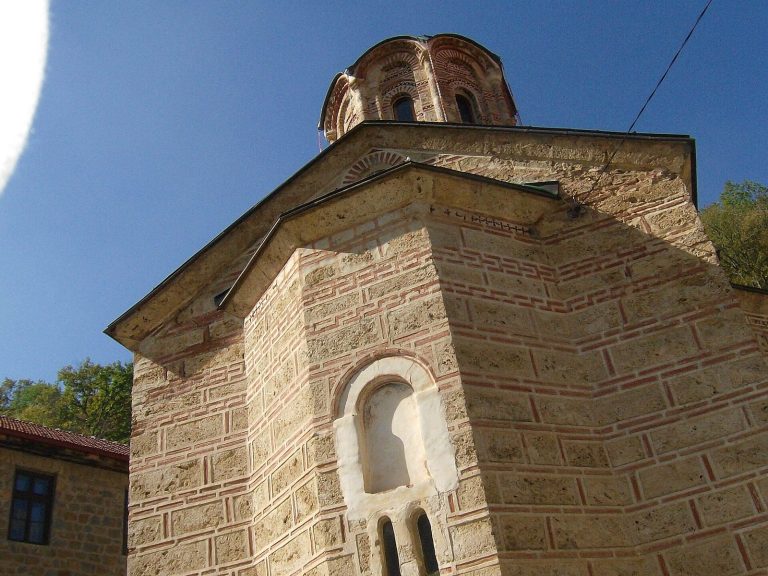
Tatar Sinan Bey Mosque is a single-domed building with a north porch, a form characteristic of early Ottoman mosques and widely used in the Balkans during the sixteenth century. Its plan is described as one large square accompanied by seven smaller squares. The mosque has one dome and one minaret. Except for later additions, its walls are made from carefully dressed square blocks of yellow-brown stone from the Žegligovo region, a construction method unusual for this type of building in Macedonia.
Prayer Hall and Dome
The transition from the prayer hall to the dome is formed by a frieze of Turkish triangles, a rare architectural device. The dome also has an unusually high drum, circular on both the inside and outside. This combination is described as unique among sixteenth-century mosques in Macedonia. Inside, the mihrab, the niche indicating the direction of Mecca, the minbar, or sermon pulpit, and the mahfil, a raised interior gallery or platform, all use simple forms.
Stone Decoration
Shallow-relief decoration appears on the exterior window lintels, especially in the upper window zone. The lintel above the main entrance and the minaret balcony also receive decorative treatment. Floral and geometric ornaments in the upper window zones closely resemble elements at the Church of Saint George in Mlado Nagorichane, suggesting that local craftsmen may have produced the mosque’s decoration.
Minaret and Courtyard Cemetery
The minaret stands west of the mosque and rises approximately 23 metres. Its square base continues into a polygonal shaft, with elegant muqarnas, a three-dimensional geometric ornament, beneath the şerefe, the minaret balcony.
A cemetery occupies the western part of the courtyard and contains numerous gravestones. At least one is dated to 1659 and 1660, while the inscription identifying Haji Osman Suleiman’s service as mutawalli provides a named connection between the cemetery and the mosque’s administration.