St Oswald’s Church, Grasmere: A Medieval Anglican Parish Church
Site at a Glance
- Rating
- 4.8
- Popularity
- Very Low
- Country
- United Kingdom
- Primary era
- Medieval
- External website
- Open
- Eras represented
- Medieval, Early Modern, Modern
- Civilizations
- English
- Site type
- Religious
- Remains
- Church
On this page9 sections
History
St Oswald’s Church is an Anglican parish church in Grasmere, United Kingdom, whose present building dates from the fourteenth century. It stands on or near the site traditionally identified with Grasmere’s first church, founded in 642 and associated with a visit by Oswald of Northumbria, a seventh-century Anglo-Saxon king and Christian saint linked with the Northumbrian kingdom. The church remains an active place of worship within the parish of Grasmere, the deanery of Windermere, the archdeaconry of Westmorland and Furness, and the Diocese of Carlisle.
Medieval enlargement and later restoration
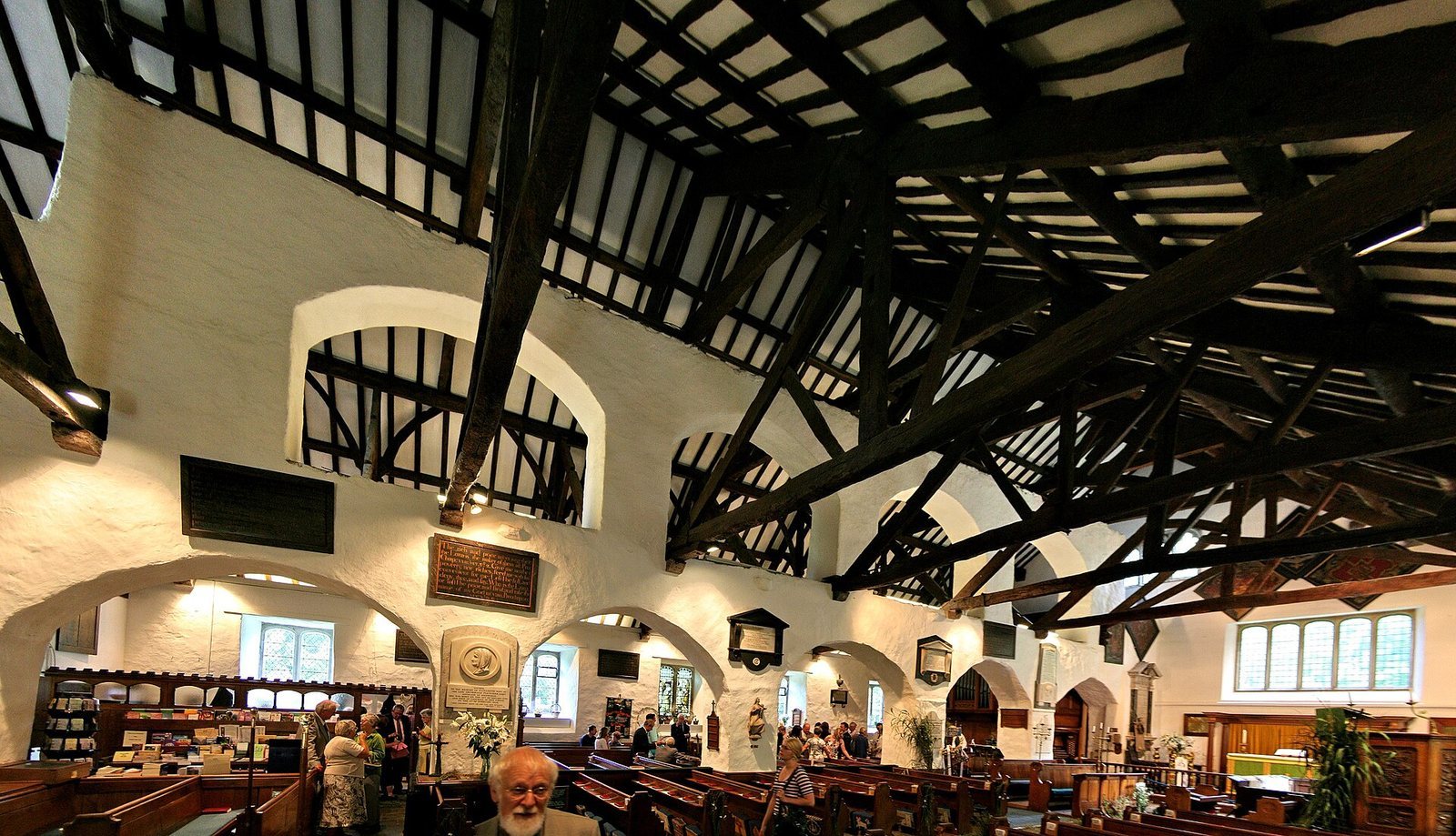
The medieval church was doubled in size between 1490 and 1500, when a parallel nave was added to the north of the original nave. Around 1562, the roof was rebuilt and a second tier of arches was inserted into the internal arcade. George Webster restored the windows and doors in 1840, contributing to the building’s later appearance while retaining its earlier plan and structural features.
Wordsworth, local tradition, and memorials
St Oswald’s is closely associated with William Wordsworth, the major English Romantic poet who lived in Grasmere from 1799 and was buried in the churchyard. The church contains a monument to him made by the Victorian sculptor Thomas Woolner, with an epitaph by the Anglican priest and poet John Keble. A wall tablet in the chancel commemorates the antiquary Daniel Fleming, a scholar who collected and studied historical objects and records and who died in 1701. The church is also connected with the annual rushbearing ceremony, a Christian custom involving the ceremonial carrying or spreading of rushes traditionally used to cover a church floor.
Organs and twentieth-century commemoration
In the 1870s, the church acquired an organ made by Wilkinson of Kendal. It was later moved to Lancaster after a Binns of Leeds organ was installed in 1923. The Binns instrument was commissioned as a memorial to Nellie Taylor, a nurse who died in France during the First World War. J. W. Walker & Sons rebuilt it in the 1960s, and Nicholson & Co. Ltd. renovated it for its centenary. James Lancelot gave the inaugural recital in 2023. St Oswald’s Church is listed at Grade I in the National Heritage List for England, with that designation dating from 21 January 1967. The group of twelve Wordsworth and Quillinan family graves in the churchyard has a separate Grade II* listing.
Remains
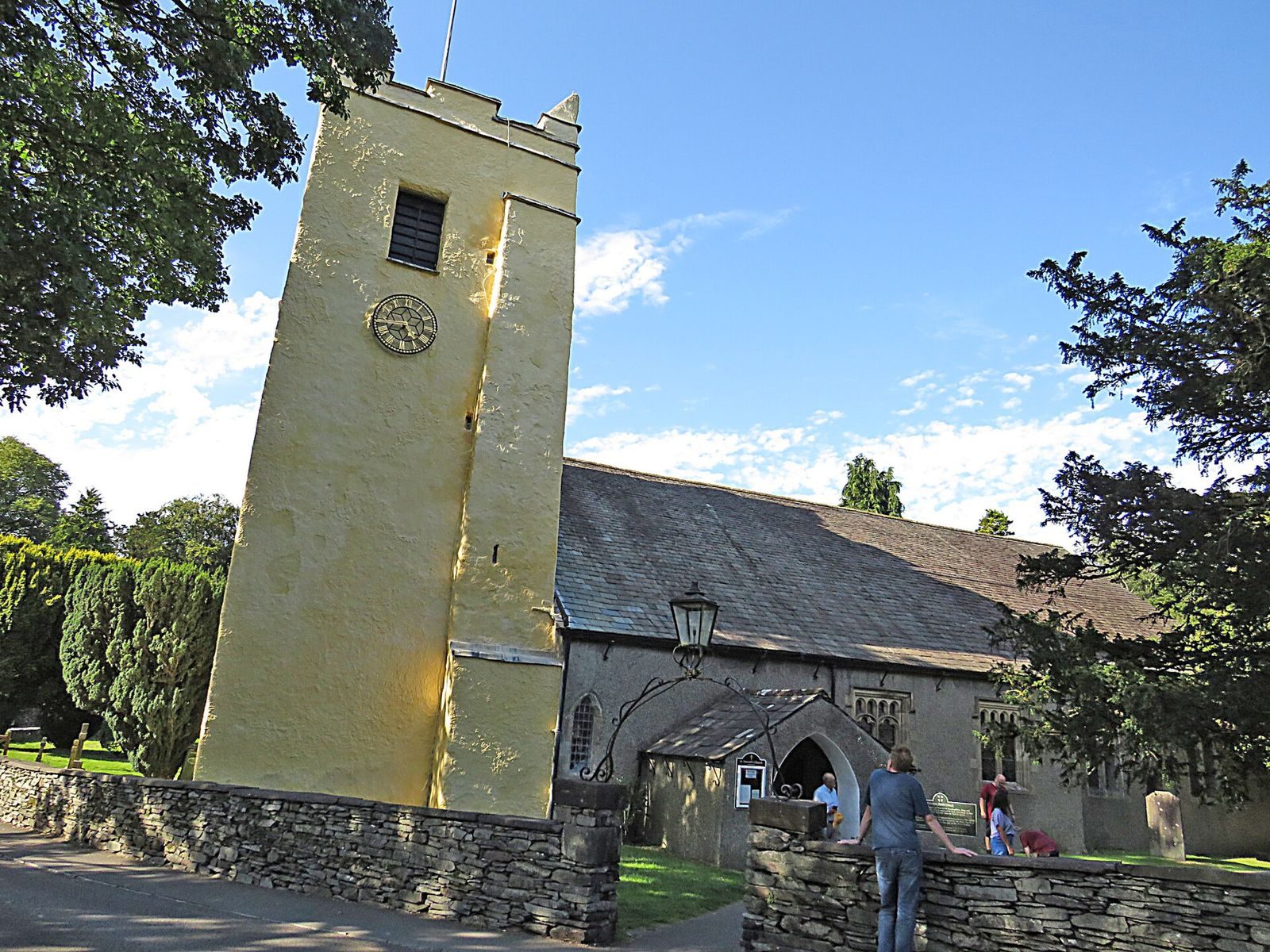
St Oswald’s has a double-nave plan with a south porch and a southeast tower. Roughcast stone forms the walls, while the roofs are covered with slate. The building’s physical arrangement reflects the late medieval enlargement, when the additional nave was built parallel to the earlier one.
Tower and external structure
The southeast tower is battered, meaning that its walls incline inward as they rise. It has lancet windows, which are narrow openings with pointed arches characteristic of Gothic architecture, and plain corner pinnacles. Together with the porch, double nave, and slate-roofed body of the church, the tower forms the principal external elements of the surviving building.
Arcade and timber roof
Inside, the arcade has five arches rising from ground level and four arches above. The upper arches do not continue to the roof ridge. Instead, the arcade ends at the upper tie beams of the open timber roof, preserving a clear relationship between the internal division of the two naves and the roof structure.
Furnishings and stained glass
The church retains a poor box dated 1648 and a balustered altar rail dated 1725. Balusters are small shaped supports used in a railing or balustrade. The pulpit is in the Arts and Crafts style, which valued traditional craftsmanship and handmade decoration, and is carved with fruits and flowers. A medieval font has an octagonal bowl set on a stepped base. The stained glass includes a north-side window made around 1926 by Shrigley and Hunt, two south-side windows from the 1890s by Henry Holiday, and medieval glass in the south-side windows of the chancel. The church also contains a Madonna and Child sculpture by Ophelia Gordon Bell, who lived and worked in Grasmere.
Wordsworth and Quillinan graves
Twelve Wordsworth and Quillinan family graves occupy the southeast corner of the churchyard. The group is enclosed by railings and forms a distinct memorial area connected with the families’ association with Grasmere and St Oswald’s Church.