Liebfrauenmünster: An Early Gothic Hall Church in Wolframs-Eschenbach
Site at a Glance
- Rating
- 4.8
- Popularity
- Very Low
- Country
- Germany
- Primary era
- Medieval
- External website
- Open
- Eras represented
- Medieval, Early Modern, Modern
- Civilizations
- Holy Roman Empire, Teutonic Order
- Site type
- Religious
- Remains
- Church
On this page14 sections
History
Liebfrauenmünster is the Roman Catholic parish church of Wolframs-Eschenbach, Germany, dedicated to the Assumption of Mary. Developed through medieval building phases as an early Gothic hall church, it belongs to the Diocese of Eichstätt and the Herrieden Episcopal Deanery. The church stands within Wolframs-Eschenbach’s protected historic ensemble and is listed in Bavaria as a protected architectural monument. It is considered one of Germany’s earliest Gothic hall churches.
Early churches and the medieval building
Settlement remains and a wooden predecessor church at the site date from the eighth century. An Ottonian-period stone church, built during the tenth and early eleventh centuries when the German kingdom was ruled by the Ottonian dynasty, was destroyed during Hungarian incursions. A successor church was then erected with approximately the dimensions of the present building.
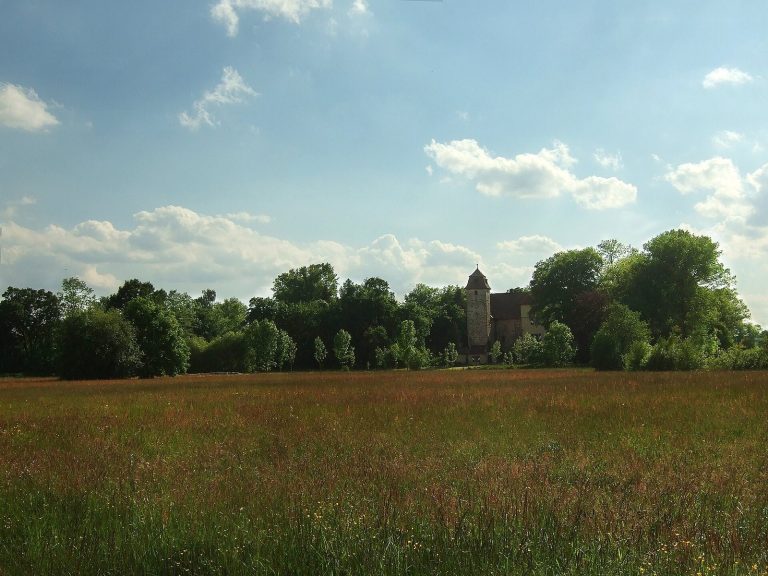
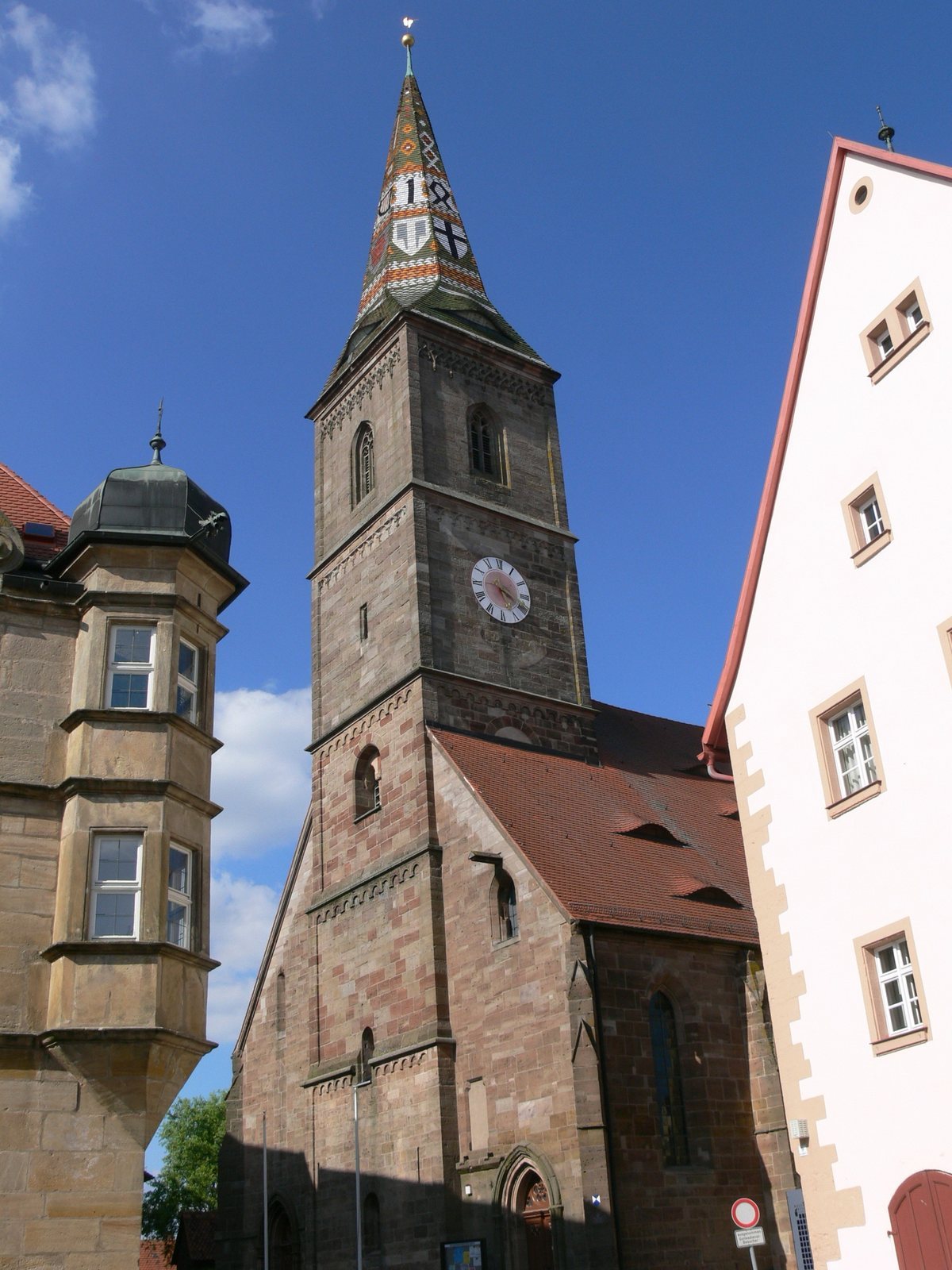
The lowest level of the Romanesque tower belonged to the church consecrated by Bishop Gundekar of Eichstätt, an eleventh-century church leader. Under the Teutonic Order, a medieval religious and military order with territorial and institutional authority in parts of central and eastern Europe, additional tower stories were built between 1220 and 1230. The choir followed around 1250, and the nave was constructed around 1300.
Gothic enlargement and later medieval work
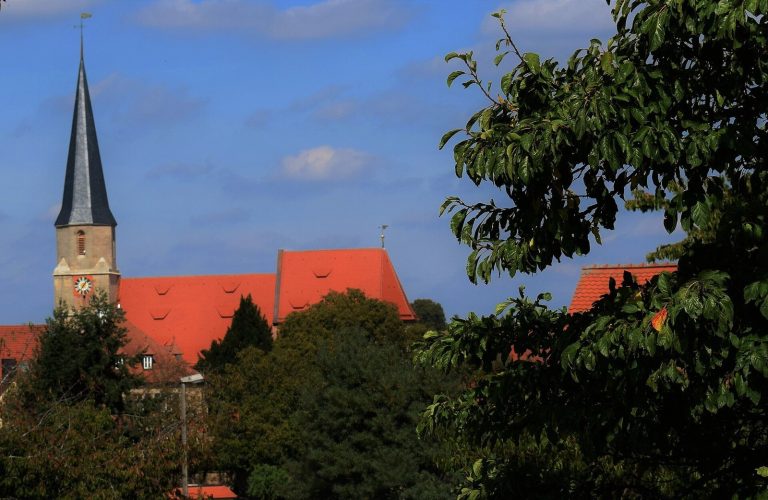
The tower gained two Gothic stories between 1430 and 1440, followed by a pointed helmet covered with glazed tiles in 1465 and 1466. The nave and choir were heightened in 1453 and 1454, changing the proportions of the medieval church. A sacristy was added on the north side in 1481.
Baroque, Neo-Gothic, and modern alterations
Between 1713 and 1719, the Teutonic Order remodelled and redecorated the church in the Baroque style, an approach associated with rich ornament, dynamic forms, and theatrical spatial effects. The work involved master builder Franz Keller, painter Franz Ignaz Roth, and his brother Franz Joseph Roth, a stucco artist who later became an Order master builder. The present Marienkapelle was built in 1749 on the site of an extension that had contained the Order’s library.
A Neo-Gothic remodelling in 1876 and 1878 removed the church’s Baroque architectural elements. The altars, pews, pulpit, and communion rail were renewed in the nineteenth-century revival style. The walls were painted with scenes from the life of Jesus, and the windows received Neo-Gothic stained glass. These elements were removed during another renovation in 1946.
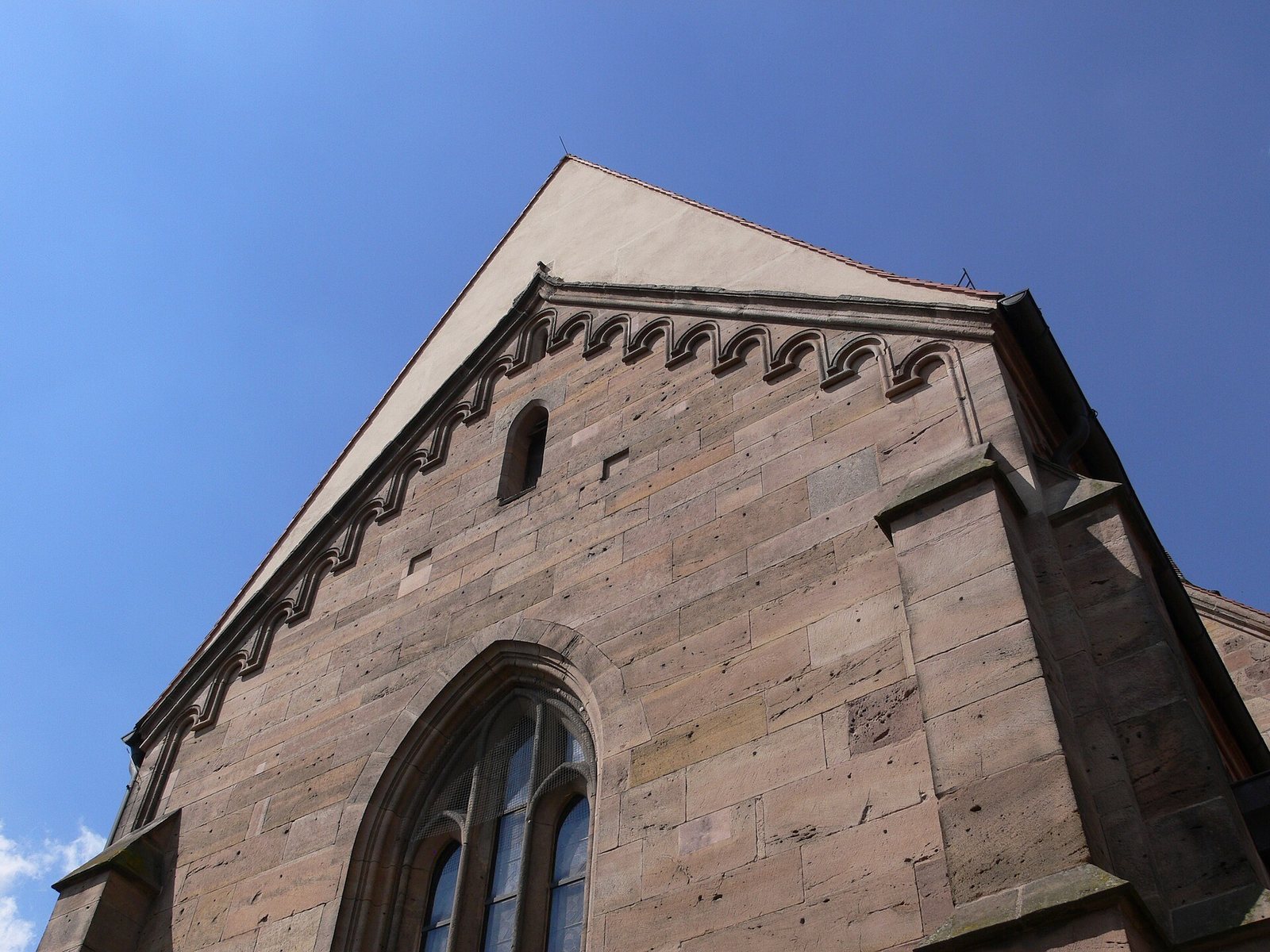
Exterior work from 1985 to 1990 repaired serious damage to the roof structure, strengthened the east gable with additional masonry, and renewed weathered string courses and eaves cornices. A major remodelling in 2000 and 2001 removed the gallery and permanently removed the pulpit. The sanctuary was redesigned, the organ was moved to the northern side aisle with space for the choir, and the central aisle was replaced by a continuous block of pews.
A memorial plaque installed in 1922 commemorates Wolfram von Eschenbach, the medieval German poet who wrote the epic poem Parzival. His grave is said to be inside the church, although its exact location can no longer be identified.
Remains
Layout and medieval fabric
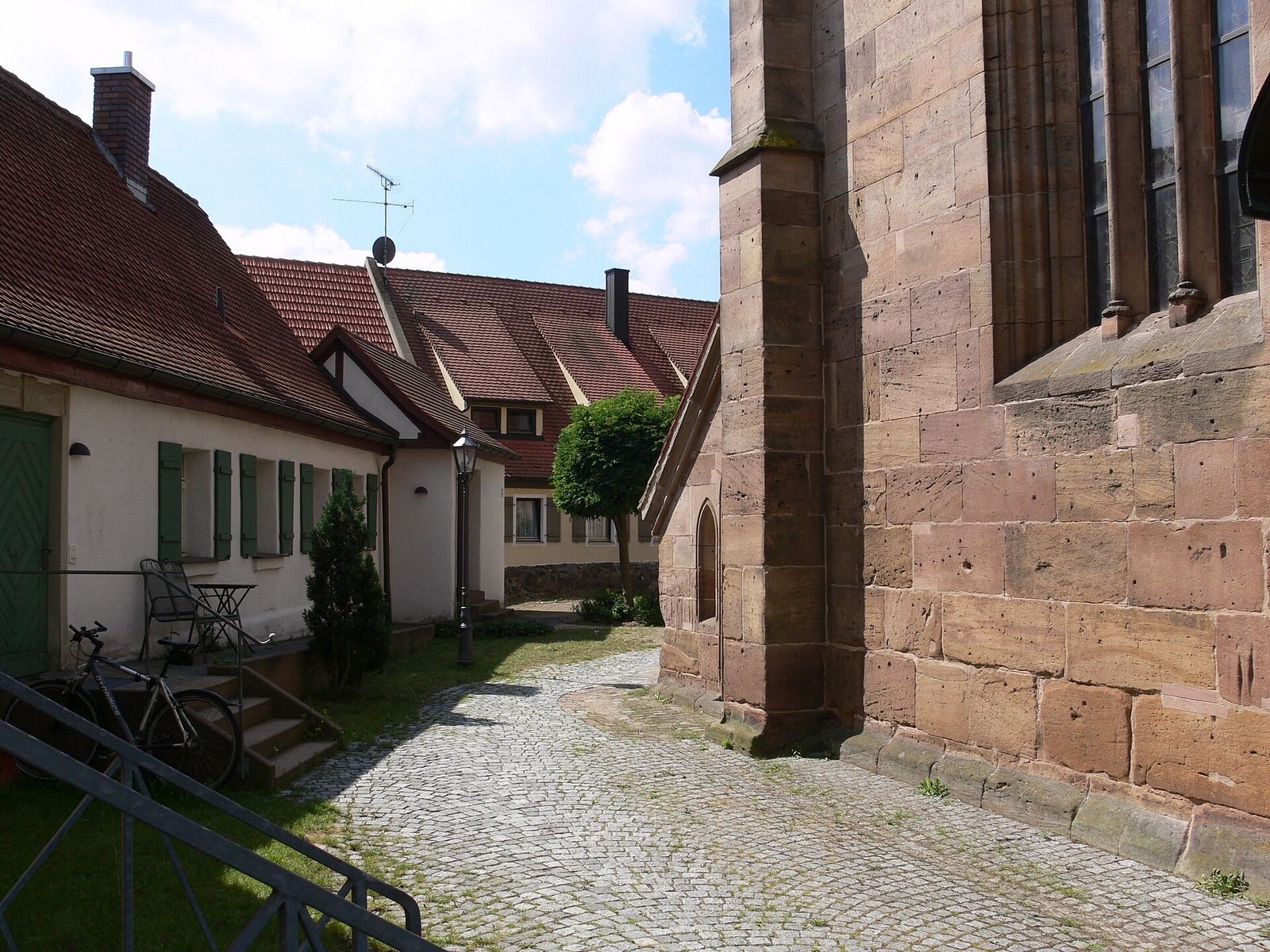
Liebfrauenmünster stands at an elevation of 443 metres above sea level in the centre of Wolframs-Eschenbach’s protected historic ensemble. Its form combines a Romanesque lower tower level with later Gothic tower stories, a pointed glazed-tile helmet, a nave, a choir, northern and southern side aisles, a north-side sacristy, and the Marienkapelle. As a Gothic hall church, its nave and side aisles are approximately equal in height, creating a unified interior rather than a strongly elevated central nave.
The church’s surviving architectural character reflects successive alterations. The tower preserves its Romanesque base and later Gothic upper stages, while the nave and choir retain the enlarged proportions created during the fifteenth-century work. The Baroque remodelling left no surviving Baroque architectural elements after the Neo-Gothic intervention and its reversal in 1946. The exterior roof structure, east gable, string courses, and eaves cornices were repaired or renewed during the late twentieth-century renovation.
Altars and devotional art
Cross-Finding Altar
The Cross-Finding Altar in the southern side aisle dates from around 1490. Its central scene shows Empress Helena, the Christian imperial figure traditionally associated with the discovery of the True Cross, together with her retinue and Makarios of Jerusalem, a fourth-century bishop linked to the same tradition. An adviser and two craftsmen also appear in the scene. The side wings depict the Roman martyrs John and Paul, while their reverse sides show Saints Gangolf and Martin. Martin is dressed as a wealthy Nuremberg patrician. The predella, the lower section of an altarpiece, contains the Fourteen Holy Helpers, a group of saints traditionally invoked for protection against illness and danger.
High altar Pietà
A Late Gothic Pietà dating from 1480 stands on the high altar. The image shows the Virgin Mary mourning over the dead Christ. Figures of Saint Elisabeth and Saint George, made in 1745, flank the Pietà.
Rosary Altar
The northern side aisle contains the Rosary Altar, also known as the “Heavenly Court.” Dated to 1510, it belongs to the school of Veit Stoß, a late-medieval sculptor and woodcarver active mainly in southern Germany and Krakow, and was probably made by members of his workshop tradition. The heavenly host is framed by a rosary, with groups of saints arranged around an oversized cross. These include figures from the Old Testament, the apostles, martyrs, popes and bishops, theologians, virgins, and holy mothers.
Other devotional works
A wooden sculptural group of the Nativity, made around 1500, is placed before the altar during the Christmas holidays. A painting of the Seven Sorrows of Mary hangs in a side chapel and copies the miraculous image at Oberelchingen near Ulm. The chapel’s altarpiece depicts the Assumption of Mary and formerly served as the high-altarpiece image, reflecting the church’s dedication.
A figure of Saint Sebastian stands with a historical votive candle dating from 1700 to 1730. The figure and candle originally came from the cemetery church of Saint Sebastian west of the town. A votive candle is offered in fulfilment of, or as a sign of, a religious vow or petition.
Organ and bells
Organ
The organ in the northern side aisle was built in 1984 as Opus 89 by the Georg Jann workshop in Laberweinting. It has 21 stops distributed across two manuals and a pedalboard. Stops control sets of pipes, manuals are keyboards played by the hands, and the pedalboard is played by the feet.
Bells
The large bell was cast by Georg Herold in Nuremberg in 1629. It has the strike tone E and bears the inscription “IESV CHRISTE FILI DEI VIVI MISERERE NOBIS GEORG HEROLT IN NVRMBERG 1629.” The oldest bell dates from the fourteenth century and has the strike tone G. Between cord mouldings, it bears the names of the four Evangelists and Mary. After the Second World War it was recast and its tone was altered. Three new bells from the Heidelberg bell foundry, with strike tones A, B, and D, were added in 1975.