Rieterkirche: A Late Gothic Parish Church and Rieter Family Memorial in Germany


Site at a Glance
- Rating
- 4.9
- Popularity
- Very Low
- Country
- Germany
- Primary era
- Medieval
- External website
- Open
- Eras represented
- Medieval, Early Modern, Modern
- Civilizations
- German, Holy Roman Empire
- Site type
- Religious
- Remains
- Fortified Church
On this page23 sections
History
Rieterkirche is an Evangelical-Lutheran parish church in Kalbensteinberg, Germany, built in the late Gothic period between the laying of its foundation stone in 1464 and its completion in 1488. Dedicated to the Virgin Mary, it became a pilgrimage church before the Reformation and later a family memorial for the Rieter patricians of Nuremberg. Its survival through fire, war damage, and iconoclasm has preserved an unusually complete group of medieval and early-modern works, giving the church the nickname “Franconian Treasure Box.”
Kalbensteinberg and the Rieter estate
Kalbensteinberg was first mentioned on 20 June 1248, when Pope Innocent IV confirmed the possessions of Roggenburg Abbey there. The abbey initially held about two-thirds of the village’s properties. A series of transfers between 1412 and 1418 eventually led to the estate passing to the Rieter family of Kornburg in 1437 through Klara Wernitzer, the wife of Hans Rieter. The family’s lordship over the village shaped the later history of the church, which became closely associated with Rieter memory, heraldry, and patronage.
A smaller and lower church stood on the site during the fifteenth century. It was dedicated to Mary, Saint Anne, Saint George, and Saint Nicholas. Paul Rieter, who had leased the Kalbensteinberg majorate from his brother Andreas Rieter, laid the foundation stone of the present church on 13 July 1464. Construction continued for more than two decades. The nave was consecrated as a Marian church on 10 September 1469 by Auxiliary Bishop Leonhard Pilhamer. On 5 May 1488, Auxiliary Bishop Jakob Raschauer consecrated the choir, high altar, and completed building. Letters of indulgence helped finance the work.
Pilgrimage and the Reformation
Before the Reformation, the church attracted pilgrims who venerated a terracotta Madonna and Child. Local tradition held that the image had wept blood. Relics associated with Saint Walburga, the 11,000 Virgins, and Saint Christopher were also kept in the church. The Marian dedication is certain, but the date and circumstances of Saint Christopher’s addition as a second patron are unknown. The association was not established before the Reformation and may have resulted from an unreliable nineteenth-century parish description or an error by Pastor Medicus.
The Reformation, a sixteenth-century movement that established Protestant churches across much of Europe, reached Kalbensteinberg in 1542 under Pastor Wolfgang Reutaler, also recorded as Reintaler. Most of the church’s inventory was removed, including much of its earlier Catholic imagery. Catholic pilgrims nevertheless continued to visit the Evangelical church and venerate its Marian figures into the nineteenth century.
Rieter restoration and refurnishing
Between 1609 and 1613, Hans Rieter, an art collector, restored the church and refurnished it with late Gothic works removed from Nuremberg churches during the Reformation. Objects that had belonged to the church before the Reformation and had been stored in its attic were also returned to display. Rieter commissioned new works from Georg Gärtner, Nicolaus Oeller, and the sculptor Christoph Großdietz. The campaign added the pulpit, galleries, family crypt, wooden coffered ceiling, choir-wall frescoes, and a frieze bearing 204 coats of arms.
The nave roof structure was rebuilt because of severe damage. The work cost 2,866 gulden, 5 pounds, and 12.5 pfennigs, paid for through the early Mass foundation in Kornburg, tithes, and parish funds. Fifteen newly made memorial shields were installed, further turning the church into a Rieter family memorial. The heraldic frieze was later covered with whitewash. Parts of it were uncovered during renovations in 1929–1930 and 1990–1992.
Later ownership and preservation
The church survived the Thirty Years’ War without damage. A pastor served the parish again from 1649, and parish registers have been kept from 1654. After the Rieter family became extinct in 1753, ownership passed to Nuremberg’s Heilig-Geist Hospital. Nuremberg lost its patronage rights to the Kingdom of Bavaria during the mediatization of 1806, but regained them in 1818 on the condition that it maintain the church. The city administered the Rieter Foundation until 1970, when the church passed to the Bavarian regional church.
The attic was used for storing grain and hops until the Nuremberg city magistrate prohibited the practice in 1914. In 1955, the church narrowly escaped a fire when neighboring farm buildings burned. Renovations took place in 1929–1930, 1972, and 1990–1992. A comprehensive exterior renovation followed in 2018–2019. The tower and choir were repaired first, then the nave and both roof coverings. Chemical treatment was ultimately used against timber pests after biological control with parasitic wasps proved unsuccessful.
The church is protected as a listed monument in Bavaria, while the building and the underground remains of its medieval predecessor are also protected as an archaeological monument. The surrounding landscape forms part of the protected appearance of the monument, and since 2019 the church has been assessed as a monument of national importance. Long-eared bats and mouse-eared bats nest beneath the roof, and their presence has been included in the species-protection inventory since the 1980s.
Remains
Building and fortified setting
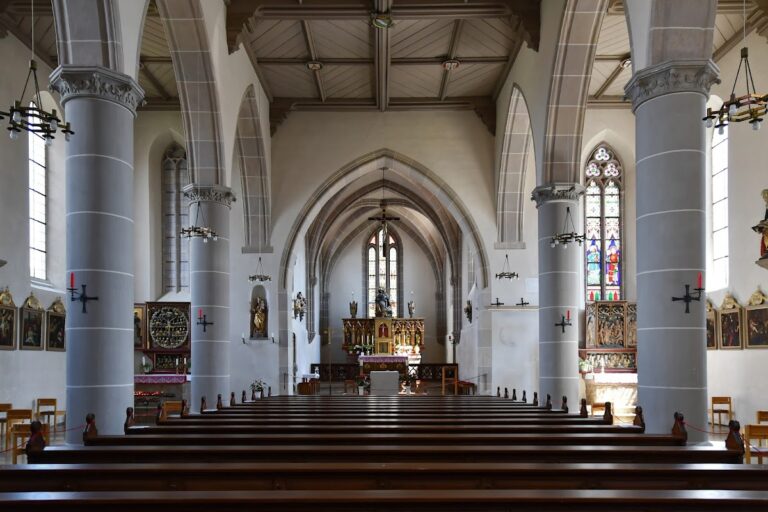
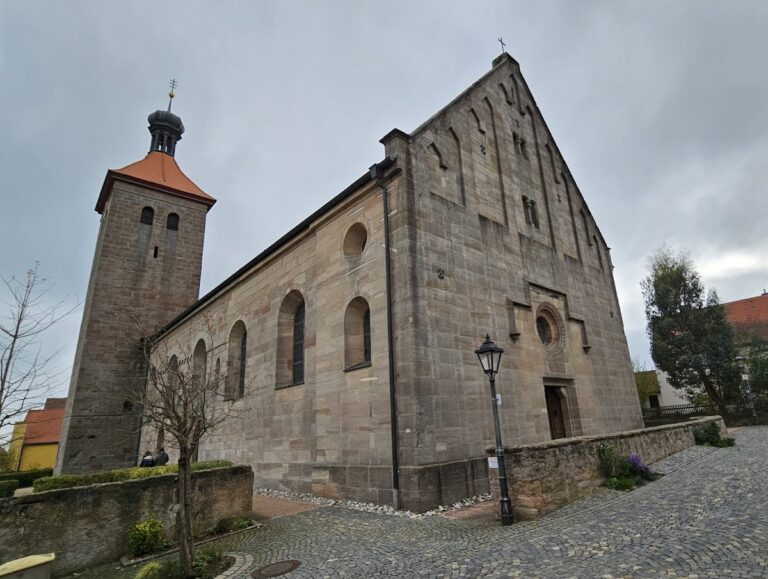
Rieterkirche is a late Gothic single-nave church built from blocks of Rhät sandstone. It has a gabled roof, a west tower, and a raised choir, and stands within a medieval cemetery wall altered in the nineteenth century. The church is classified as a fortified church with a rare independently fortified nave. Including the tower, the building measures 36 metres in length. The nave is 17.6 metres high and 13.8 metres wide, the choir reaches 20.75 metres, and the tower rises 45 metres. A stone plinth and string course run around the building.
Choir and nave
The choir ends in five sides, forming a 5/8 termination, and is covered by a net vault. Five three-light pointed-arch windows have seven rows of glazing and three tracery panels. The choir and the eastern part of the nave, where the side altars stand, are raised by three steps. The rectangular, single-aisled nave has four window bays and a flat wooden coffered ceiling that cuts into the chancel arch. Its central field carries the arms of Hans Rieter and his three wives, together with their names and the year 1620. Three two-part pointed-arch windows with Gothic tracery light each of the north and south walls, and the pointed chancel arch has a chamfered inner edge.
Tower and portals
The lower four tower stories, divided by sloping string courses and pierced by loopholes, date from around 1400 and belonged to the predecessor church. Between 1507 and 1511, an octagonal upper story was added, with round-arched windows filled with tracery and an octagonal spire. The tower was raised above the octagon in 1864. Its Baroque bell frame survives, and the tower stands slightly south of the church’s main axis. A sundial occupies the south wall of the third story, while the story above has clock faces on its south and north sides. A cross with a crescent moon and weather vane crowns the tower.
The south nave portal has a pointed arch, a relief of the Rieter coat of arms, and an inscription naming the foundation-stone date and Marian dedication. The sacristy is attached to the choir’s southwest corner. A newer cemetery lies about 100 metres to the east of the medieval enclosure.
Sacristy and family crypt
Sacristy
The sacristy opens from the choir through a round-arched doorway with a richly moulded surround. The arch panel contains the Rieter arms and the year of the foundation stone. Two narrow vertical windows light the room, whose stellar-rib vault is painted with coats of arms. Wooden panels on the north and west walls list pastors from the late fifteenth century to the present.
Three late sixteenth-century roundels, each 35 centimetres across, are set vertically in the east window. The upper image shows a crowned, haloed, white-haired man beneath the inscription PAX VOBIS. He may represent God the Father or a holy emperor. The other two roundels, made in Zurich, carry the arms and names of Hans Rieter and Katharina Gößwein, with the date 1583. The south window contains a 16-centimetre grisaille, a monochrome painting, probably made in Augsburg around 1500. It shows Christ mourned after removal from the cross, a subject also identified as his Entombment.
Rieter crypt
The Rieter family crypt lies beneath the altar area. Hans Rieter established it around 1609, probably in connection with the death of his first wife, Maria von Imhoff. The barrel-vaulted chamber is reached by a stair behind the high altar. Its former entrance in the choir is sealed by a stone slab dated 1609, fitted with bronze elements and bearing an inscription for Maria von Imhoff, her arms, and four additional heraldic shields.
In 1893, naturally mummified bodies were transferred from deteriorating wooden coffins into thirteen glass coffins, a child’s coffin, and a stone sarcophagus. Those buried there include Hans Rieter, Johann Albrecht Andreas Adam Rieter, the last male member of the family, his wife, who was buried there in 1782 as the last family member, and Anna Catharina von Lindenfels. Her burial in a ball dress is connected with a local legend. The crypt is no longer open for conservation and reasons of respect.
Choir furnishings and memorials
High altar
The Renaissance high altar, made in 1611, is a triptych, an altarpiece with a central shrine and hinged wings. It is reached by five steps. The inner faces of the closable wings show putti’s heads against a white-and-blue sky, while the outer faces carry painted floral scrollwork. The central shrine contains a late Gothic Madonna holding the Christ Child and an apple. She stands within a halo on a downward-pointing crescent moon with a face. The Madonna and the two angels holding a crown above her date from around 1470 and are regarded as Nuremberg works.
A Pietà, representing the dead Christ mourned by Mary, stands above the shrine and dates from around 1470. A Crucifixion group of Christ, Mary, and John crowns the altar, with a date proposed around 1490 or around 1510. Nicolaus Oeller painted the predella, the lower section of an altarpiece, in 1611. It shows Hans Rieter, his three wives, and their children kneeling before a view of Kornburg Castle. The back of the predella bears a 28-centimetre round painting, probably the Nativity of Mary, executed in dark yellow on a dark blue ground.
Choir glazing and paintings
Andreas Rieter donated five choir windows around 1480. Probably made in Nuremberg, they contain three-part pointed-arch windows with decorative tracery and originally held fifteen rectangular painted panes. Thirteen survive. The glazing was restored in 1613, repaired in the mid-nineteenth century, and restored again in 1985 at the Nuremberg workshop of Gottfried Frenzel.
The east window contains Saint Andrew, Saint Veronica with the Veil of Veronica, and Anna Selbdritt, an image of Saint Anne with Mary and the Christ Child. The coats of arms of Andreas Rieter and his wives Veronika Rehm von Bocksberg and Anna von Freyberg appear with emblems associated with four orders. The other windows contain saints who represent Rieter family name saints, including John the Apostle, Margaret, John, Clare, Veronica, and Andrew.
Nicolaus Oeller painted thirteen choir-wall frescoes between 1609 and 1613. They show Rieter family members serving the church in religious vestments, accompanied by their coats of arms and identifying inscriptions. Three historical panels beneath the first three northern frescoes describe events in Kalbensteinberg before the present church was built and display the arms of the Oettingen, Stromer, and Wernitzer families.
Memorials and galleries
The choir contains the epitaph of Anna Catharina von Lindenfels, who died at eighteen. It includes commemorative texts, a girl above an open coffin, three full coats of arms, and a putto. A second epitaph, set into the northeast wall below the choir window, commemorates Johann Albrecht Andreas Adam Rieter. It is made of fossil-bearing Altdorf marble and bears a Latin inscription with an inverted family coat of arms. A memorial stone for the dead of the First World War stands on the southeast choir wall, with names arranged under the years 1914–1918.
A Renaissance-style patron’s gallery is attached to the south choir wall above the sacristy entrance. Another gallery stands on the east wall of the nave above the right side altar. Both have richly carved post-Gothic tracery parapets. A related parapet belongs to a six-part window visible from the choir between the chancel arch and nave ceiling. A painting of Christ made in 1872 hangs above the sacristy entrance and was commissioned to cover the crescent-moon Madonna on the high altar.
Nave furnishings and devotional images
Altars and sculptures
The two side altars beside the chancel arch were made in the early seventeenth century and fitted with late fifteenth-century carvings and paintings probably associated with Michael Wolgemut’s workshop. Each has a central shrine, two pairs of wings, and a lower painted section. The northern altar contains Ursula of Cologne, Ulrich of Augsburg, and Walburga, dating from around 1490–1500. Its painted wings show the Massacre of the Innocents and the finding of the True Cross by Empress Helena. Other panels represent Andrew, John the Baptist, Peter, and Mark. Figures on its cornice represent Oswald, Walburga, and Otmar of Saint Gall.
The southern altar shows the Descent of the Holy Spirit, Wolfgang of Regensburg with a bishop’s staff and church model, and Barbara of Nicomedia with a chalice and Host. Its other panels depict the Ascension, Saint Giles with a doe, and Nicholas of Myra with three loaves on a book. Its cornice carries an armoured knight with a shield bearing the Rieter arms, half-figures of Peter and Mary with the Child, and Saint Sebastian tied to a tree trunk. These figures date from around 1480.
A terracotta Madonna and Child made around 1460 is mounted on the western wall of the chancel arch. It was the object of pre-Reformation pilgrimages and is traditionally said to have shed blood-like tears. Reddish mineral-bearing water seeping from the crown into the face offers a possible physical explanation for the tradition. The figure may have stood in the crypt from 1609 until the period before the First World War.
A late Gothic offering box from the church’s construction period stands at the foot of the chancel arch. It has a twisted column and decorated cuboid head. Above it is an alms panel, an oil painting on copper from around 1600 showing a wealthy man distributing alms. A relief of Saint Ottilia is fixed above the panel, with a relief of Saint Jodocus set diagonally above it. Nearby stands a statue of Saint Margaret, possibly a Swabian work from around 1500 and perhaps connected with the workshop of Veit Stoss. She holds a cross staff, while a dragon crouches at her feet.
Choir stalls and sacrament house
The choir stalls date from 1490 and have carved drolleries and grotesque figures on their seat backs. They probably came from a Nuremberg monastery. Neo-Gothic tracery was added to their dorsals in 1848, along with a tracery superstructure and hanging frieze. The sacrament house on the east side of the north choir wall belongs to the choir’s construction period. Its cabinet is closed by a wrought-iron grille, stands on a double pedestal and pier base, and is crowned by a finial-like structure with crockets and tracery panels.
Nave memorials and Palm Sunday figure
Ten memorial shields hang at window height on each side of the nave. Fifteen were made by Christoph Großdietz in the early seventeenth century, with ten on the south wall and five in the eastern half of the north wall. Five later shields occupy the western half of the north wall, the newest commemorating Johann Ludwig Rieter, who died in 1732. Seven inscriptions without shields are mounted beside the organ on the west wall. Above the entrance hangs a shield attributed to the legendary Kalwenberger nobility and dated 1340. It is a forgery made in 1610, using a sixteenth-century barred helmet.
Beneath the pulpit stands a movable Gothic Palm Sunday figure, or Palmesel, a wheeled sculpture of Christ entering Jerusalem on a donkey. Made in Nuremberg around 1470, it shows barefoot Christ blessing from a naturalistic donkey on a simple wheeled platform. Christ wears a white tunic, a purple cope lined in blue, and a five-pointed leafy crown. Hans Rieter received the figure from his brother Joachim in the early seventeenth century.
Paintings, icons, organ, and bells
Picture cycles and icons
The two-panel work Vita Mariae et Christi is a picture Bible of 56 scenes from the lives of Mary and Jesus. Probably made by a Nuremberg master around 1480–1490, it entered the church in March 1609 as a gift from Anna Regina Rieter, Hans Rieter’s sister. Its painter, precise origin, original function, and possible artistic influences remain uncertain. The work measures 0.97 by 2.75 metres. Its scenes are arranged in four registers of fourteen, beginning with the lives of Mary, Joachim, and Anna and continuing through Christ’s life, Passion, Resurrection, Ascension, Pentecost, Mary’s death, and the Last Judgment.
In a closable wooden shrine beneath the eastern nave window is an icon of Saint Theodore Stratelates, protected from light and environmental damage. Probably painted by a Pskov icon painter around 1573, it entered the church after 1613 by an unknown route and may have been brought from Russia or Poland by Philipp Rieter. The 1.37-by-1.07-metre image is a vita icon, with the saint’s principal figure surrounded by twelve scenes from his life. Johann Alexander Döderlein published a treatise on it in 1724. The engraving in that work is probably the earliest printed depiction of an icon, and the publication is regarded as the beginning of Russian icon studies.
Near the south nave altar hangs a painting of the Twelve Apostles, made around 1500. Matthias replaces Judas and Paul of Tarsus replaces Thaddeus, while Christ as Salvator mundi, or “Saviour of the World,” occupies the centre with a globe. The painting probably served as a high-altar predella before the Reformation and was heavily overpainted in the early seventeenth century. Beside it is a painting of the Fourteen Holy Helpers, saints traditionally invoked together for protection from illness and danger. Probably made by Hans Leonhard Schäufelin at the beginning of the sixteenth century, it may also have served as an altar predella. Its image of Christopher is the only representation of the church’s second patron in the building.
Organ and bells
The church first received a small positive organ during the refurnishing of 1609–1613. Johann Andreas Rieter donated a replacement after that instrument became unplayable. Another organ was acquired in 1790, followed by an instrument made by G. F. Steinmeyer & Co. in 1899. The present organ was installed in 1994 by Deininger & Renner of Oettingen, using the 1899 Neo-Gothic case. It stands on the west gallery and underwent cleaning, adjustment of its key-to-pipe connections, and renewal or tonal improvement of some stops from 2022.
A bell weighing 18 hundredweight and 81 pounds was hung in the tower in 1469. Further bells were acquired in 1540, 1541, 1571, and 1729. The 1541 noon bell, the largest, was recast in 1892 after cracking. The medium-sized 1540 eleven-o’clock bell is the only historic bell still preserved. The prayer bell and community bell were melted for wartime purposes in 1917. Replacement bronze bells were consecrated in 1924, while two further replacement bells from Heidelberg, a noon bell and a prayer bell, were consecrated on 26 September 1954 after the Second World War requisitioning of the other bells.
Nearby sites