Prieuré de Saint-Rémy: A Benedictine Priory in France


Site at a Glance
- Rating
- 4.5
- Popularity
- Low
- Country
- France
- Primary era
- Medieval
- External website
- Open
- Eras represented
- Medieval, Early Modern, Modern
- Civilizations
- French
- Site type
- Religious
- Remains
- Monastery
On this page10 sections
History
Prieuré de Saint-Rémy is a former Benedictine priory in France, located at Saint-Rémy-la-Varenne in Brissac Loire Aubance beside the Loire. Fulk the Red, the tenth-century count of Anjou, gave the domain in 929 to Saint-Aubin Abbey and the Chapter of Saint-Lézin, establishing the religious foundation that grew into one of Anjou’s wealthiest estates and later one of the region’s most important priories.
Foundation and medieval development
The church was built first, followed soon afterward by the refectory, the communal dining hall of the religious community. Fragments of sarcophagi were reused in both buildings, pointing to an earlier pagan cemetery on the site. A dispute between the two owners ended in 1014, when the domain became the sole property of Saint-Aubin Abbey.
The Saint-Aubin cartulary records that the foundation was functioning as a priory by 1157. Governed according to the Rule of Saint Benedict and subordinate to the abbey, it acquired numerous dependencies in the surrounding region. These holdings made the priory an important source of income for Saint-Aubin Abbey.
Renaissance transformation
Mathurin Legay de la Hamonnière, prior from 1510 to 1541, undertook major embellishment works. Under his direction, the religious complex was gradually reshaped into a manor inspired by the Loire chateau tradition. From 1540 to 1541, he also served as a suffragan, an ecclesiastical deputy to the bishop of Angers.
Decline, division, and restoration
The domain was leased from 1670. The priors then ceased to live there permanently, although they retained the use of several rooms during visits. During the French Revolution, the estate was confiscated and sold as national property, meaning property taken and sold by the revolutionary state, for 85,600 livres.
The estate was divided into several lots in 1845. The presbytery was separated from the priory residence, while the church had already been independent for several centuries. The priory residence was divided into rented dwellings. In 1823, the domain had been donated to the church fabric of Saint-Rémy-la-Varenne, the institution responsible for administering a church’s property and finances, which commissioned a new presbytery in 1847.
In 1989, pressure from the municipality led to the sale of the badly deteriorated monument below its market value. Horticulture enthusiasts then founded the Association du Prieuré de Saint-Rémy-la-Varenne to restore it. Their events included Les Hortomnales, a pumpkin festival that made the squash a symbol of the monument. Successive restoration projects gradually recovered the complex’s structural stability and Renaissance appearance. The medieval fresco was classified as a historic monument in 1955, and the entire priory received the same protection in 1957. The site is now owned by the municipality of Brissac Loire Aubance.
Remains
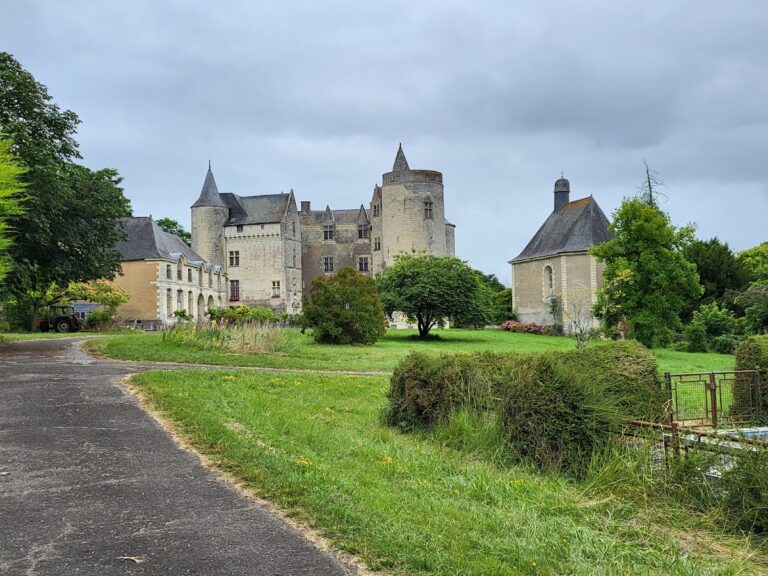
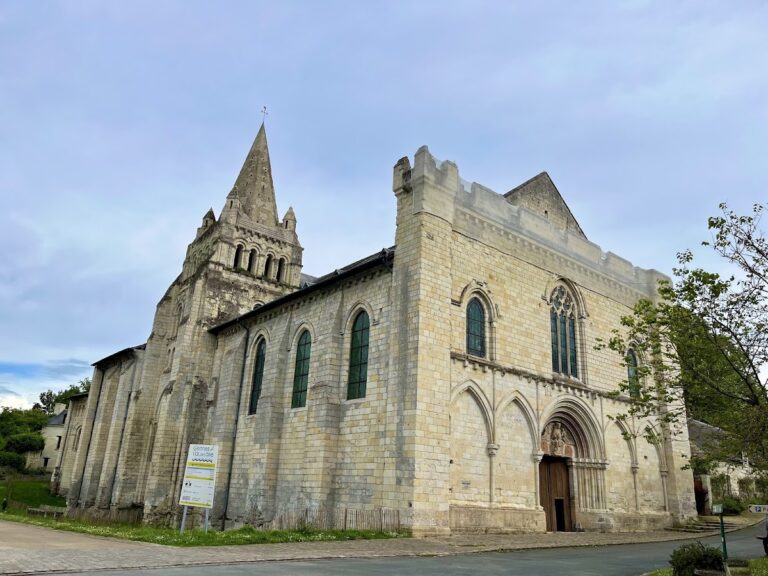
The surviving priory stands beside the Loire and is organized around four principal components: the church, the refectory, the priory residence, and the nineteenth-century presbytery. Its buildings preserve evidence of medieval religious use alongside later domestic and Renaissance alterations.
Medieval religious buildings
Church
The church belongs to the earliest building phase of the priory. It was erected before the refectory, and fragments of sarcophagi were incorporated into its construction. These reused stone elements relate the building to the earlier pagan cemetery identified at the site.
Refectory
The refectory contains a well-preserved medieval wall painting created between 1150 and 1175. This Crucifixion fresco, a wall painting showing Christ’s crucifixion, presents Christ on the cross with Mary and John mourning below or beside him. The cross is green, expressing life, and is framed with gilding associated with Christ’s victory over death.
The composition also includes the triumphant Church over the Synagogue. In medieval Christian art, these figures personify Christianity and Judaism, and their arrangement expresses a Christian theological interpretation. Beneath the Crucifixion is the Virgin and Child between two bays that have since been blocked. A geometric city appears between the two scenes, although its meaning remains unresolved.
Priory residence
The priory residence was built in the thirteenth century and was originally twice as wide as the surviving building. A fire at the end of the fifteenth century destroyed its southern section. The remaining structure was then raised by an additional storey, changing the form of the residence before its later Renaissance embellishment.
A polychrome fireplace, meaning a fireplace decorated in several colours, was installed between 1520 and 1530. It uses red, black, ochre, and blue, and is divided into fifteen compartments. Each compartment contains a different scene, including human and sometimes mythological figures as well as flowers. Some panels retain an uncertain meaning.
Early-sixteenth-century wall paintings with related themes and colours accompanied the fireplace. When the residence was divided into dwellings in the mid-nineteenth century, a thick layer of lime was applied over the walls and fireplaces to conceal the Renaissance decoration. This covering indirectly preserved the wall decorations, among other elements, in very good condition. Restoration of the polychrome fireplace in 2013 recovered its original colours and clarified the meaning of some previously enigmatic panels.
Presbytery
The nineteenth-century presbytery forms one of the principal surviving components of the former estate. It was commissioned in 1847 after the domain had been donated to the church fabric of Saint-Rémy-la-Varenne and remained physically distinct from the priory residence after the estate was divided into separate lots.