St. Hilarius: A Baroque Parish Church in Freiburg im Breisgau
Site at a Glance
- Rating
- 5
- Popularity
- Very Low
- Country
- Germany
- Primary era
- Early Modern
- External website
- Open
- Eras represented
- Medieval, Early Modern, Modern
- Civilizations
- German, Holy Roman Empire
- Site type
- Religious
- Remains
- Church
On this page14 sections
History
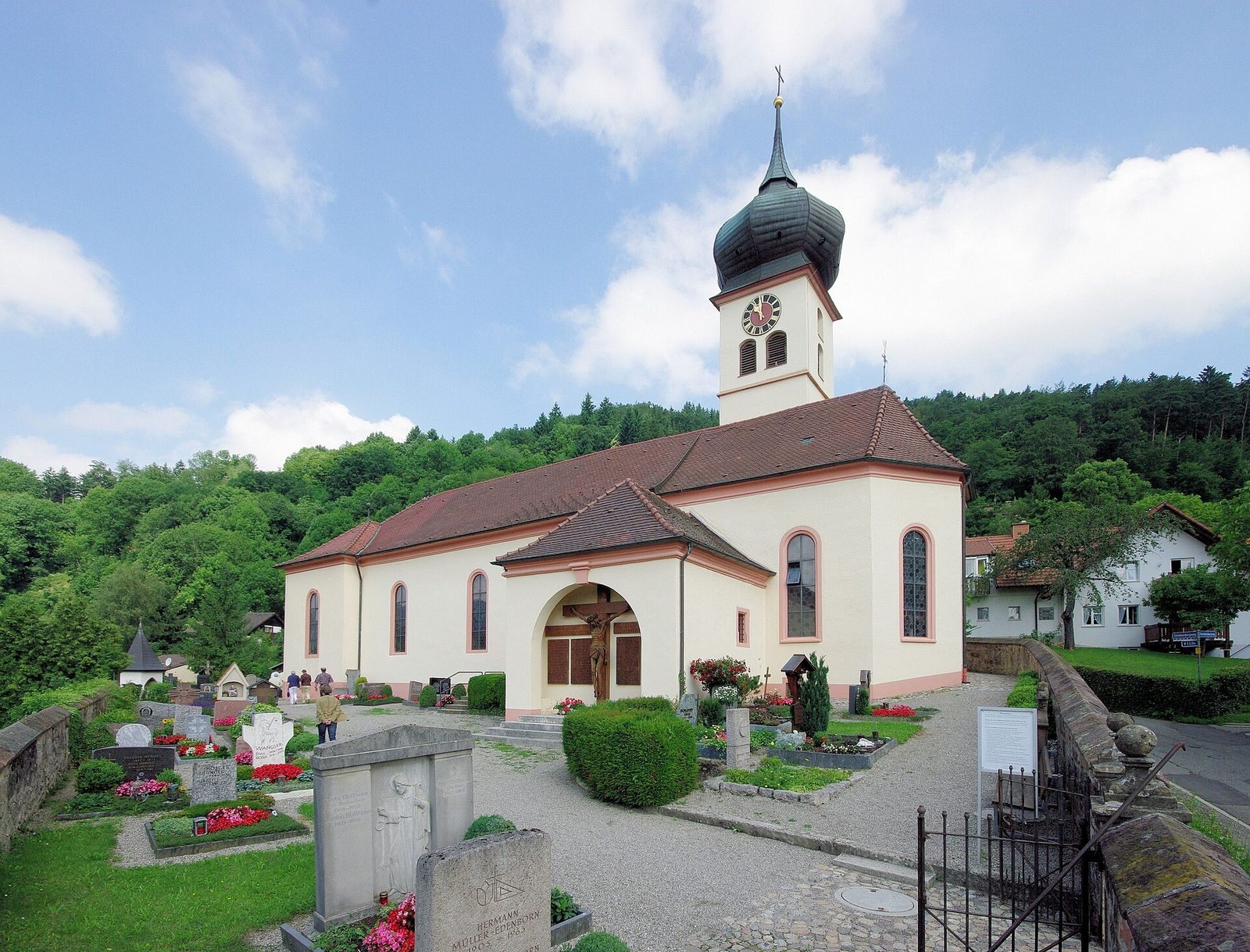
St. Hilarius is a Roman Catholic parish church in Ebnet, a district of Freiburg im Breisgau, Germany. Built between 1720 and 1725 in the Baroque period, it is regarded as the oldest Baroque rural church in the Breisgau. Its joint patronage of Saint Hilarius and Saint Remigius, Christian bishops venerated as saints, is documented from 1583.
Medieval origins and parish foundation
The church was first recorded in 1275 as a filial church of Kirchzarten, meaning that it depended on that parish. A consecration may have taken place in 1463, while the predecessor building is dated to 1473. The Baroque church later rose on the foundations of this Gothic predecessor, retaining parts of the earlier building.
Ebnet and its church belonged to the lordship of the Falkenstein family, which for a period held the village jointly with the Schnewlin-Landeck family. In 1631, the Sickingen family separated the Falkenstein chaplaincy foundation from the mother parish of Kirchzarten. This created an independent parish and established St. Hilarius as its parish church.
The Baroque rebuilding
Baron Ferdinand Hartmann von Sickingen initiated the construction of the present church between 1720 and 1725. Ferdinand Sebastian von Sickingen-Hohenberg commissioned its interior decoration. Benedikt Gambs carried out the decoration and later died in Ebnet, where he was buried in the church and commemorated by a memorial tablet.
In 1725, the ossuary was demolished to make room for the Sickingen family burial crypt. When a warm-air heating system was installed in the choir, the crypt was opened. The remains of eight adults and seven children were found and reburied together in a concrete sarcophagus after the coffins had decayed.
The church was enlarged between 1904 and 1908, an intervention that removed the eighteenth-century western porch. Further renovations took place in 1979 to 1981 and in 1998. A second memorial tablet commemorates Bonaventura Josef Schweizer, who was born in Ebnet, became superior general of the Salvatorians, the Society of the Divine Savior, participated as a synodal member in the Second Vatican Council, and was made an honorary citizen of Ebnet.
People and bells associated with the church
On 14 September 1756, Franz Fridolin Weber, an official, married Maria Cäcilia Cordula Stamm at St. Hilarius. They were the parents-in-law of Wolfgang Amadeus Mozart.
Ferdinand Hartmann von Sickingen and his wife, Maria, Countess von Pappenheim, donated the church’s three bells in 1699, two years after their marriage. Plans for a larger fourth bell in the nineteenth century were abandoned after the archiepiscopal building authority raised substantial structural concerns.
The bells survived both world wars without permanent loss. Their artistic and historical value protected them from requisition during the First World War. During the Second World War, the two smaller bells were taken to a collection depot. In 1945, August Feyel, the Ebnet school principal, organist, and choir director, found them there and arranged for their return to the tower.
Remains
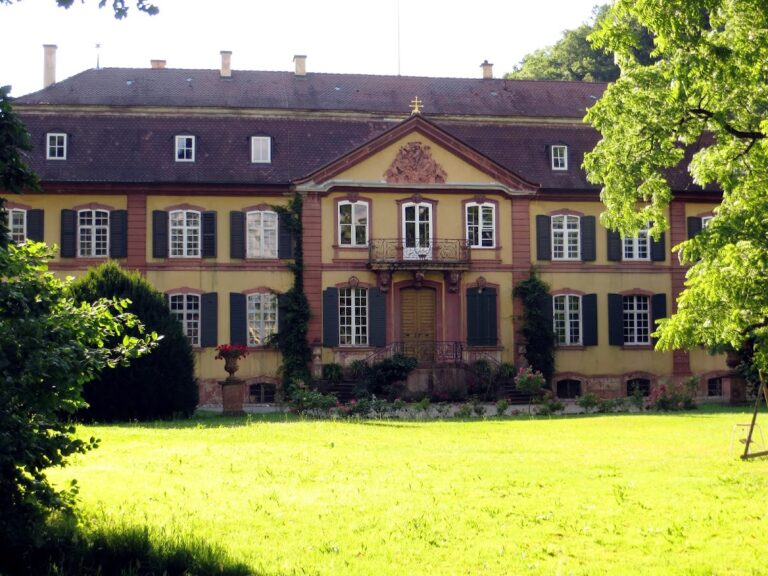
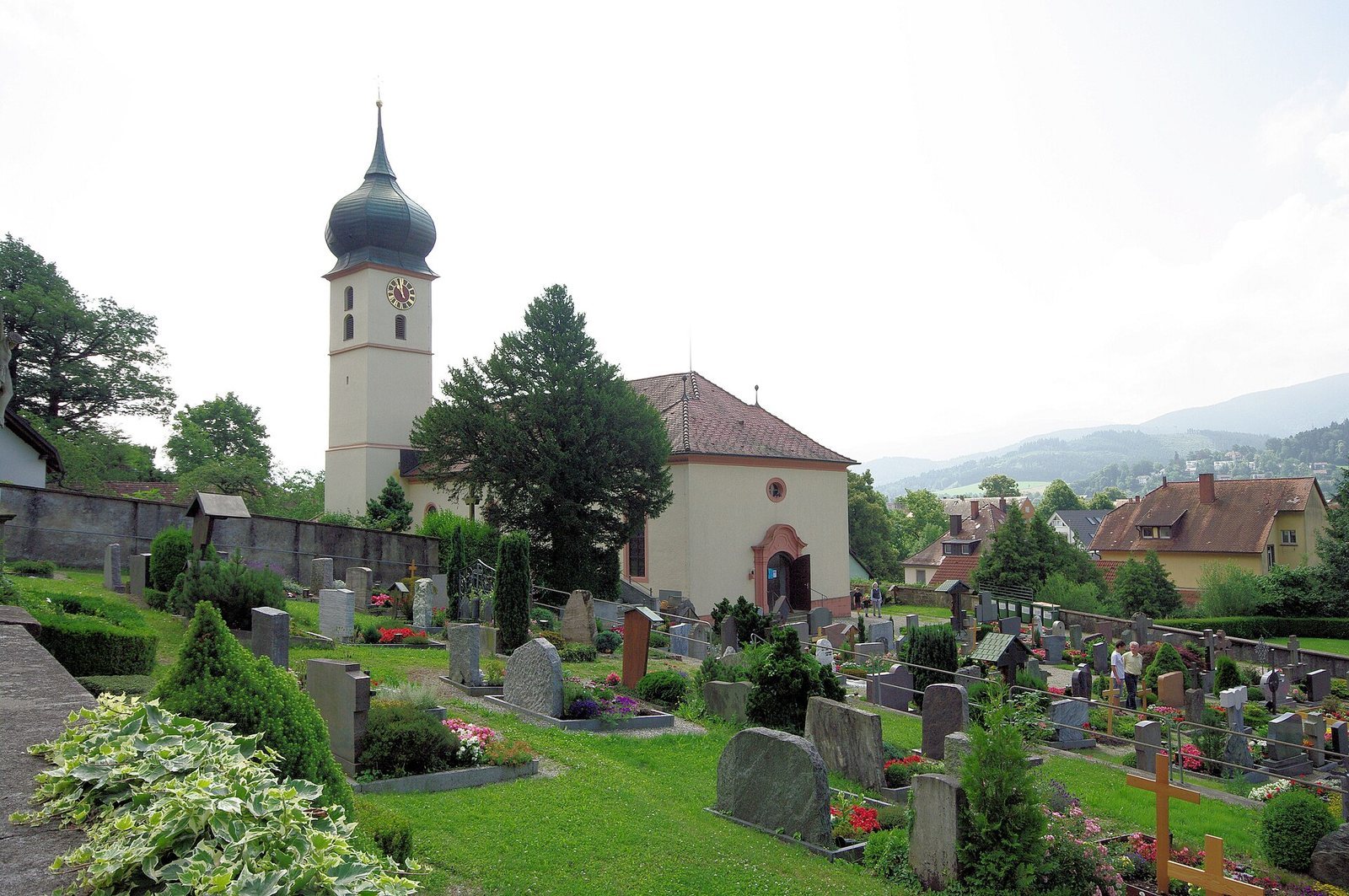
St. Hilarius stands above the village on a hillside rather than in the village center. Together with Ebnet Castle in the Dreisam valley, the church forms a counterpart to the castle. Its Baroque nave follows the foundations of the Gothic predecessor, while surviving earlier fabric and later additions record the building’s successive phases.
Church interior
Nave and decoration
Franz Hamm, a Freiburg master builder and stonemason, designed the nave. Franz Joseph Vogel executed the stucco work, while Benedikt Gambs created the interior decoration. Some figures and the sacrament tabernacle, a furnishing used to reserve consecrated Eucharistic elements, were made by the woodcarvers Matthias Faller and Franz Xaver Hauser. The tabernacle itself survives from the 1473 church.
High altarpiece
The high-altarpiece was painted in 1730 by Franz Bernhard Altenburger. Its signed inscription gives his name and the year of painting. The scene shows Hilarius and Remigius beneath the Virgin Mary and the Trinity. Three angelic children unfurl a view of Ebnet below them, including the village and castle before the castle’s later rebuilding. The painting consequently preserves a visual record of the settlement’s earlier appearance.
Crypt and memorial tablets
The Sickingen-Hohenburg family crypt forms part of the church’s surviving interior furnishings. The remains recovered during the heating installation were placed together in a concrete sarcophagus. Memorial tablets commemorate Benedikt Gambs and Bonaventura Josef Schweizer.
Organ
The organ was built in 1961 by Gebrüder Späth Orgelbau of Ennetach. It has two manuals, a pedal, and 18 stops, with each stop forming an individually voiced sound group. Mönch Orgelbau of Überlingen rebuilt the instrument in 1981.
Bell tower
Historic bells
All three bells were cast in Ebnet in 1699 by Ignaz Joseph Thouvenet, an itinerant bell-founder from Lorraine. The casting took place on the estate of Mathias Hettich, directly beside the parish house. An inscription identifies the founder, the place, and the year. The bells remain in the positions planned for them and hang in a historic bell frame, the timber structure that supports and operates swinging bells. Its wooden headstocks are decorated with small carvings.
Largest bell
The largest bell carries the donors’ names, the Sickingen alliance coat of arms, and a floral ornament. Its Latin inscription, Sit nomen Domini benedictum, means “Blessed be the name of the Lord.” Relief figures represent the church’s patrons, Bishops Hilarius and Remigius, together with Mary surrounded by rays, the martyr Aurelia, Saint Anne with the Virgin and Child, and Saint Sebastian. The two smaller bells have considerably simpler decoration.
Clock and striking mechanism
The tower has clock faces with Roman numerals on two sides. All three bells are connected to the striking mechanism. The largest marks the hours, while the two smaller bells mark the quarter-hours.