Dreifaltigkeitskirche Kappl: A Baroque Trinity Pilgrimage Church in Germany


Site at a Glance
- Rating
- 4.7
- Popularity
- Medium
- Country
- Germany
- Primary era
- Early Modern
- External website
- Open
- Eras represented
- Early Modern
- Civilizations
- Holy Roman Empire
- Site type
- Religious
- Remains
- Church
On this page10 sections
History
Dreifaltigkeitskirche Kappl is a Roman Catholic pilgrimage church in Germany, built in the Baroque period between 1685 and 1689 on the site of an earlier pilgrimage chapel near Waldsassen. Dedicated to the Holy Trinity, the Christian doctrine of one God existing as Father, Son, and Holy Spirit, it stands on territory formerly belonging to the imperially immediate Cistercian Abbey of Waldsassen. The church is a protected monument in Bavaria and is associated with the Archdiocese of Munich and Freising.
Origins of the pilgrimage
Tradition places the beginning of the pilgrimage near a grazing area used by the brothers of Waldsassen Abbey. A lay brother attached an image of the Trinity to a tree, and the image soon gained a reputation for miraculous powers. A wooden shelter was built around it, both to protect the image and to give increasing numbers of pilgrims a place for prayer.
Under Abbot Daniel, the head of Waldsassen Abbey, a predecessor pilgrimage church was constructed during the second half of the twelfth century, with the building work placed between 1161 and 1194. The earlier buildings later suffered destruction and decay during the Hussite Wars, the Landshut War of Succession, the Reformation, the secularization of Waldsassen Abbey between 1571 and 1669, and the Thirty Years’ War. Repeated restoration followed these periods of damage.
Decline and revival
Protestant and later Calvinist influence weakened the pilgrimage and reduced the use of the chapel. The pilgrimage revived after recatholicization began in the Upper Palatinate in 1626. The Thirty Years’ War nevertheless brought extensive destruction to the Waldsassen area, affecting the renewed religious activity around the site.
A healing said to have taken place at the chapel in 1644 attracted considerable attention. In the following years, a modest new pilgrimage chapel was built, probably between 1645 and 1648. After the Thirty Years’ War, the pilgrimage flourished, and this chapel soon proved too small for the number of worshippers it attracted.
Construction of the present church
The parish priest Paul Eckhart responded by deciding to build a larger church on the same site. Georg Dientzenhofer, a leading Baroque architect and builder known for centralized church designs, designed and directed the work from 1685 to 1689. The new church was constructed around the approximately forty-year-old chapel. That earlier building was demolished only after the central vault of the new church had been completed. Dientzenhofer died in 1689, shortly before the church was finished.
The church was solemnly dedicated in 1711 by Albert Ernst von Wartenberg, an auxiliary bishop associated with the Diocese of Regensburg. Its design and decoration repeatedly use groups and arrangements of three, presenting the doctrine of the Trinity through the building’s formal structure as well as its imagery.
Fire and later restoration
A roof fire in 1880 destroyed the original Baroque ceiling frescoes and the old bells. The bells were replaced, while new ceiling frescoes were painted between 1934 and 1940 by Oskar Martin-Amorbach. These paintings imitate Baroque decoration. One fresco representing mercy includes soldiers, among them members of the Wehrmacht, the unified armed forces of Nazi Germany from 1935 to 1945, as merciful Samaritans. Their appearance in this religious scene is incongruous.
Remains
Setting and exterior
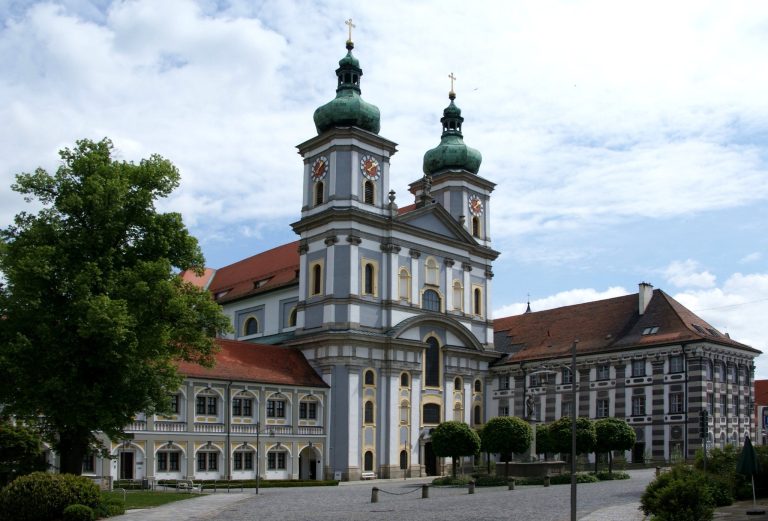
Dreifaltigkeitskirche Kappl is a centralized Baroque building in a saddle-shaped depression between Glasberg and Dietzenberg, in the Kappl district of Waldsassen. It stands at approximately 599 metres above sea level, near the roughly 600-metre-high Glasberg in the Kohlwald. The exterior gives visible form to the church’s Trinitarian program through three towers and three roof riders, each crowned with an onion dome.
Centralized interior
The interior is organized around a centralized plan rather than a single longitudinal axis. Three apses, or shell-like recesses, are arranged around an imagined equilateral triangle. Three hemispherical domes span the principal areas, while three columns occupy the corners of the ground plan. Nine altars are arranged in three groups of three. The ceiling frescoes painted by Oskar Martin-Amorbach from 1934 to 1940 show God the Father, God the Son, and the corporal and spiritual works of mercy. The high-altar painting also preserves an earlier visual record of the 1640s chapel, depicting it with a tower.
Organ
The organ was built between 1734 and 1738 by the Bohemian builders Joh. Franz Fasmann, David Schmidt, Hans A. Pleyer, and Leopold Goll of Elbogen. It has twelve registers, which are selectable sets of pipes, distributed across two manuals, the hand-played keyboards, and a pedal keyboard operated by the feet. Eight registers are original, while four were newly made in 2020 after historical models. The instrument retains the short octave, an earlier keyboard arrangement that conserved space by omitting or reassigning certain bass notes.
The organ’s design extends the church’s use of the number three. It rests on three wall columns, and its gallery shell has three fields, as do the railings on either side. Its three divisions consist of two manuals and a pedal. The instrument contains 666 pipes, arranged as two sets of 333. The smaller positive division has three registers, the case has three towers, and three fields appear on each side of the central tower. Figures of Faith, Hope, and Love stand on the towers. Faith holds a cross, while Love has atypical attributes.
Dlabal and Mettler in Bílsko, in the Czech Republic, restored the organ in 2020, and it was dedicated on 26 July of that year.
Bells
After the 1880 fire destroyed the earlier bells, bell-founder Anton Spannagl produced a new three-bell peal tuned to f1, g1, and a1. The largest bell was requisitioned for military purposes during the Second World War and melted down. In 1968, the Passau foundry Perner cast its replacement with the strike note c2. The three bells are distributed among the church’s three towers.