Waldsassen Abbey: A Cistercian Monastery in Germany
Site at a Glance
- Rating
- 4.8
- Popularity
- Very Low
- Country
- Germany
- Primary era
- Early Modern
- External website
- Open
- Eras represented
- Medieval, Early Modern, Modern
- Civilizations
- Electorate of Bavaria, German, Holy Roman Empire
- Site type
- Religious
- Remains
- Fortified Monastery
On this page16 sections
History
Waldsassen Abbey is a Cistercian monastery in Waldsassen, Germany, founded around 1133 in the early twelfth century under the association of Margrave Diepold III of Vohburg. Dedicated to the Virgin Mary, it was settled by monks from Volkenroda Abbey in Thuringia and belonged to the institutional lineage of Morimond Abbey. Its position in the Upper Palatinate, within the Diocese of Regensburg, helped it become a major religious, political, and economic center.
Foundation and Imperial Authority
In 1147, King Conrad III granted Waldsassen direct subjection to the emperor, making it an Imperial Abbey. This status gave the monastery an unusually autonomous political and judicial position within the Holy Roman Empire. The abbey developed extensive territorial, judicial, colonizing, and economic activities, although its growth brought it into conflict with the nearby imperial city of Eger, now Cheb.
Waldsassen also extended the Cistercian network through daughter foundations. It founded or supplied the communities of Sedlec in Bohemia during the 1140s, Walderbach in 1166, and Osek in 1194. These monasteries retained particularly close connections with Waldsassen until the Hussite period, when religious and military upheavals disrupted many of the region’s established relationships.
Expansion of the Stiftland
The abbey’s territorial lordship, known as the Stiftland, expanded through a series of acquisitions. Tirschenreuth came under its control in 1217 and became the secular center of the territory. Falkenberg and Liebenstein followed in 1294 and 1295, Wiesau in 1297, and the Hohenstein provostship in 1442. In 1515, Waldsassen acquired Neuhaus from the Leuchtenberg family. The Schönbacher territory had been sold in 1348, and an attempt to reverse that sale failed.
Much of this territory was administered by ministeriales, medieval officials who acted as administrators, judges, and sometimes military servants. They occupied existing fortified residences or newly constructed ones, several of which were later converted into castles. Pope Lucius III confirmed the abbey’s extensive landholding and income in 1185.
Political Change and War
From the early fifteenth century, Waldsassen’s political protection shifted from the kings of Bohemia to the Counts Palatine. King Sigismund recognized this change in 1414. Around 1400, a dispute produced three simultaneous abbots, a schism that was resolved by the Council of Constance in 1415.
The monastery suffered repeated attacks during the Hussite conflicts, a series of religious and military struggles associated with the reform movement of Jan Hus, and during the Landshut War of the Succession from 1503 to 1505. Hussite forces burned Waldsassen in 1430 while retreating through the Upper Palatinate. The buildings were burned again during the Bavarian conflict around 1504, after which rebuilding included a church consecrated in 1517.
In May 1525, during the German Peasants’ War, rebels stormed and plundered the monastery after Abbot Nikolaus V Seber fled to Eger. Palatine forces occupied it temporarily in 1537 and imprisoned the Catholic Abbot Georg III Agmann. Emperor Charles V then appointed secular administrators to govern the former monastic territory.
Lutheran Administration and Restoration of the Abbey
Waldsassen became Lutheran in 1569 under the Palatine administrator Reichard. From 1571 to 1669, it functioned as a Palatine administrative office, and its territory remained Lutheran for three generations. Partial sales reduced the former estates. Although the monastery later regained its abbey status, it did not recover Imperial immediacy because the territory was then ruled by the Bavarian elector.
In 1617, the monastery buildings briefly accommodated Frederick V of the Palatinate, later called the Winter King, and his entourage as they travelled through Eger to Prague for his coronation as King of Bohemia. The buildings were already in poor condition after plundering and a fire caused by Swedish Protestant troops in 1647.
After the Thirty Years’ War and the subsequent re-Catholicization of the region, Cistercian monks from Fürstenfeld resettled Waldsassen in 1661. The monastery became a priory in 1669 and returned to abbey status in 1690 under Abbot Albert Hausner. Its former property and income were restored, although its earlier imperial position was not.
Baroque Rebuilding
A major Baroque rebuilding campaign began in 1681. Abraham Leuthner and the Dientzenhofer brothers were involved in the work, which replaced buildings damaged by war and fire. The new church was solemnly consecrated in 1704, and the library was completed in 1727. This rebuilding began a second period of religious, cultural, and economic prosperity for Waldsassen.
Secularization and Industrial Use
Bavaria dissolved Waldsassen Abbey in 1803 during secularization, the transfer of ecclesiastical property to the state. At that time, the Stiftland covered about 715 square kilometers and included approximately 20,000 subjects, the town of Tirschenreuth, Hardeck Castle, six market towns including Waldsassen and Konnersreuth, and more than 150 other settlements. The former monastic property passed to the Bavarian state, while the monastery church became Waldsassen’s parish church.
In 1828, the Eger merchant Wilhelm Rother acquired parts of the complex and established a factory there. The business first produced cotton goods and later specialized in felt, cloth, and footwear. It continued until 1863 and helped reduce economic hardship in Waldsassen and neighboring settlements.
Refoundation and Modern Heritage
On 18 December 1863, the monastery was refounded as a Cistercian nuns’ priory under the Diocese of Regensburg. Nuns from Landshut-Seligenthal established the new community, with Superior Cäcilia Schmid and the administrator Michael Lorenz playing important roles in the refoundation. The community became an independent abbey in 1925.
Since 1949, Waldsassen has been a place of veneration for the mutilated wooden figure known as the Christ of Wies. The figure came from a former pilgrimage church in Wies, Bohemia, demolished during the construction of border fortifications. It was found at a nearby border barrier and brought to Waldsassen, where it has been especially venerated by petitioners from the Egerland.
Since the mid-1990s, the complex has undergone its first comprehensive restoration since the Baroque period. The work addressed buildings threatened by decay and accompanied the creation of a guesthouse and a cultural and meeting center. Since 2008, a foundation company has operated the complex and its cultural center, as well as a private Roman Catholic girls’ secondary school where Cistercian sisters teach. The former monastery also belongs to the Cisterscapes group of landscapes associated with Cistercian monasteries, included in the European Heritage designation on 17 April 2024.
Remains
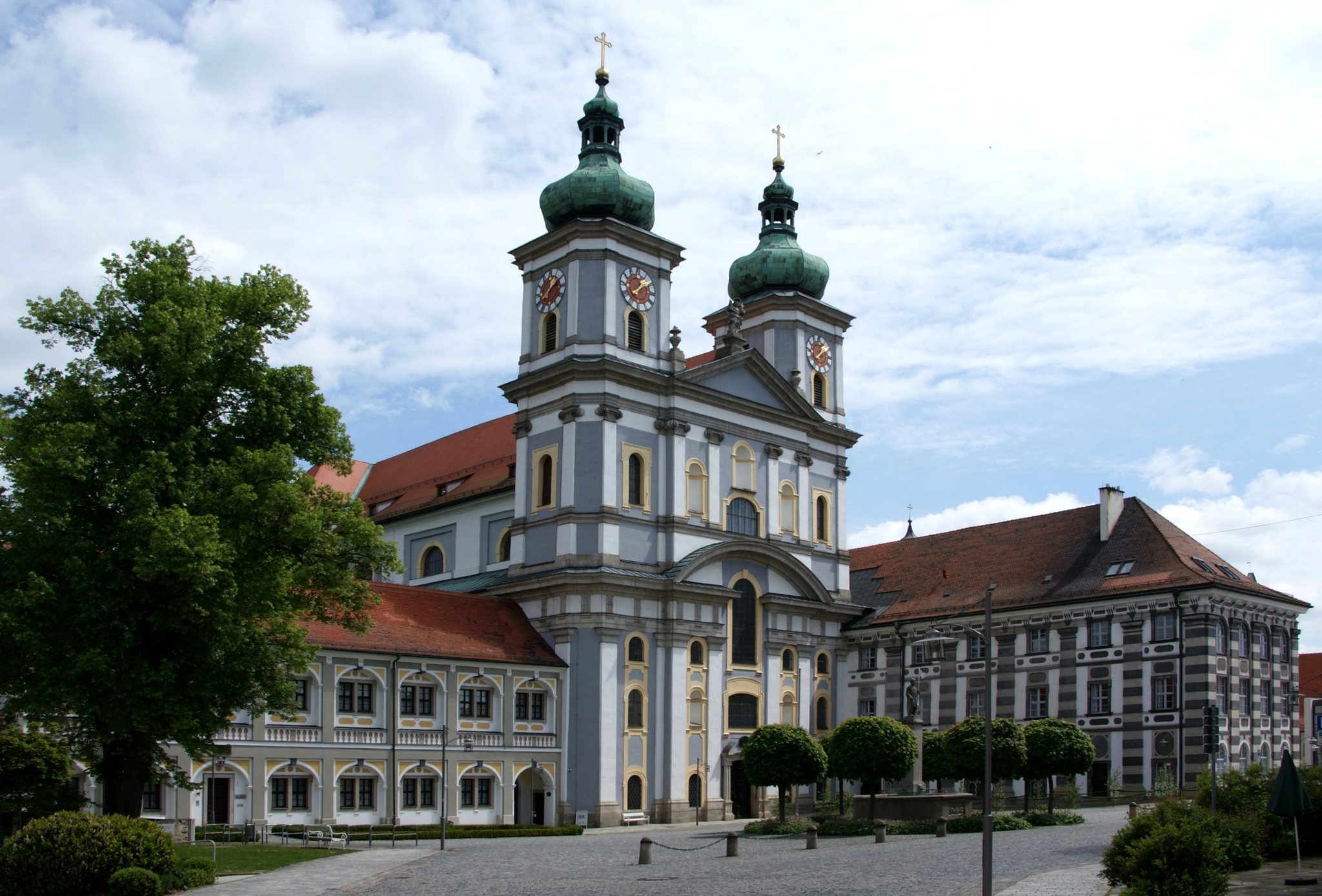
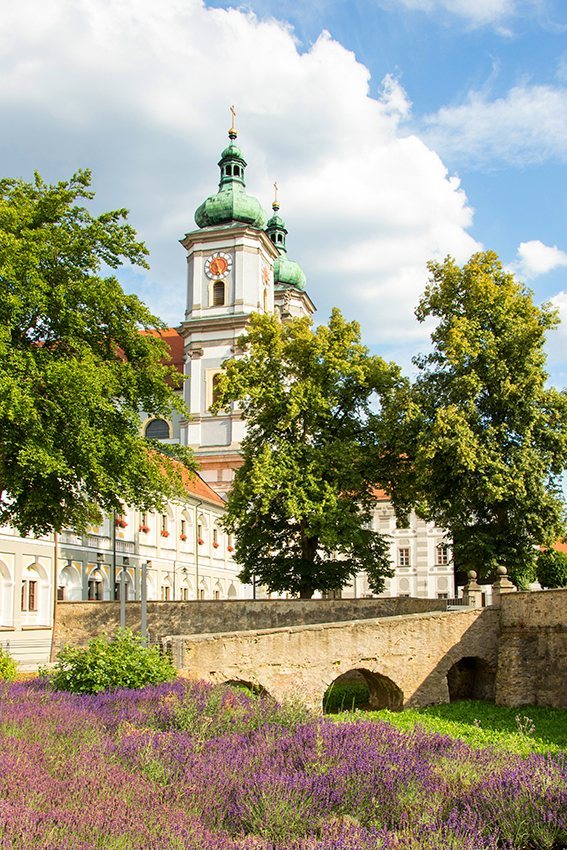
The abbey complex stands beside the Wondreb River at Waldsassen, near Tirschenreuth and close to the Czech border. Its principal surviving elements include the former abbey castle, the basilica of the Assumption of the Virgin Mary, a later convent church, the library, gardens, and associated service and residential buildings. Together, these structures preserve medieval foundations, Baroque rebuilding, and later monastic adaptations.
The Basilica of the Assumption
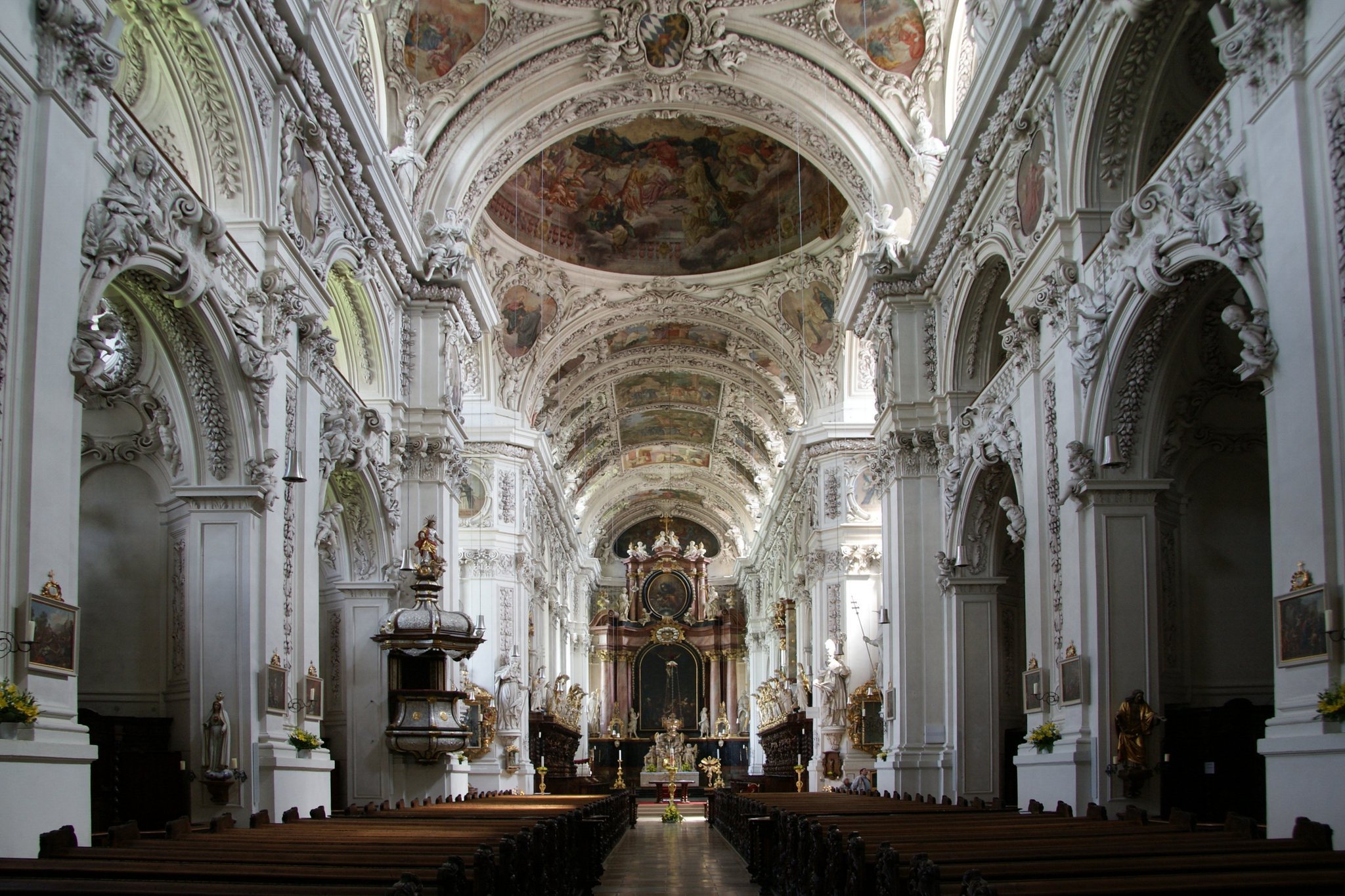
The medieval church was a three-aisled Romanesque basilica consecrated in 1179 by Bishop Conrad II of Regensburg in the presence of Emperor Frederick Barbarossa. The present church was built on Gothic foundations during the rebuilding that began in the late seventeenth century. Its plan is a three-aisled Latin cross with a rectangular eastern end, two towers on the facade, a dome over the crossing, two rows of side chapels, circular windows above the chapels, and two levels of galleries. The building measures 82 meters in total length, including the choir.
Construction began after the foundation stone was blessed in 1685, with building work proceeding from 1689 according to Abraham Leuthner’s plans. Georg Dientzenhofer directed the work until his death at Waldsassen, after which Christoph Dientzenhofer took over. Abbot Albert Hausner presided over the church’s consecration in 1704. A two-story organ loft occupies the west wall, and the upper gallery contains the principal organ, equipped with a striking clock dated 1698. Two smaller positive organs, intended for fixed liturgical use, stand in the choir and were made by the Bohemian organ builder Gartner of Tachov.
The vault frescoes by the Prague artist Jan Jakob Stevens of Steinfels show scenes from the foundation legend in the choir, episodes from the life of Christ in the nave, and the Virgin Mary as protectress in the dome. Giovanni Battista Carlone created the elaborate stucco framing and modeled the four Western Doctors of the Church beside the crossing piers: Gregory the Great, Jerome, Ambrose, and Augustine.
The high altar combines a Crucifixion with the Three Marys and Mary Magdalene, a representation of God the Father as Creator, and sculptures of Saints Benedict and Bernard, Moses, and John the Baptist by Karl Stilp. Its tabernacle includes an Annunciation group with angels adoring the Holy Cross and a gold celestial sphere that covers the container for the monstrance and ciborium. A silver repoussé antependium, or decorated altar front, bears a colored-glass imitation-gem Christogram.
Other furnishings include the Assumption of the Virgin altar, with a 1701 painting by Johann Andreas Wolff, as well as altars dedicated to Saint Benedict, Saint Bernard of Clairvaux, the Lamentation, Our Lady of Sorrows, and the archangel Michael fighting the Devil. The altar of Saint Bernard includes sculptures by Martin Hirsch, while the Lamentation altar contains a Pieta group.
Ten Roman early-martyr skeletons are displayed in glass coffins on the side altars alongside other reliquaries, containers made to preserve or present relics. The remains were brought from the Roman catacombs between 1685 and 1765. Decorative garments covered with gilt wire and imitation glass gems were made largely by the lay brother Adalbert Eder. The church has held a special feast for these martyrs on the first Sunday of August since the eighteenth century.
The choir stalls feature ornamental woodcarving, sculptures, and oval paintings of saints associated with the Cistercian order. A former crypt beneath the nave now serves as a chapel. The basilica received the papal title Basilica minor in 1969, an honorary designation for a church of particular historical, liturgical, or pastoral importance.
The Abbey Castle
The three-story abbey castle has had a hipped tent roof with high gables since 1601. Its main entrance is a chamfered stone portal with an iron double door from the fifteenth century. The southern rectangular tower originally served as a gate tower reached by a bridge. Another entrance led from the basilica’s Paradise through a fortified wall and across a wooden drawbridge to the upper story of the gate tower.
Other Buildings and Grounds
Convent Church
The new convent church of the Assumption of the Virgin Mary was built in 1923 in the eastern courtyard. Unlike the basilica, it is enclosed within the complex and is not visible from outside.
Library
The library hall was redesigned under Abbot Eugen Schmid during the period described for the library as 1724 to 1764. Karl Stilp created the sculptural decoration, Karl Hofreiter painted the ceiling frescoes, and Andreas Witt produced the woodcarving. The late Baroque and early Rococo interior contains richly carved shelves, ornamental stucco, a painted ceiling, and ten carved columns supporting a balustraded mezzanine. The columns take the form of allegorical figures associated with the production of books.
The library formerly held about 19,000 volumes. After secularization, 3,520 books were removed to Munich and partly sold. The hall was restored in 2015 as part of the wider restoration of the abbey complex.
Gardens
The monastery garden was redesigned from 1730 under Abbot Eugen Schmid. Part of it lies within the enclosure and includes the monastic cemetery. The associated nature-experience garden contains a bee trail, a water playground, a kitchen garden with herb spirals, weather and climate installations, and a Marian garden.
Stiftland Museum
The Stiftland Museum occupies a site southwest of the church. Its collections present religious, historical, geological, and regional material from Waldsassen and its surroundings.