Dorfkirche Dobiesław: A Late Gothic Parish Church in Poland
Site at a Glance
- Rating
- 4.8
- Popularity
- Very Low
- Country
- Poland
- Primary era
- Medieval
- External website
- Open
- Eras represented
- Medieval, Early Modern
- Civilizations
- Duchy of Pomerania, Holy Roman Empire
- Site type
- Religious
- Remains
- Church
On this page8 sections
History
Dorfkirche Dobiesław is a fourteenth-century church in Dobiesław, Poland, built in the late Gothic tradition. Formerly known as the church of Abtshagen in the Schlawe district of Pomerania, it served for centuries as both the village church and the parish church of the surrounding community. The building was probably originally dedicated to Saint Anne, the traditional maternal grandmother of Jesus, while since 1946 it has been dedicated to Our Lady of Częstochowa, the venerated Marian image associated with the Jasna Góra sanctuary in Częstochowa. The dedication under its present title took place on 1 September 1946.
From the Reformation to 1945
After the Reformation reached Pomerania, the church became Lutheran in 1535 under Laurentius Lemcke, its first post-Reformation pastor. Lemcke was probably a former monk of Buckow Cistercian monastery, whose members belonged to a Western Christian monastic order that developed from reforms of Benedictine monasticism. The church remained Lutheran until after 1945, when it was transferred to the Roman Catholic Church in Poland.
Abtshagen parish originally included Abtshagen, Alt Wieck, and Neu Wieck. Pirbstow also belonged to it until 1580, when that congregation was transferred to See Buckow. In the same year, Karnkewitz and Seehof joined the parish. Karnkewitz later received its own church and became an independent affiliated congregation. Until 1945, the parish formed part of the Rügenwalde church district in the Pomeranian ecclesiastical province of the Evangelical Church of the Prussian Union, a Protestant body created by the union of Lutheran and Reformed congregations in Prussia. The parish counted 1,800 members in 1939.
Parish records and clergy
The church registers began in 1565 and served as an important local chronicle. Baptismal, marriage, and burial registers from 1858 to 1874 are preserved at the civil registry office in Koszalin. The former parish archive also held a biography of Adam Ewald Brates, pastor from 1762 to 1786, who compiled a valuable resource for art history. The present location of that biography is unknown.
The pastors serving the church from the Reformation until 1945 were Laurentius Lemcke, Michael Runge, Heinrich Böckenhusen, David Hoffmann, Joachim Brockwedel, Bogislaw Ernst Sporges, Martin Pantenius, Friedrich Ephraim Behmer, Daniel Kniephoff, Gottfried Tietz, Adam Ewald Brates, Joachim Gottfried Backe, Adolph Leonhard Friedrich Jobst Siedler, Ernst Heinrich Haese, Ludwig Alexander Weise, Johann Karl Hermann Theodor Laasch, Emil Reetz, and Friedrich Jahn. Martin Pantenius served from 1687 to 1719, while Joachim Brockwedel held the pastorate from 1642 to 1662.
The church after 1945
Following the Second World War, the church entered the Roman Catholic structures of Poland and received its dedication to Our Lady of Częstochowa in 1946. It is again a parish church, with the affiliated church at Iwięcino and communities in Bielkowo, Rzepkowo, Wiekowo, Wiekowice, and Wierciszewo connected to the parish. Tadeusz Gorla has served as its priest since 2002. The settlement, once part of the Amt of Eventin in the Schlawe district and the Köslin administrative region, is now within Gmina Darłowo, Powiat Sławieński, in the West Pomeranian Voivodeship.
Remains
Building and tower
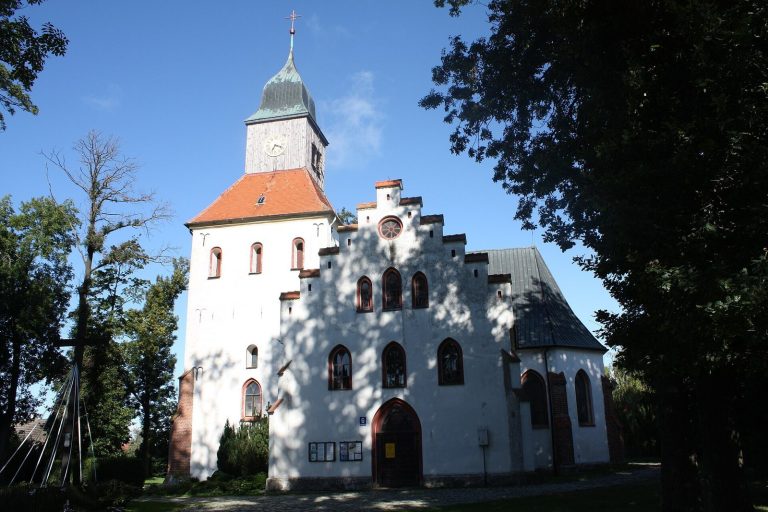
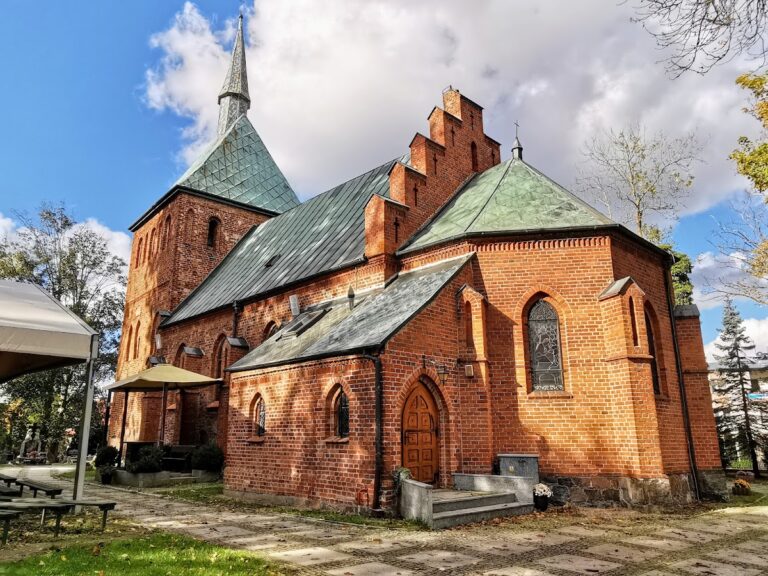
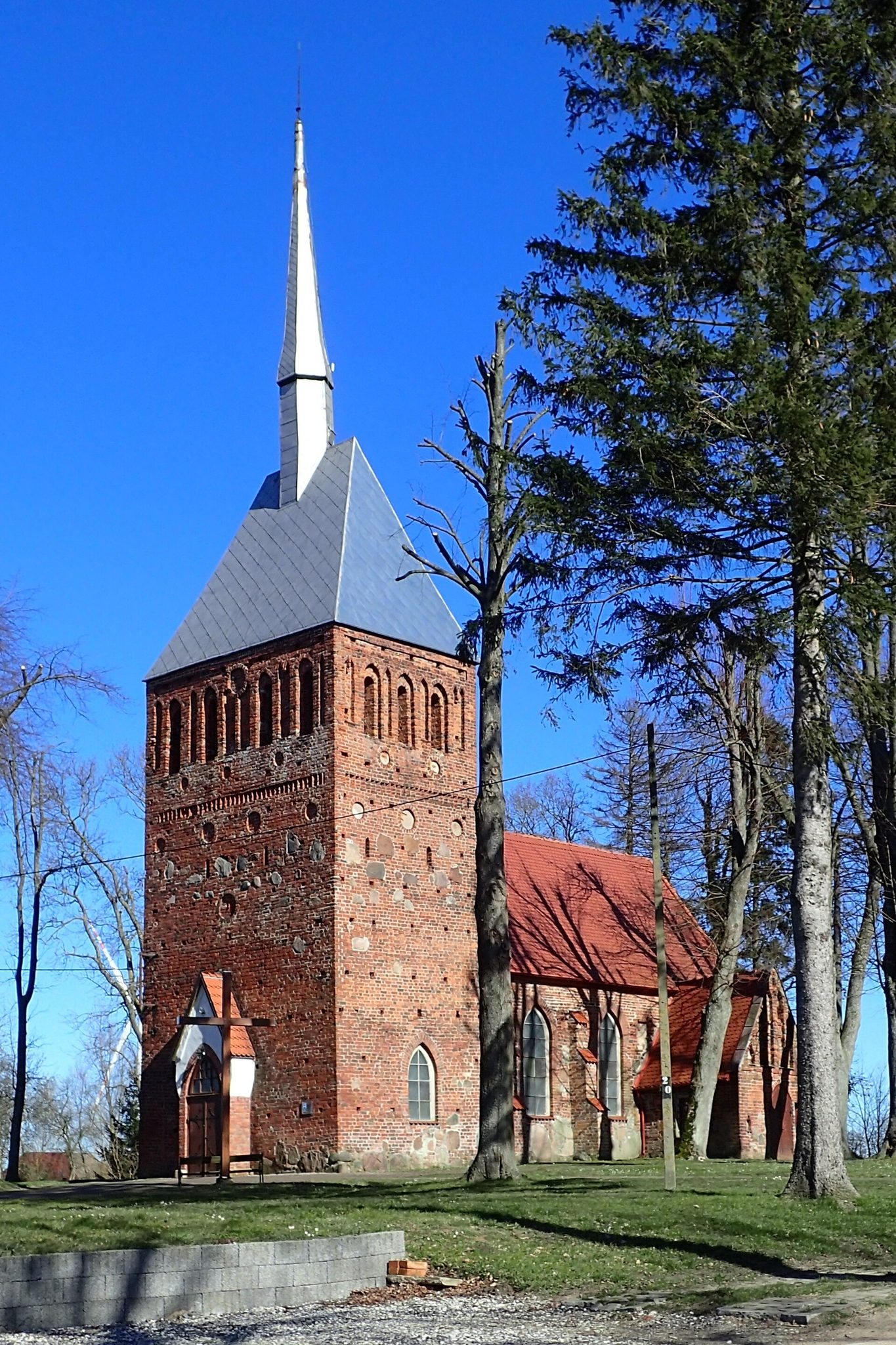
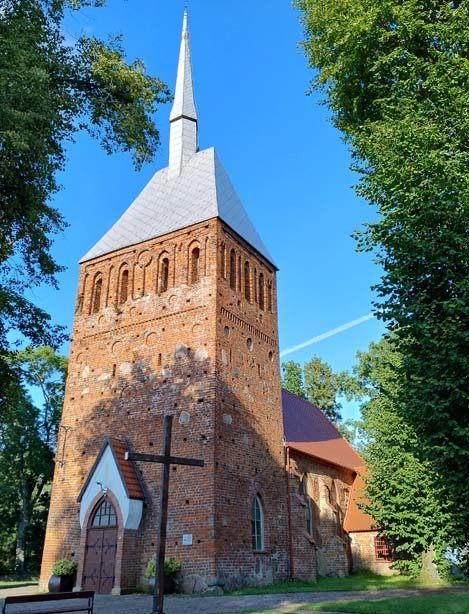
Dorfkirche Dobiesław is a substantial brick-and-fieldstone building. Fieldstones rise to considerable height within the brick masonry, while the surviving architectural elements point to a late Gothic origin. The church stands at the southern, or “church end,” of the elongated roadside village. Its strongly built western tower is especially prominent and is probably the oldest part of the building. Extensions project from both the northern and southern sides of the nave.
The western face of the tower contains unusual sculptural elements. Above the portal’s round-arched blind panel is a terracotta human head. Higher in the masonry, a crouching figure and a face can be seen. These figures are thought to represent building sacrifices intended to ward off old pagan deities and the Devil.
Interior and historic furnishings
The interior has a simple finish and a flat wooden barrel-vaulted ceiling. The preacher’s seating is a Renaissance work dating from around 1650. An altar made in 1645 and renovated in 1853 once showed the Last Supper and included a crucifix, but it is no longer present.
A choir window donated during a church visitation in 1656 contained 15 stained-glass panels. The panels combined coats of arms with figurative scenes, pairing the people responsible for ecclesiastical affairs in that year with biblical figures. An inscription dated 1784 identifies Johann Conradt Schlicht as the builder of the gallery.
Among the church’s notable carved works was an oak pew cheek measuring 2.80 metres in height. Its upper section showed a dragon holding a shield with the Pomeranian Griffin, the heraldic emblem of the former Pomeranian ruling dynasty and region. The lower section depicted Saint George with a smaller crowned, praying female figure. The carving was regarded as an exceptional artwork and was considered to date from the fifteenth century.
Memorials and churchyard
A simple epitaph depicts Martin Pantenius, who served as pastor of Abtshagen from 1687 to 1719. A portrait of Martin Luther bears the inscription “Joachim Brockwedel” and commemorates the pastor who served at the church from 1642 to 1662.
The old churchyard formerly surrounded the building and survives as a green area. A granite holy-water basin that once stood at the entrance is now used inside the church. At the eastern end of the village, the new cemetery continues to function as a burial ground.