Franciscan Monastery in Cheb: A Medieval Religious House
Site at a Glance
- Popularity
- Low
- Country
- Czechia
- Primary era
- Medieval
- Eras represented
- Medieval
- Civilizations
- Holy Roman Empire, Kingdom of Bohemia
- Site type
- Religious
- Remains
- Monastery
On this page9 sections
History
The Franciscan Monastery in Cheb is a Catholic religious house in Cheb, Czech Republic, where members of the Franciscan Order, a Catholic religious order founded in the early 13th century, were present before 1247. Its foundation date is unknown. A monastery guardian, the head of a Franciscan house, was recorded before that year, and a bishop’s visit in 1256 indicates that buildings existed by then. The foundation has been attributed to local citizens Hecht z Pograthu and Honigar Schmidl ze Seebergu.
Medieval foundation and rebuilding
At the time, the town was known as Eger. It had gained town status in 1179 and became an imperial city in 1277, meaning it was directly subject to the Holy Roman Emperor rather than a territorial lord. The town expanded eastward, southeastward, and southward in the early 13th century. The Franciscans settled just southwest of its new walls, perhaps by choice. A dense settlement developed around the monastery, arranged like a small fortress and linked to the town by a single road. Later, the town walls enclosed this quarter, although it is uncertain whether that happened before or after the fire of 1270.
The monastery belonged to the Franciscan regional province called Saxonia and was one of five religious houses in Eger. The others were a Teutonic Order commandery, a Dominican monastery, a house of the Knights of the Cross with the Red Star, and a Poor Clare monastery. Franciscan pastoral care was confined to their own quarter. In 1256, Bishop Albert I of Regensburg stayed at the monastery and granted additional tithes toward building a hospital.
A town fire in 1270 almost entirely destroyed both the Franciscan settlement and the old castle settlement. Four friars and ten other people died in the church. The church and monastery were rebuilt over the next 15 years. In 1280, John, Bishop of Gurk, granted an indulgence, a remission of temporal punishment for sin in Catholic teaching, to support the rebuilding. Henry II, Bishop of Regensburg, reconsecrated the church on 26 January 1285 in the presence of King Rudolf I, numerous princes, and seven bishops. The ceremony took place during celebrations in Eger for the marriage of Bohemian King Wenceslaus II and Guta, Rudolf’s daughter. Their wedding followed in Prague on 7 February.
The rapid construction of the original monastery and its rebuilding has been linked to generous gifts from Eger’s wealthy ruling families and the surrounding nobility. Donations and grants from Bohemian kings increased the monastery’s properties, which continued to grow until 1465. From the first half of the 14th century, the monastery also offered asylum, or temporary sanctuary from arrest. The town limited stays to 14 days, with a possible further 14 days for illness, and excluded people expelled from the town and outlaws.
Conflict, reform, and religious change
On 25 March 1350, a Franciscan preacher blamed the Jews for the arrival of plague, triggering a pogrom in which most of Eger’s Jewish population was murdered. The town seized Jewish communal property. Because the Jews had been under royal protection and paid money for it to the royal treasury, Emperor Charles IV fined the town and demanded compensation for the lost payments. After the fine was paid, Eger received a pardon letter in Nuremberg. The monastery itself was among the larger and more important houses in its Franciscan province; provincial meetings were held there in 1394 and 1397 under the regional superior Johann von Gmünd.
In 1451–52, the Franciscan preacher John of Capistrano sought Eger’s support against the Utraquists, a Bohemian Christian movement associated with the Hussite tradition. He did not win sufficient backing, particularly among the Bohemian nobility, and local nobles also put pressure on the town over his presence. He left under the town’s safe conduct, first travelling to Bayreuth. In a later letter, he thanked Eger for hospitality at the Franciscan and Poor Clare monasteries and for assistance from Waldsassen Abbey.
Around 1460, two Eger friars, Johann and Lewin von Wirsberg, preached against church hierarchy, the sale of indulgences, and clerical property. Their views drew on the ideas of Jan Hus, a Bohemian religious reformer, and Joachim of Fiore, a medieval theologian. The monastery’s discipline then declined, with its rules neglected and the friars accused of scandalous conduct. After the town council, local nobles, and royal captain appealed to Pope Pius II, he appointed the Franciscan guardian in Breslau and the abbot of Waldsassen to restore stricter observance of the order’s rule. The attempt failed, and all but one sick friar left. In 1465, friars from Saxony who followed the stricter rule took over; the monastery’s secular property passed to the Poor Clares.
Franciscans expelled from their monastery in Annaberg, Saxony, were partly received in Eger in 1541 under their guardian, Franz Seidel, while others went to Kaaden. By the second half of the 16th century, Eger had become predominantly Protestant. A provincial meeting in 1544 noted the influence of the Lutheran Reformation on the monastery. Some friars converted: Johann Fritschhans became a pastor in Magdeburg, while Franz Limberg served at Oberlohma and, from 1565, at Frauenreuth.
The friars may have left in 1555, but guardians continued to be recorded. Emperor Maximilian II ordered the town magistrate in 1569 and 1572 not to harass Catholics, although the magistrate continued to implement the Reformation. A friar named Hanns died in 1582 and was buried in the monastery cemetery; guardian Ludolph Hülber, who also led the Poor Clare monastery, died the following year. Three new friars joined in 1591. By the end of the century, Eger and Halberstadt were the only active convents remaining in Saxonia.
The friars may have been expelled again in 1604. As Saxonia neared extinction in the early 17th century, Franciscan leaders assigned Eger to the Upper German, or Strasbourg, Province. With the approval of King Rudolf II, the temporarily abandoned monastery was staffed again in 1608. After Protestant Bohemian forces were defeated at the Battle of White Mountain in 1620, King and Emperor Ferdinand II pressed to restore Catholicism in Protestant parts of Bohemia. Jesuits arrived and established a college in Eger in 1651. The Franciscans also took part in efforts to restore Catholic practice in the town and surrounding region.
War, imperial policy, and the modern community
During the War of the Austrian Succession, an 18th-century European conflict over the Habsburg succession, Eger was besieged and capitulated on 19 April 1742. French troops occupied the town. French commissioners seized church bells, and the Franciscans paid 130 gulden to recover two bells from their church. Typhus spread among soldiers and townspeople and killed 18 friars. On 26 October 1742, the friars had to vacate the monastery so that it could house sick soldiers; the guardian and a few friars remained to guard it. The French imposed a contribution of 100,000 gulden on the town, of which the monastery paid 500. The French garrison surrendered in September 1743 and was taken prisoner.
The monastery belonged to the Upper German Province until 1781, when Emperor Joseph II transferred it to the Bohemian Province. A decree in 1784 proposed closing the house, dispersing its friars, and turning the buildings over to the military. The town magistrate and citizens, together with the Bishop of Regensburg, appealed. On 16 April 1787, Joseph II ruled that the monastery could remain open and its friars could stay.
The community numbered 14 priest friars and six lay brothers in 1792, but by 1819 it had four of each. Around 1850, the Franciscans ran a brewery that apparently supplied only their own needs. In 1874, the house comprised a guardian, four priests, and three lay brothers.
After Germany occupied the Sudetenland in 1938, the predominantly German-speaking border region of Czechoslovakia, the monastery was grouped in 1939 with four other Franciscan houses into a regional commissariat. The Bavarian Province administered it until 1947. The commissar, Petrus Mangold, lived at the monastery in Mährisch-Trübau and died in Dachau concentration camp in 1942. The Franciscans were forced to leave the Cheb monastery in 1951 by order of the communist government.
Remains
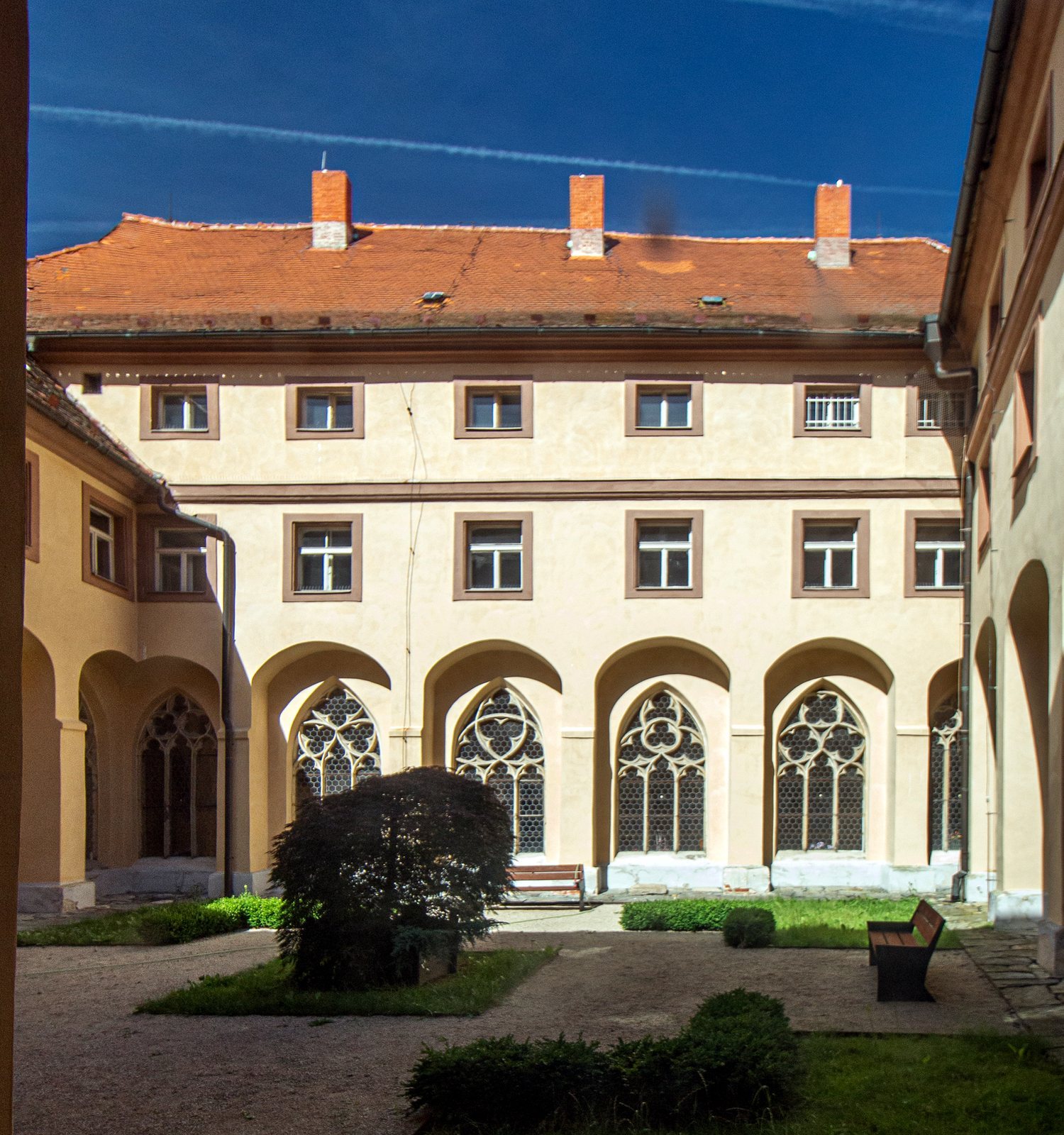
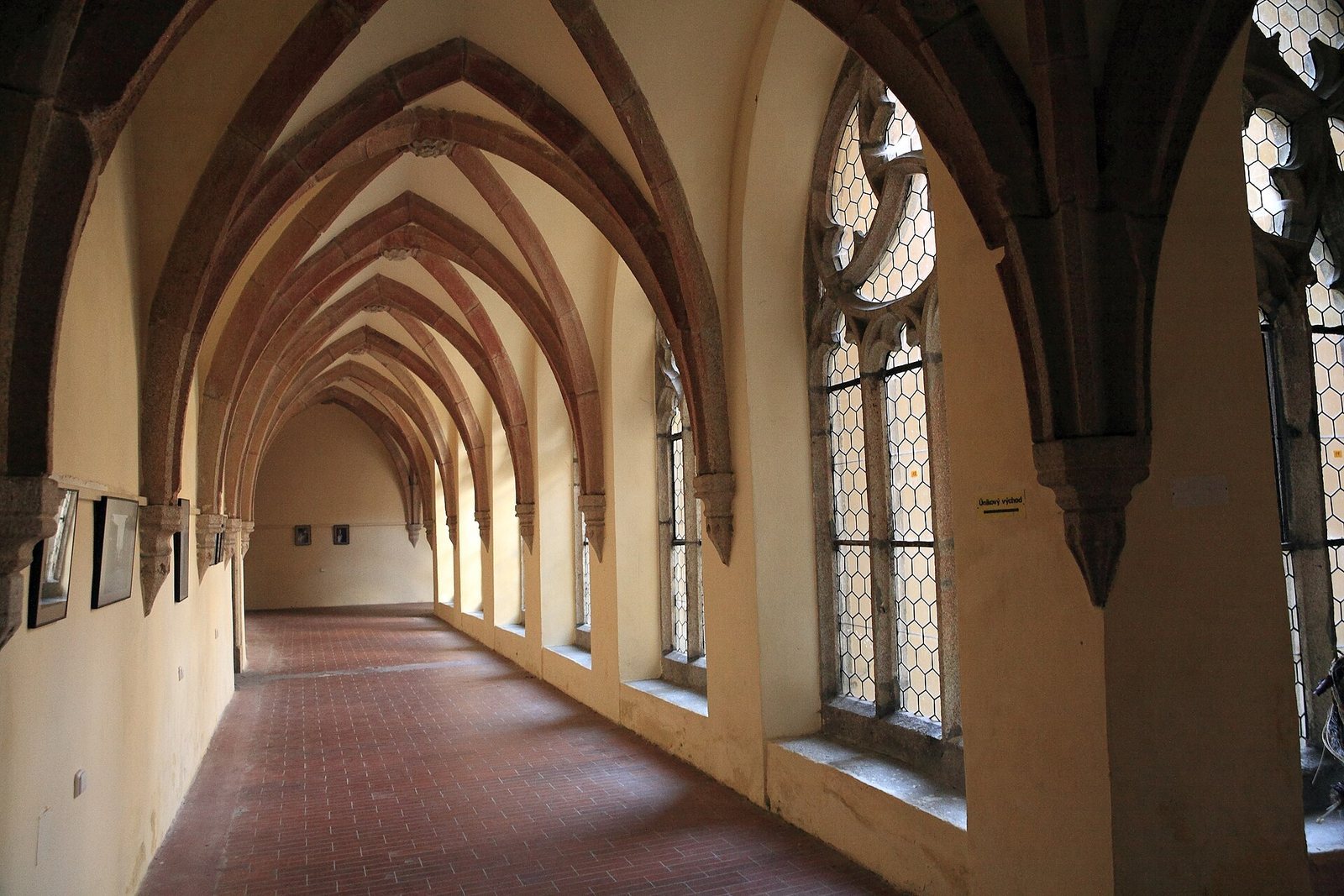
The monastery stands in the southwest of Cheb’s old town, at the corner of Dlouhá Street and Františkánské náměstí. The former Poor Clare monastery and its Church of St Clare are across the street. The surviving complex includes the Church of the Annunciation, its sacristy, part of the adjoining monastery wall, a cloister, former monastery buildings, and a monastic garden.
Church, cloister, and burial places
Church of the Annunciation
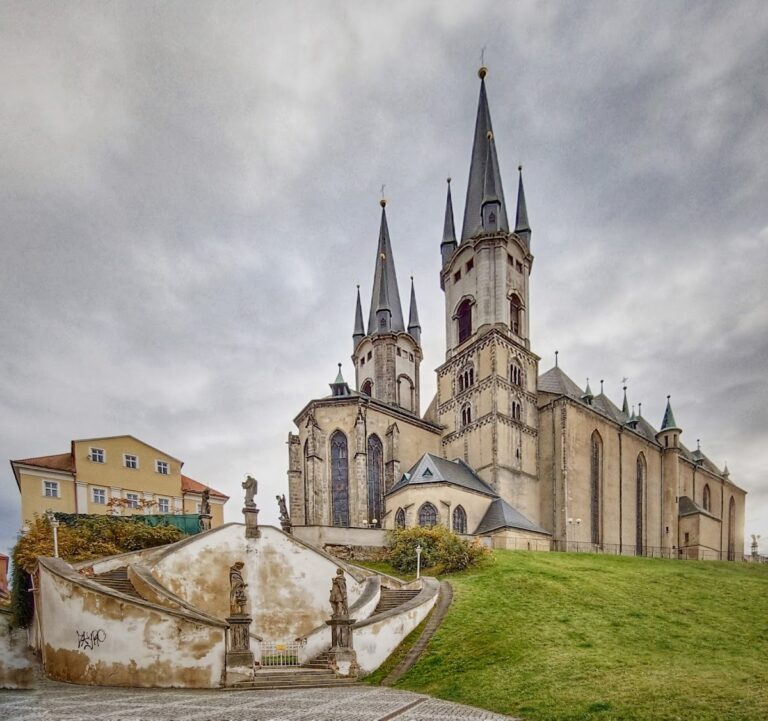
The Church of the Annunciation is a three-aisled Gothic church, with three lengthwise interior spaces. The building may have been planned to extend farther than the completed church. When the town wall was built in the mid-13th century, it passed so close to the recently built church that one corner was incorporated into the wall and had to be shaped on a diagonal. The surviving church complex also includes a sacristy, a room for clergy and church furnishings, and a section of the monastery wall adjoining the church.
Cloister and burials
The cloister, a covered walkway around a courtyard, dates from the first half of the 14th century and retains wall paintings from the 15th century. Franciscan priests were buried in the cloister, while lay brothers were buried in the monastery cemetery.
Noble burials in the church
Although most prominent Eger families had family burial chambers in the parish Church of St Nicholas, several nobles were buried in the Franciscan church. Johann Junckher von Oberkunreut was laid to rest there in 1521, and his daughter-in-law Barbara, born Crahmer von Pograth, was later placed in the same chamber. Sidonia, wife of Field Marshal and Knight of the Order of the Golden Fleece Georg Ernst, Count of Schlick, was buried there in 1626. Heinrich von Pißnitz, a baron who became a Franciscan and was the last of his family, died in 1773 and was buried in the church with his sword and helmet.