Pantanassa Monastery: A Late Byzantine Monastic Complex at Mystras


Site at a Glance
- Rating
- 4.8
- Popularity
- Low
- Country
- Greece
- Primary era
- Medieval
- Eras represented
- Medieval, Early Modern
- Civilizations
- Byzantine, Ottoman
- Site type
- Religious
- Remains
- Monastery
On this page7 sections
History
Pantanassa Monastery is an Eastern Orthodox monastic complex in Greece, located in the medieval Byzantine city of Mystras. Its principal church was built and dedicated in September 1428 in the late Byzantine tradition known as the Mystras style. The foundation belongs to the Despotate of the Morea, a Byzantine state governed by members of the imperial dynasty in the Peloponnese, and was established about a decade before the Ottoman conquest of Mystras.
Foundation in the Despotate of the Morea
The monastery’s principal church, or katholikon, was founded by Ioannis Phrangopoulos, a senior military and administrative official of the Despotate of the Morea. His name, offices, and role as donor survive in an inscription on the church’s western gallery and in monograms carved at the base of an arch in the nave. The date of construction was preserved in a record that was later lost, but the abbot Fourmont found and read it in 1730.
Dedicated in 1428, Pantanassa was the last church constructed at Mystras during the Byzantine period. Its foundation came during the Palaiologan era, the period of rule by Byzantium’s final imperial dynasty, which was associated with a late Byzantine revival in art and architecture. The monastery formed part of this cultural setting shortly before the city passed under Ottoman control.
The Mystras style
Pantanassa belongs to the architectural development known as the Mystras style, a local late Byzantine tradition used at Mystras from the thirteenth to the fifteenth century. It combined Byzantine construction with Western influences that entered medieval Greece through Western-ruled states. At Pantanassa, these influences are especially visible in the exterior, while the church’s religious imagery remained strongly Orthodox in character.
The monastery’s artistic program was shaped in part by the Hodegetria church at the Brontochion Monastery, and its scenes from the life and theology of Christ resemble those at the Peribleptos Monastery. The frescoes were made by at least three painters. Their exceptional quality has led to the view that the artists probably came from Constantinople, where artists continued moving to Mystras from the fourteenth century through the first half of the fifteenth.
Continuing religious foundation
Pantanassa is the only monastery within the archaeological site of Mystras that remains permanently inhabited by a religious community. The monks have departed, but Orthodox nuns continue to live there, making them the only permanent residents of the upper city. The nuns maintain the religious foundation, receive pilgrims, provide blessings and accommodation for them, and guide people through the monastic complex.
The monastery is also the best-preserved monument at Mystras, while much of the surrounding medieval city survives in a ruined condition. Pantanassa forms part of the Archaeological Site of Mystras, which was inscribed on the UNESCO World Heritage List in 1989.
Remains
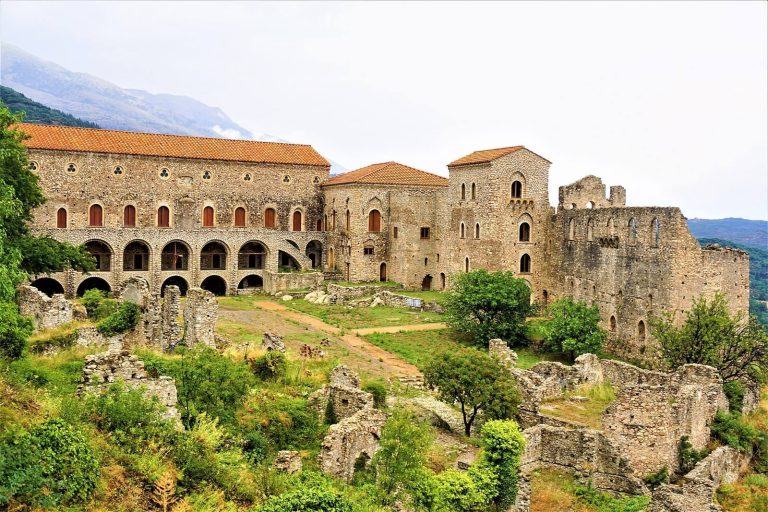
Pantanassa stands within the citadel on the eastern slope of the Mystras acropolis, at the foothills of Mount Taygetos. It occupies the former upper city, approximately between the Church of Saint Nicholas and the Peribleptos Monastery, near the former boundary between the upper and middle towns. The complex is organized around the church, with open galleries and lower service and residential buildings supporting the monastic community.
The church and exterior
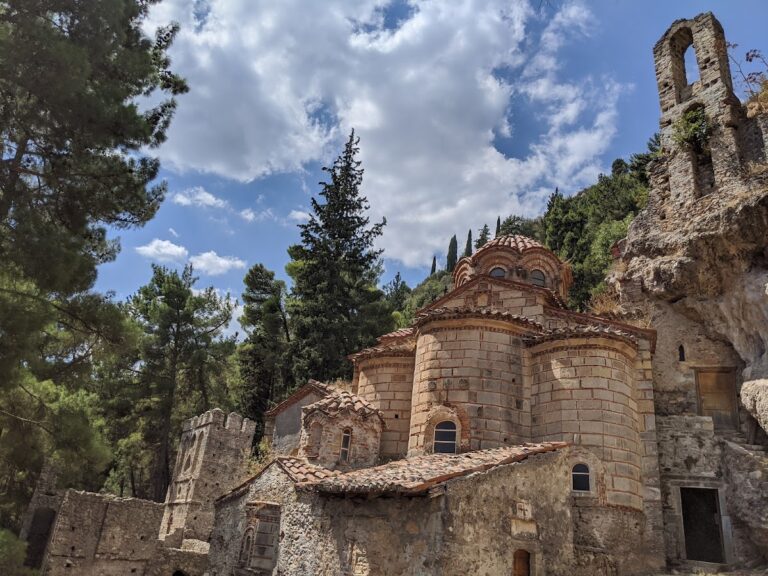
The katholikon combines two Byzantine church arrangements. Its ground floor is a three-aisled basilica, with a central nave and two side aisles, while the upper level follows a cross-in-square plan, a roughly square arrangement centered on a dome. Five domes rise above the upper church, although the four corner domes project only slightly above the roof.
The building follows aspects of the Hodegetria church but adds conspicuous Western features. A projecting bell tower, richly decorated apses, and windows framed by pointed arches give the exterior a distinctive character. The four-storey bell tower shows particularly strong Frankish influence, referring to the Western European influence present in parts of medieval Greece. The church has been described as the building at Mystras with the strongest Western architectural influence.
An elaborately carved stone façade and relief ceramic decoration combine Byzantine and Western ornament within a Byzantine structural design. Open galleries or arcades were important parts of the monastic complex, and one survives. Lower economic and residential buildings surround the church and continue to serve the needs of its religious community.
Frescoes and sculpture
The interior preserves exceptionally rich and colorful fresco decoration, much of it in its original form. The paintings on the vaults and galleries date from around 1430 and are distinguished by intense color, animated movement, and high artistic quality. They belong to the late Byzantine artistic world associated with the Palaiologan period.
The frescoes on the ground floor were painted later, during the seventeenth or eighteenth century. Their style and artistic quality differ from those of the earlier paintings above. Together, the two groups of frescoes reflect the long religious use of the church while preserving distinct phases of its decoration.
The church’s sculptures vary in style. Important examples include the capitals, impost blocks, and the portal between the narthex, or entrance hall, and the main church. Some reliefs were reused, while others date from the construction of Pantanassa. The iconostasis, the screen separating the sanctuary from the nave, carries an image program whose arrangement and selection of figures derive partly from the Hodegetria church. Its Christological scenes are comparable to those at the Peribleptos Monastery.