Santa Maria in Piazza: A Roman Catholic Church Complex in Mogliano
Site at a Glance
- Rating
- 4
- Popularity
- Very Low
- Country
- Italy
- Primary era
- Early Modern
- Eras represented
- Medieval, Early Modern, Modern
- Civilizations
- Italian, Papal States
- Site type
- Religious
- Remains
- Church
On this page8 sections
History
Santa Maria in Piazza is a Roman Catholic church complex in Mogliano, Italy, comprising the church and the adjacent Oratory of the Madonna della Misericordia. It belongs to the Roman rite and is affiliated with the Archdiocese of Fermo. The complex is principally known for Lorenzo Lotto’s Madonna in Glory, an altarpiece commissioned in the sixteenth century.
The fifteenth- and sixteenth-century foundations
The Oratory of the Madonna della Misericordia was built in 1420 as an ex voto, a devotional offering made in thanksgiving for deliverance from a crisis, after a plague epidemic ended. Between 1532 and 1542, the community constructed a larger church beside it. That building had a single nave, one of the main longitudinal divisions of a church, and a wooden coffered ceiling.
In 1547, Jacomo Boninfanti, then a church administrator, commissioned Lorenzo Lotto to paint the altarpiece now known as the Madonna in Glory. Lotto was an Italian Renaissance painter noted for religious altarpieces and portraits. The completed work is dated 1548.
Eighteenth-century rebuilding
Mogliano undertook a major rebuilding campaign during the eighteenth century, in a period affected by earthquakes in 1703, 1729, and 1760. Citizens’ bequests provided much of the money for reconstruction. The elevation of Pietro of Mogliano, a Franciscan religious figure, to the rank of Blessed in 1760 also encouraged the production of paintings associated with him. A Blessed is a person formally recognized by the Catholic Church for limited public veneration, usually within a particular region or religious community.
Plans for the present church included acquiring premises belonging to the Lauri family beside the sixteenth-century building. In 1742, the project was already under consideration. On 20 March 1743, Mogliano’s parish priests reported through their representative in the Congregation of Bishops, Alessandro Borgia, that the existing church could accommodate only half of the town’s approximately 3,000 inhabitants.
The municipal council approved a design by the Milanese architect Giambattista Rusca on 5 March 1750. The foundation stone of the present church was laid on 8 September 1759, the feast of the Nativity of the Blessed Virgin Mary. An inscription found in 1951 states that construction was directed by A. Rusca of Lugano, who covered the roof vaults in 1769. The building is also attributed to designs by Giovanni Battista Rusca of Lugano. Urbano Paracciani, then archbishop of Fermo, consecrated the church in 1774.
Parish use and recent history
Under a contract approved by King Vittorio Emanuele III on 5 February 1929, the church was transferred for exclusive parish use and took the title Parish of Santa Maria Assunta. That title had been granted in 1730 to the mother church of Santa Maria da Piedi.
In 1923, Cardinal Tacci Porcelli, who was born in Mogliano and was then secretary of the Congregation for the Oriental Churches, renovated the chapel of the Sacred Heart. This department of the Roman Curia is responsible for Catholic Churches of Eastern traditions. The Montegiorgio artist Nicola Achilli carried out work connected with the renovation and decorated the Chapel of Saint Joseph in stucco, with the involvement of Biagio Biagetti, director of the Vatican Museums from 1921.
The 2016 earthquake made the church structurally unsafe, and it remained closed for seven years. It reopened to the public in October 2023. The former oratory was converted into the civic Museum of Sacred Art of Mogliano, which preserves religious works and objects associated with the oratory’s confraternity, a lay religious association organized around shared worship, charitable activity, or a particular devotion, together with material from churches that had closed or disappeared.
Remains
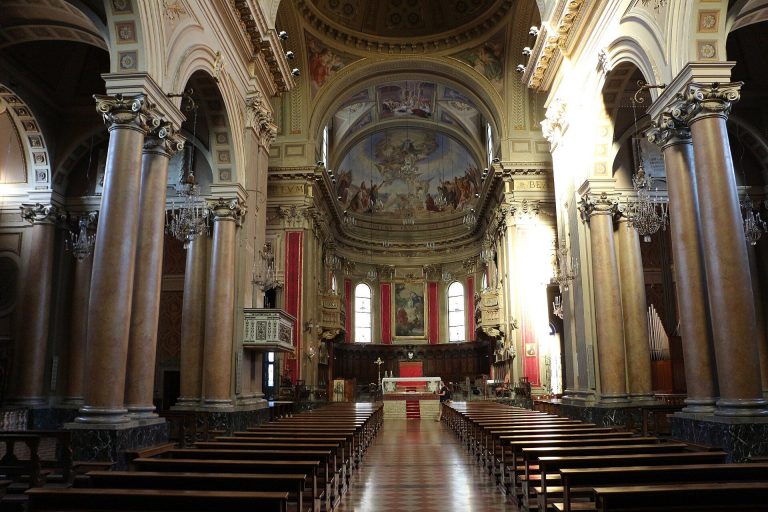
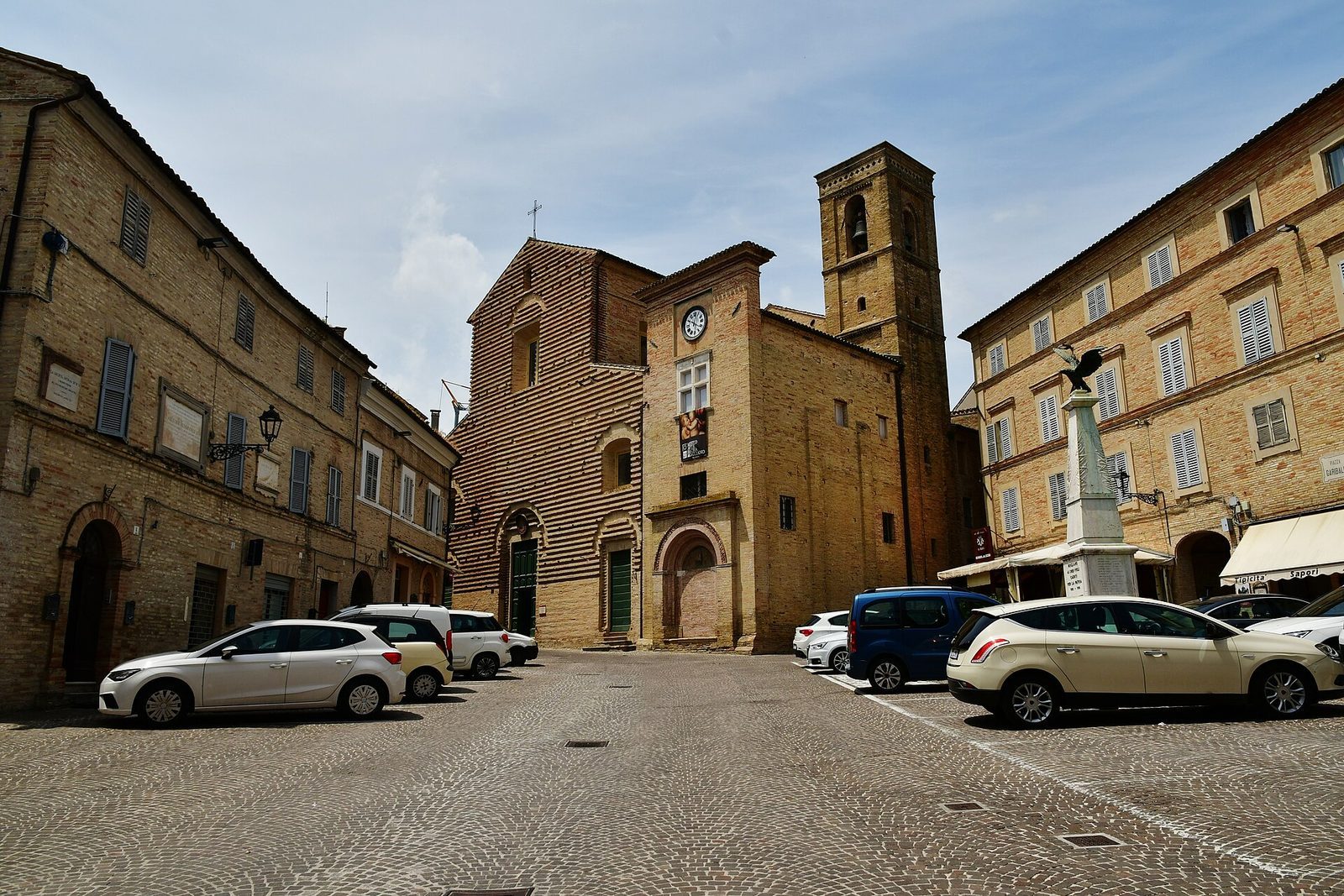
The complex flanks Piazza Garibaldi in the center of Mogliano. The present church covers approximately 29 by 35 meters and has three naves. Its restrained Baroque decoration, classicizing lines, and extensive stucco work belong to the eighteenth-century rebuilding. The main facade remains unfinished, with exposed brick striations.
The present church
The church’s side altars include Alessandro Ricci’s Pietà, painted in 1789, and Giovanni Battista Fabiani’s 1786 image of Blessed Pietro of Mogliano caring for people affected by plague. A Madonna of the Rosary shows the Virgin enthroned between Saints Sebastian and Stephen, surrounded by fifteen medallions representing the mysteries of the Rosary. The church also contains a Madonna of Loreto dated 1711.
Lotto’s Madonna in Glory places Mary in glory in the upper part of the composition, while Saints Joseph, John the Baptist, Mary Magdalene, and Anthony of Padua look upward from below. The four saints are understood to represent marriage, baptism, extreme unction, and confirmation. This sacramental reading reflects the Counter-Reformation, the Catholic reform movement that followed the Protestant Reformation and emphasized doctrine, disciplined worship, and the role of the sacraments. Lotto’s monumental frame for the altarpiece was designed by the painter himself and is mentioned in his Libro di spese diverse.
The former Oratory of the Madonna della Misericordia
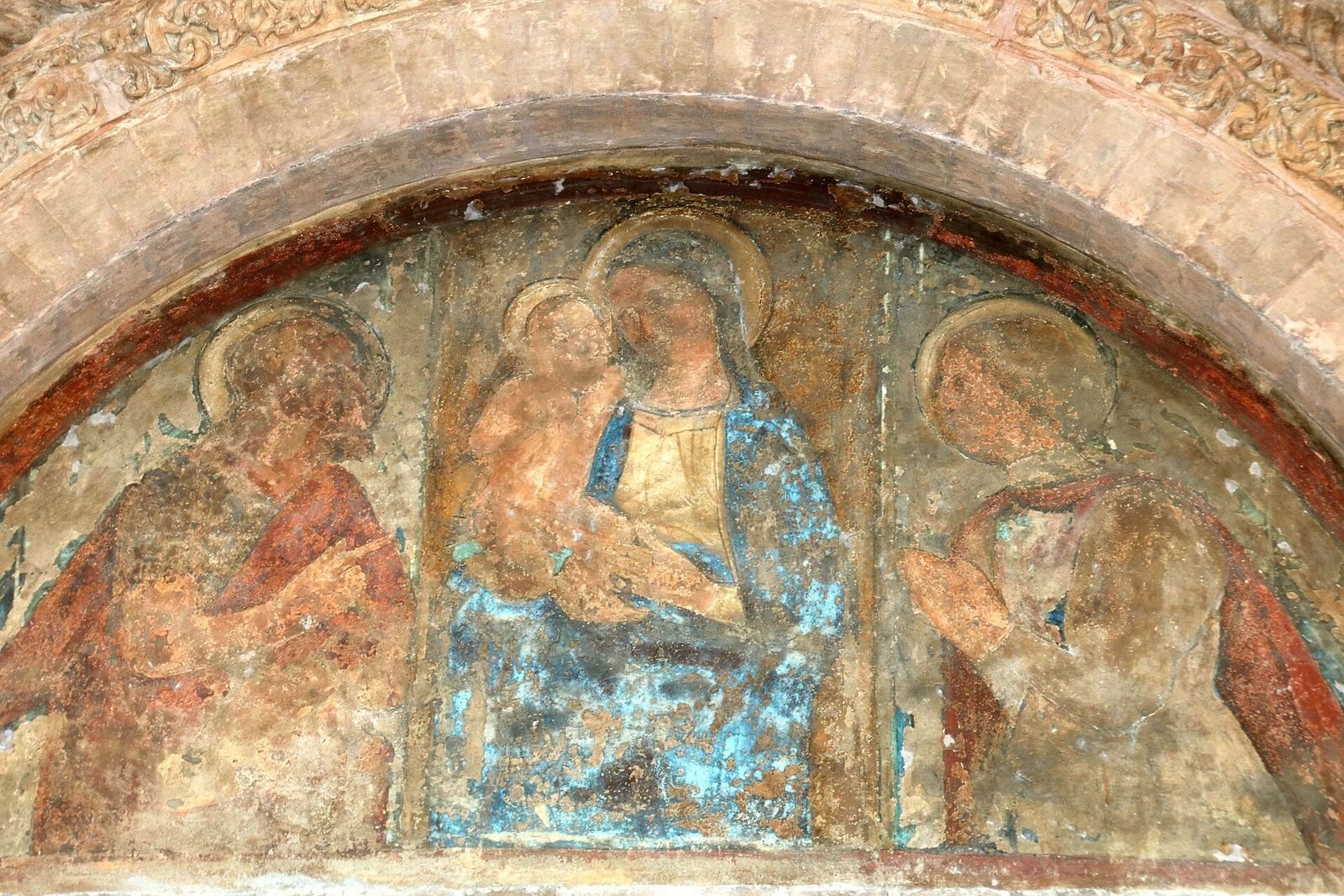
The former oratory retains an elegant fifteenth-century portal with a round arch and sculpted plant-like motifs. The arch is now sealed with brick. Above it, a painted lunette by Giovanni Angelo d’Antonio depicts the Madonna and Child with Saints Roch and Sebastian.
Inside, the former oratory has a groin vault, a vaulted ceiling formed by the intersection of two barrel vaults. Its historic portion now serves as the sacristy and a chapel, while the upper level houses the Museum of Sacred Art.
The Museum of Sacred Art
The museum contains an eighteenth-century predella, the lower platform or painted section beneath an altarpiece, as well as a processional baldachin dated 1785. A baldachin is a canopy carried in procession over a sacred image, relic, or member of the clergy. The collection also includes processional crosses and a silver processional cross attributed to Antonio da Sant’Elpidio and dated to around 1420.
Among the paintings are a Holy Family attributed to Innocenzo Francucci and a Byzantine-style Madonna and Child dating to approximately 1420. Religious statuary and decorative works include a nineteenth-century papier-mache statue of Saint John the Baptist by the Mogliano craftsman Giambattista Latini.