San Giuliano Church: Former Cathedral of Macerata
Site at a Glance
- Rating
- 4.2
- Popularity
- Very Low
- Country
- Italy
- Primary era
- Early Modern
- External website
- Open
- Eras represented
- Medieval, Early Modern, Modern
- Civilizations
- Italian, Papal States
- Site type
- Religious
- Remains
- Cathedral
On this page17 sections
History
San Giuliano Church is a Roman Catholic church in Macerata, Italy, dedicated to Saint Julian and built in its present form during the late Baroque and Neoclassical period. The church occupies a site associated with a parish of Saint Julian by the tenth century and became the cathedral of the Diocese of Macerata before that function ended in 2023.
Medieval parish and rebuilding
By the tenth century, the site was known as a parish dedicated to Saint Julian, the Christian saint who is also the patron of Macerata. A small rural church was built there in 1022. During the fourteenth and fifteenth centuries, a second church took shape on the site, and its bell tower was completed in 1478. The later church was formed by bringing the earlier buildings together, creating the foundation for subsequent rebuilding.
The medieval bell tower belongs to the Gothic-florid tradition. Built between 1467 and 1478, it is probably attributable to Marino di Marco Cedrino. Its survival beside the later church preserves a visible element of the medieval history of the parish.
The present church
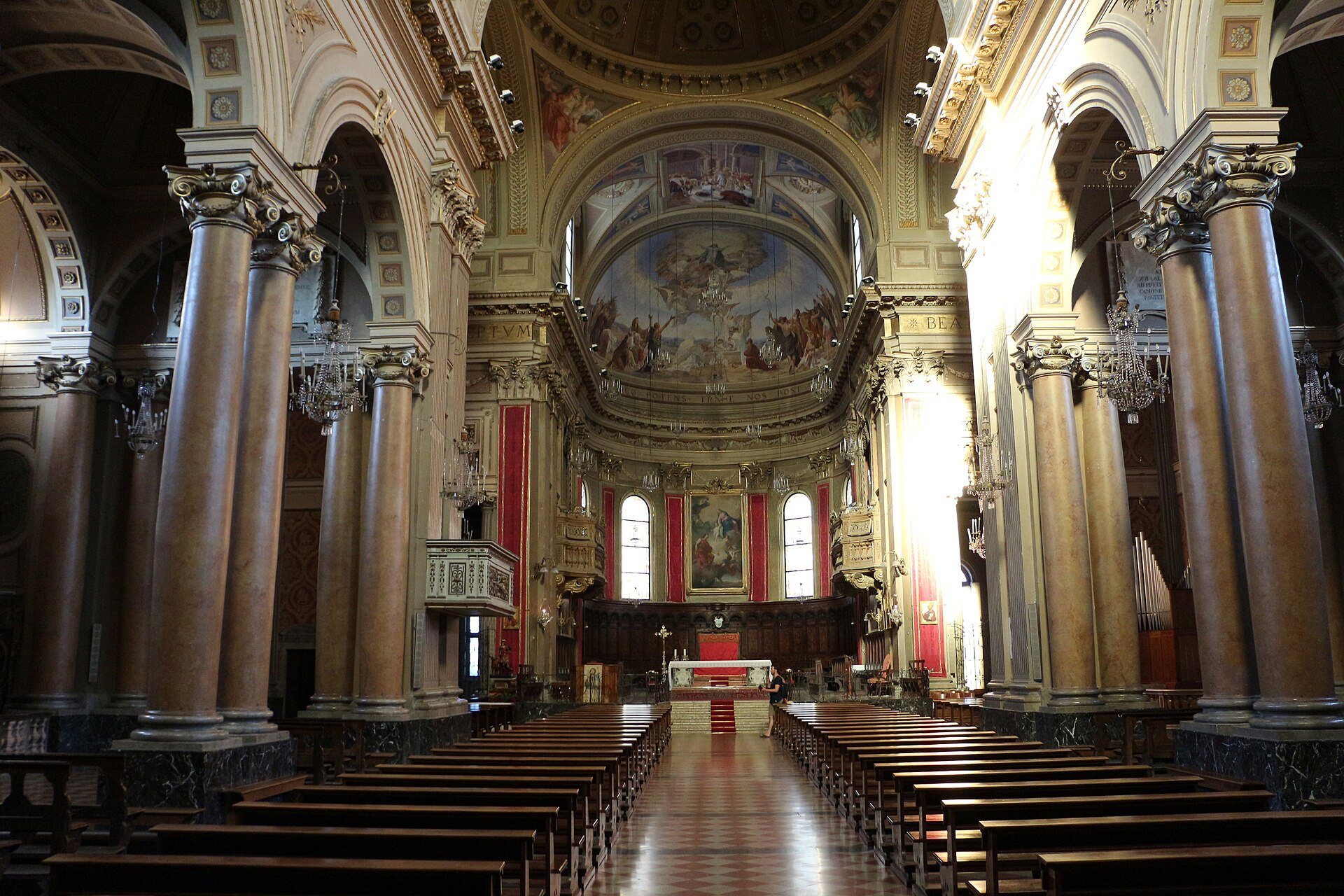
Construction of the present building began in 1771 to a design by the architect Cosimo Morelli. The work continued until 1790 and was paid for by Nicolò dall’Aste, who was then bishop of Macerata and Recanati. Morelli’s design established the church’s Latin-cross plan, a layout with a long central axis crossed by a shorter transept, as well as its three naves, dome, paired monumental columns, and spacious interior.
The church served as the cathedral of the Diocese of Macerata, an administrative territory governed by a bishop. The diocese was later known as the Diocese of Macerata-Tolentino-Recanati-Cingoli-Treia. A decree of Pope Francis took effect on 6 February 2023, ending San Giuliano’s cathedral function and designating the Collegiate Church of San Giovanni as the new cathedral. San Giuliano remains closely associated with the religious and civic history of Macerata through its dedication, relics, art, and former cathedral role.
Relics, devotion, and memory
The church preserves a relic of Saint Julian’s arm. It also holds a corporal traditionally believed to have been stained with Christ’s blood during a Eucharistic miracle in Macerata on 25 April 1356. The event became associated with the introduction of the Forty Hours devotion in the Catholic Church after 1556. This practice is a form of Eucharistic adoration traditionally lasting approximately forty hours.
Saint Vincent Maria Strambi, a former bishop of Macerata who is venerated as a saint, is buried in the church. San Giuliano also had an associated choir, the Cappella Musicale della Cattedrale di Macerata, linking the cathedral’s history with organized sacred music. Its musical heritage is further represented by two pipe organs that entered the building at different points in its history.
Remains
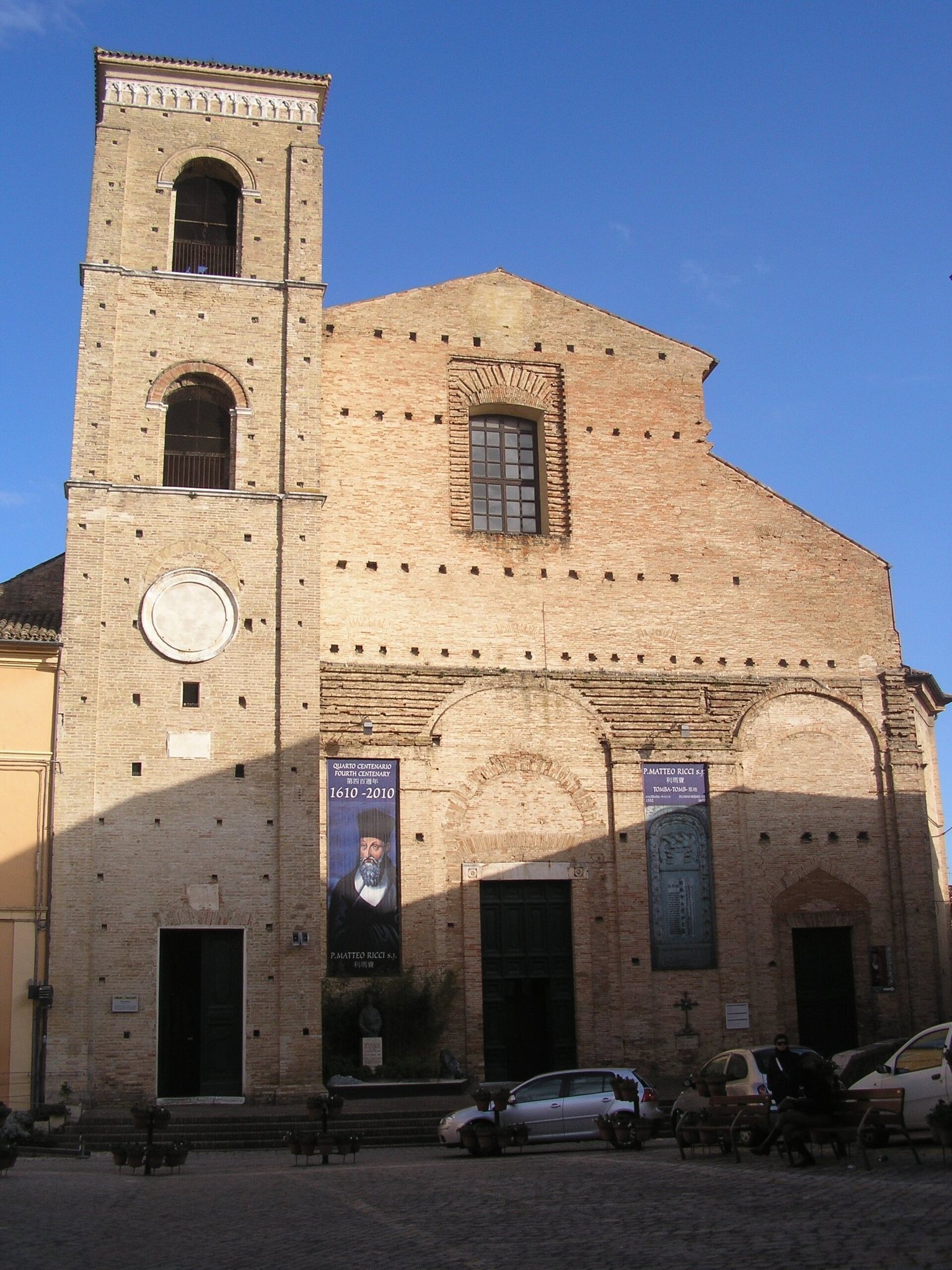
San Giuliano Church combines a medieval exterior element with an eighteenth-century interior organized around a Latin-cross plan. The building has three naves, a dome, and a bright interior divided by paired monumental columns. Its unfinished brick facade faces the piazza, while the square bell tower projects toward it as an adjacent and earlier structure.
Exterior and medieval fabric
Brick facade
The facade remains unfinished and is constructed in brick. Its incomplete surface contrasts with the more fully developed interior created under Morelli’s design, leaving the exterior as a direct expression of the building’s material construction.
Bell tower
The square bell tower projects toward the piazza. It was built between 1467 and 1478 in the Gothic-florid tradition and is probably the work of Marino di Marco Cedrino. The tower belongs to the earlier church complex and survives beside the present building.
Interior plan and chapels
Lower church chapels
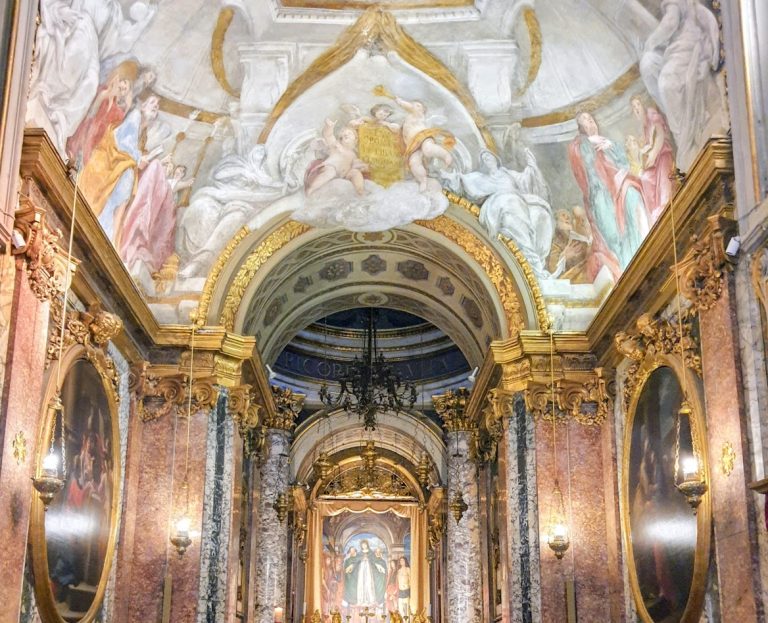
The lower church contains three chapels dedicated to Saint Mary Magdalene, the Madonna of Loreto, and the Blessed Sacrament, together with three altars. The Chapel of the Blessed Sacrament in the left transept was built in 1932 in a Neo-Rococo style by Giuseppe Rossi. Its dome is decorated with frescoes by Ciro Pavisa.
Right-side chapels
The first chapel on the right was established by the Ferri family and dedicated to Saint Peter. It originally contained three altarpieces by Giovanni Baglione, painted during the second decade of the seventeenth century. The central work, The Delivery of the Keys to Saint Peter, remains in the chapel, while The Crucifixion and The Resurrection of Tabitha are kept in the sacristy.
The second chapel on the right contains Andrea Boscoli’s 1600 painting of the Madonna with Saints Sebastian and Andrew. The third, known as the Compagnoni Chapel, contains Vincenzo Martini’s 1790 painting of Saint Charles Borromeo. The chapel of San Giuliano holds Francesco Mancini’s 1738 painting of Julian before an angel announcing his approaching death.
Altars, transepts, and presbytery
Main altar and right transept
The main altar holds Cristoforo Unterpergher’s 1786 painting of Saint Julian interceding with the Madonna and Child to avert the plague. In the right transept, Giovan Battista Calandra’s 1628 mosaic depicts Saint Michael the Archangel. The mosaic was originally made for Saint Peter’s Basilica and was donated to San Giuliano by Cardinal Guglielmo Pallotta.
Presbytery paintings
The presbytery, the area around the main altar reserved for the clergy, contains two important panel works. On its right wall is Allegretto Nuzi’s 1369 polyptych, a multi-panel altarpiece showing the Madonna and Child with Angels and Saints Anthony Abbot and Julian. Opposite it is a panel by Lorenzo di Giovanni de Carris, dated approximately to 1515–1517, showing the Madonna and Child with Saints Julian and Anthony of Padua. The latter may have come from a chapel associated with the Societas Venatorum, a confraternity of high-ranking citizens devoted to Saint Julian, who was also described as a hunter.
Choir galleries
Beneath the choir galleries are Filippo Bellini’s 1602 paintings of The Last Supper and The Supper at Emmaus. A choir gallery is an elevated area used by singers or an organ. The right gallery contains an organ built by Gaetano Callido in 1790. It has mechanical action, meaning that physical linkages connect its keys to the pipes, two 47-key manuals with a short first octave, and a 20-note pedalboard. Riccardo Sabatini of Pesaro restored it between 1999 and 2007.
Sacristy and movable artworks
The sacristy, the room used for vestments and liturgical objects, contains a group of paintings and altarpieces from different periods. These include Allegretto Nuzi’s 1369 triptych of the Madonna and Child with Saints Anthony Abbot and Julian, a three-panel work; Vincenzo Pagani’s Madonna in Glory with Saints Julian and Anthony of Padua; and Gaspare Gasparini’s 1574 Madonna and Child with Saints John the Baptist, Sebastian, and James the Greater.
The same room contains Sforza Compagnoni’s Nativity of the Virgin, Filippo Bellini’s Pietà, and Andrea Sacchi’s Miracle of Saint Gregory, designed for the Gregorian Chapel in Saint Peter’s Basilica. Baglione’s The Crucifixion and The Resurrection of Tabitha, originally associated with the Ferri family chapel, are also preserved there.
The first chapel on the left contains a baptismal font and a fragment of a large seventeenth-century wooden model reproducing Michelangelo’s project for Saint Peter’s Basilica. These features, together with the paintings kept in the sacristy, extend the church’s surviving artistic record beyond the principal nave and chapels.
Organs and musical remains
A second pipe organ was built in 1982 with electric action, two 61-note manuals, a 32-note pedalboard, and 18 stops. Electric action uses electrical controls to operate the pipes. The instrument was originally installed at Santa Maria della Consolazione, the church associated with Don Fernando Morresi’s Pueri Cantores, a Catholic choral movement involving children and young singers. Morresi donated it to the cathedral in 1987, and it was installed in the right transept.