Church of the Mother of God on Vražji Kamen: A Medieval Serbian Orthodox Church
Site at a Glance
- Rating
- 4.9
- Popularity
- Very Low
- Country
- Serbia
- Primary era
- Medieval
- Eras represented
- Medieval, Modern
- Civilizations
- Serbian
- Site type
- Religious
- Remains
- Church
On this page9 sections
History
The Church of the Mother of God on Vražji Kamen is a medieval Serbian Orthodox church in Serbia, in the village of Donja Trnica near Trgovište. Architectural and fresco evidence places its construction and painting approximately between 1350 and 1380, when the area belonged to the oblast of Žegligovo within the lands of Dejan and his sons, Dragaš and Konstantin.
Medieval origins
The site was historically known as Prosečnik, a name connected with the gorge where the Pčinja River cuts through the rock and forms a natural boundary between Upper and Lower Pčinja. A charter of the sebastokrator Dejan, a high-ranking Byzantine and Balkan court title often held by a powerful regional ruler, mentions the place. Emperor Dušan formally confirmed the Dejanović region in 1355.
The church may have served as a funerary church, although that interpretation remains uncertain. Its medieval paintings and architecture place it within the artistic and religious world of the Serbian Orthodox lands of the fourteenth century.
Later alterations and protection
A narthex, an entrance or vestibule area before the main worship space, was added to the original church during the nineteenth century. Later conservation included reconstructing the barrel vault, a continuous semicircular ceiling formed by extending an arch along a building, and placing the church beneath a single two-pitched roof covered with stone slabs. Protective treatment was also applied to the wall paintings, and further rehabilitation took place in 2005.
The church has been under state protection since 1958 and became a cultural monument of great national importance in 1983. It is the only immovable cultural monument in the municipality of Trgovište. The church remains active, and believers traditionally gather there in particularly large numbers on Good Friday.
Remains
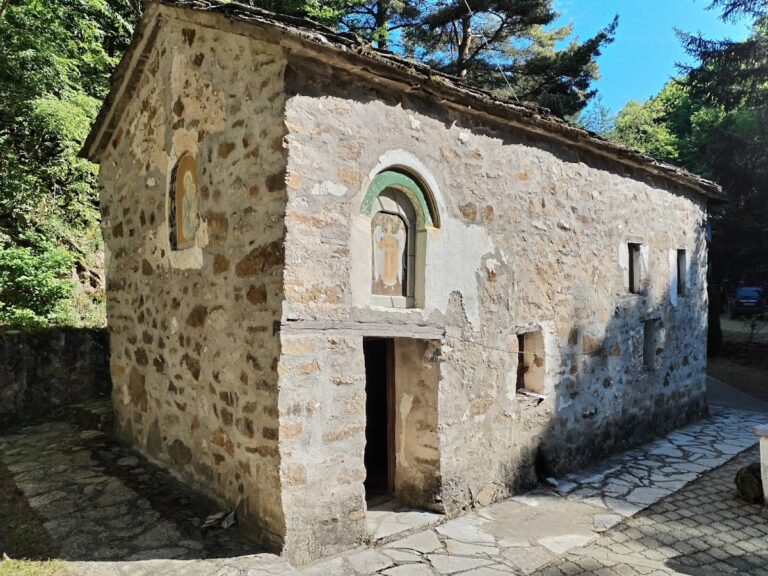
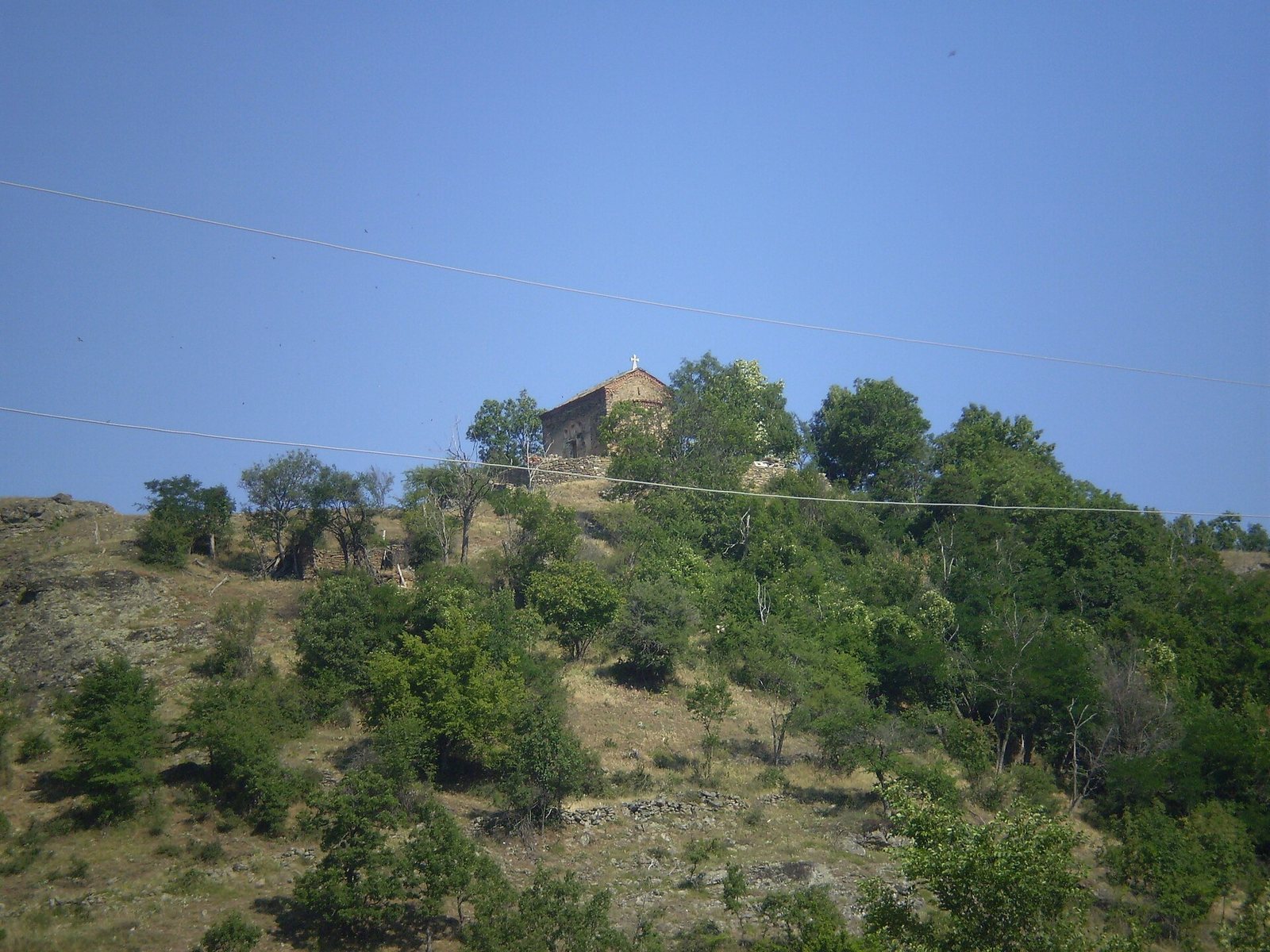
The church stands on the Vražji Kamen rock formation, also called Vražija Glava, above the Pčinja gorge near the river. The rock pinnacles rise approximately 60 metres, and the site lies about 3 kilometres west of Trgovište. The building is a small rectangular, single-nave structure with a semicircular eastern apse, a rounded recess at the eastern end of a church. Its position on irregular rock influenced both its construction and the form of later additions.
Church structure
Nave and apse
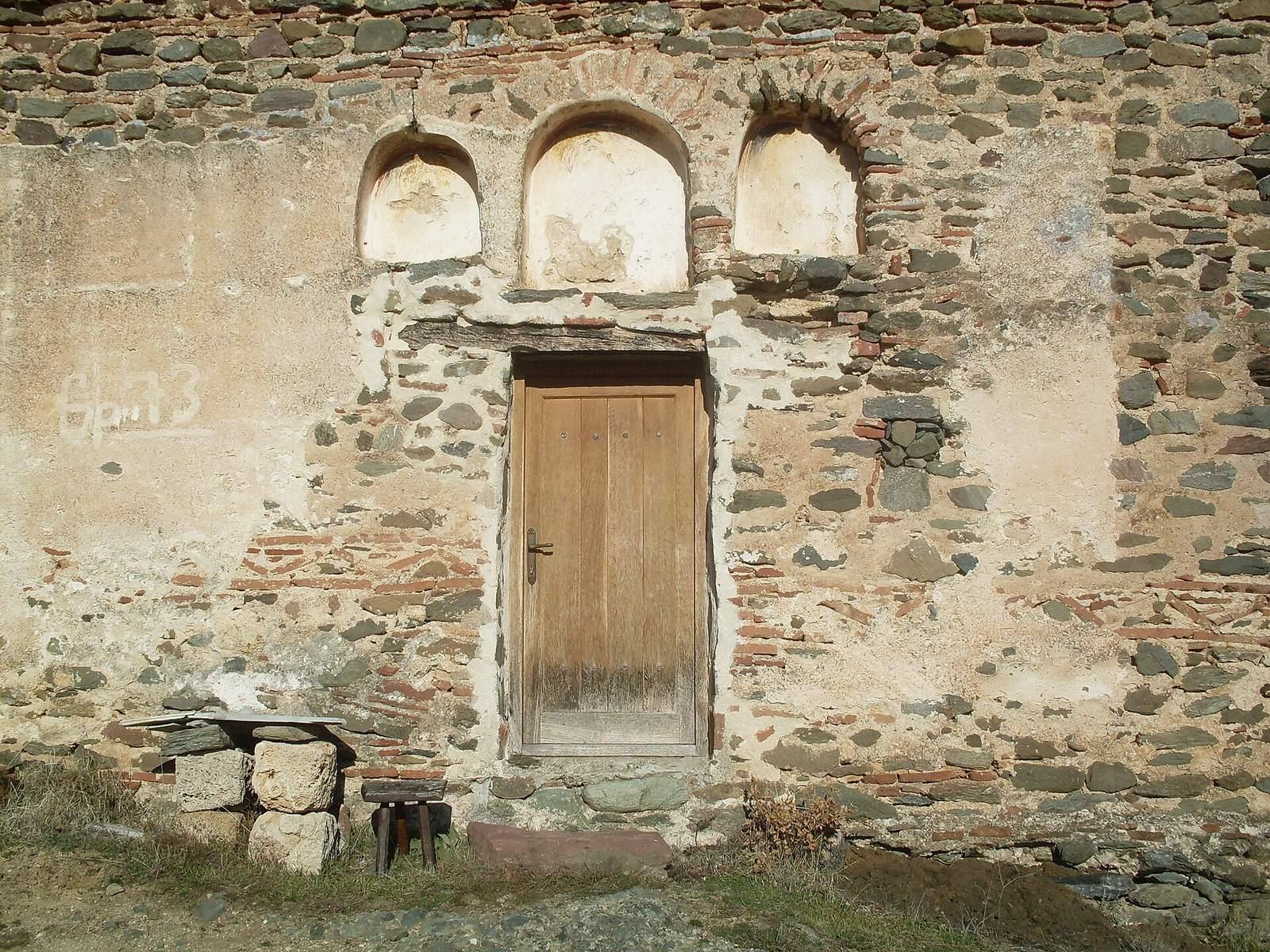
The nave has entrances on its west and south sides. Two narrow windows in the eastern wall admit the limited light that reaches the interior. The walls use alternating courses of stone and brick. The brick courses strengthen and level the roughly dressed stonework, an approach suited to the difficult terrain. The apse has especially elaborate masonry, with zigzag brick bands set into the stone. A double sawtooth frieze runs along the roof, while three blind niches surmount the southern entrance.
Nineteenth-century narthex
The nineteenth-century narthex follows the irregular rocky ground and was built at an oblique angle to the original church. This angled arrangement is an exceptional rarity among Orthodox churches and gives the entrance addition a distinct relationship to the uneven site.
Masonry iconostasis
A massive masonry iconostasis, a screen separating the nave from the sanctuary in an Eastern Christian church, rises to approximately 2 metres. It was painted with the Virgin Mary and Christ enthroned as Judge and Savior. Along with Saint Nicholas on the south wall, these images formed a Deesis, an Orthodox image of Christ enthroned with holy intercessors.
Frescoes and artistic remains
The original frescoes survive in part. They include standing figures, scenes from the cycle of the Great Liturgical Feasts, the principal festivals of the Orthodox calendar, and further episodes from the life of the Virgin Mary. Two painters can be distinguished stylistically. One used precise, refined drawing, while the other heightened emotion by distorting faces and painted the standing figures and details in scenes such as the Nativity and the Dormition of the Virgin Mary.
The paintings have stylistic parallels with fourteenth-century works at the Church of Saint Mary of Maligrad, the Church of Saint Athanasius in Kastoria, the Church of Saint George in Polog and Borje, the Church of Saint Michael in Lesnovo, Marko’s Monastery, and other churches in the Ohrid region.