San Domenico, Turin: A Medieval Gothic Dominican Church


Site at a Glance
- Rating
- 4.7
- Popularity
- Low
- Country
- Italy
- Primary era
- Medieval
- Eras represented
- Medieval, Early Modern
- Civilizations
- Duchy of Savoy, Holy Roman Empire
- Site type
- Religious
- Remains
- Church
On this page12 sections
History
San Domenico is a Roman Catholic church in Italy dedicated to Saint Dominic, the thirteenth-century Spanish founder of the Dominican Order. Dominican friars began building it in 1227, and the Gothic church was erected between 1227 and 1280. It is regarded as Turin’s principal medieval archaeological remnant and the city’s only surviving medieval Gothic church, making it one of the city’s oldest places of worship.
Foundation and medieval expansion
The Dominicans enlarged the church after the second half of the thirteenth century. Around 1260, the Dominican friar Giovanni da Torino built the adjoining convent and established its library. During the Middle Ages, the church and convent became one of Turin’s cultural centers, combining religious activity with study and education.
Because the Dominicans administered the complex, San Domenico later became the seat of Turin’s Inquisition Tribunal. The Inquisition was an ecclesiastical court that investigated and prosecuted suspected heresy. During the tribunal’s existence, approximately 80 heretics were condemned to capital punishment. The church also became a place of burial for members of the Dominican order, including Blessed Pietro Cambiani da Ruffia, one of Piedmont’s first inquisitors.
Medieval additions and Savoy patronage
The original church had neither a facade nor a bell tower. A facade was added in 1334, followed by the bell tower in 1451. The House of Savoy repeatedly donated to San Domenico, and its patronage brought Baroque decoration and the construction of several side chapels. At the request of Victor Amadeus III, an eighteenth-century ruler of the House of Savoy and king of Sardinia, a chapel dedicated to Blessed Amadeus IX opened in 1780. Amadeus IX had been a fifteenth-century duke of Savoy who was later beatified.
A violent fire in 1762 destroyed the Chapel of the Rosary and part of the church. The royal house ordered the complex to be rebuilt, and the Dominicans installed a new high altar in 1776. The altar of the Amadeus chapel, which already existed in 1612, was remodeled from 1779 according to a design by the architect Lodovico Bò.
Epidemic, Napoleonic disruption, and restoration
During Turin’s Black Death epidemic in 1630, a steel grille was placed at the entrance. Worshippers could attend Mass through the barrier without entering the building. During the Napoleonic period, most of the church’s relics and valuable materials disappeared, and the building became the seat of a Masonic lodge.
Riccardo Brayda and Alfredo D’Andrade directed major restoration work from 1906 to 1911. The campaign sought to recover the church’s original Gothic character after its Baroque alterations and other changes. The Amadeus chapel and other parts were later modified substantially. Among those buried at San Domenico are Emanuele Filiberto Pingone, a Turin historian at the court of Emanuele Filiberto of Savoy, and Padre Reginaldo Giuliani, chaplain of the Arditi, the Italian assault troops associated especially with the First World War. Giuliani was killed at Passo Uarieu and received the Gold Medal of Military Valor.
The small square in front of the church was dedicated during the 2014 beatification of Blessed Giuseppe Girotti. A friar from the convent, Girotti was deported to Dachau and died there on Easter Day, 1 April 1945. San Domenico was also commemorated by the Piedmontese poet Nino Costa in San Dumini, a poem published in the 1931 collection Fruta madura. The two sonnets form part of a five-poem cycle devoted to Turin churches.
Remains
Church body and medieval fabric
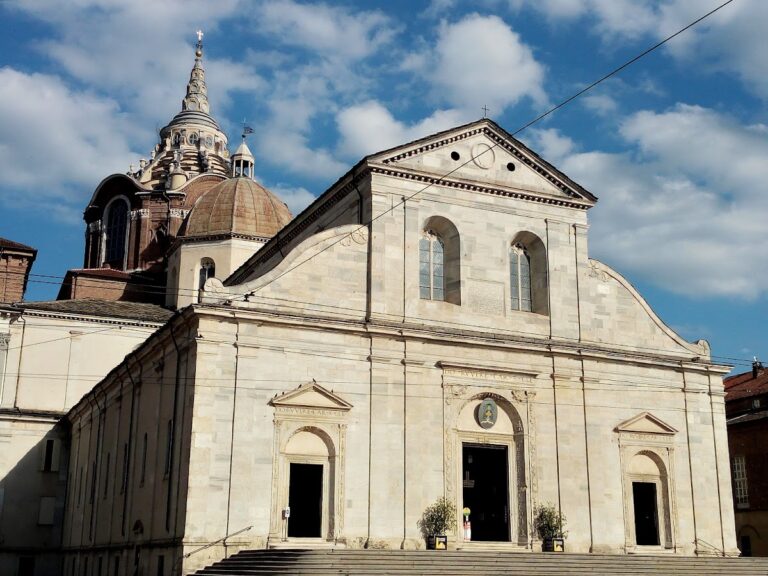
San Domenico has a three-aisled Gothic plan. Its facade opens onto a small square aligned with Via San Domenico, while the main body runs along Via Milano, the street linking Via Garibaldi with Porta Palazzo. A tall pointed gable frames the portal. Side altars occupy both lateral aisles, and two chapels stand on either side of the choir and high altar.
The surviving medieval fabric is visible in the church’s Gothic form, which was recovered through repeated restoration campaigns after Baroque alterations and other interventions. The columns separating the central nave from the side aisles carry the coats of arms of noble and notable families who donated to the restoration of 1906 to 1911. A commemorative plaque in the corridor leading to the sacristy and cloister records that campaign.
Choir chapels
Chapel of the Graces
The Chapel of the Graces stands on the left side of the choir. Around the middle of the fourteenth century, the artist known as the Master of San Domenico frescoed it. The lower registers of the central and side walls show the twelve Apostles. Its lunettes, the semicircular fields above the horizontal architectural elements, contain the Majestas Domini, a representation of Christ enthroned in divine majesty, together with the Annunciation and Saint Thomas presenting three devotees to the Virgin.
An icon at the center of the chapel dates from the sixteenth century. It depicts the Virgin and Child with Saints John the Baptist and Gabriel.
Chapel of the Rosary
The Chapel of the Rosary occupies the right side of the choir. Designed by Luigi Michele Barberis, it is an eighteenth-century work rebuilt after the fire of 1762. Its altarpiece, painted by Guercino, depicts the Madonna of the Rosary with Saints Dominic and Catherine of Siena.
Wooden carvings of the Fifteen Mysteries of the Rosary surround the altarpiece. These scenes represent episodes from the lives of the Virgin Mary and Jesus and serve as subjects for meditation in the Catholic rosary. Stefano Maria Clemente made the carvings, as well as the pulpit in the central nave beside one of the pillars separating it from the left aisle.
Paintings and furnishings
Saint Antoninus fresco
Behind the pulpit is a fresco of Saint Antoninus Pierozzi giving alms to two children. Giovanni Spanzotti painted it in 1528.
Sacristy and choir stalls
The sacristy contains The Madonna with Saint Dominic by Michele Milocco, dated 1737, and The Episode of the Plague of 1630 by Domenico Corvi. The choir stalls were made by Pietro Botto.