Basilica of Corpus Domini: Turin’s Eucharistic Pilgrimage Church
Site at a Glance
- Rating
- 4.6
- Popularity
- Low
- Country
- Italy
- Primary era
- Early Modern
- External website
- Open
- Eras represented
- Early Modern, Modern
- Civilizations
- Duchy of Savoy, Kingdom of Sardinia
- Site type
- Religious
- Remains
- Basilica
On this page10 sections
History
The Basilica of Corpus Domini is a Roman Catholic pilgrimage church in Turin, Italy, whose Baroque construction began in 1607 to commemorate a Eucharistic miracle traditionally said to have taken place there on 6 June 1453. The Eucharist is the consecrated bread and wine of Christian communion, while a Eucharistic miracle is a reported extraordinary event involving it. The basilica belongs to the Archdiocese of Turin and stands on the site associated with the miracle during the conflict between Savoy and France.
The miracle tradition
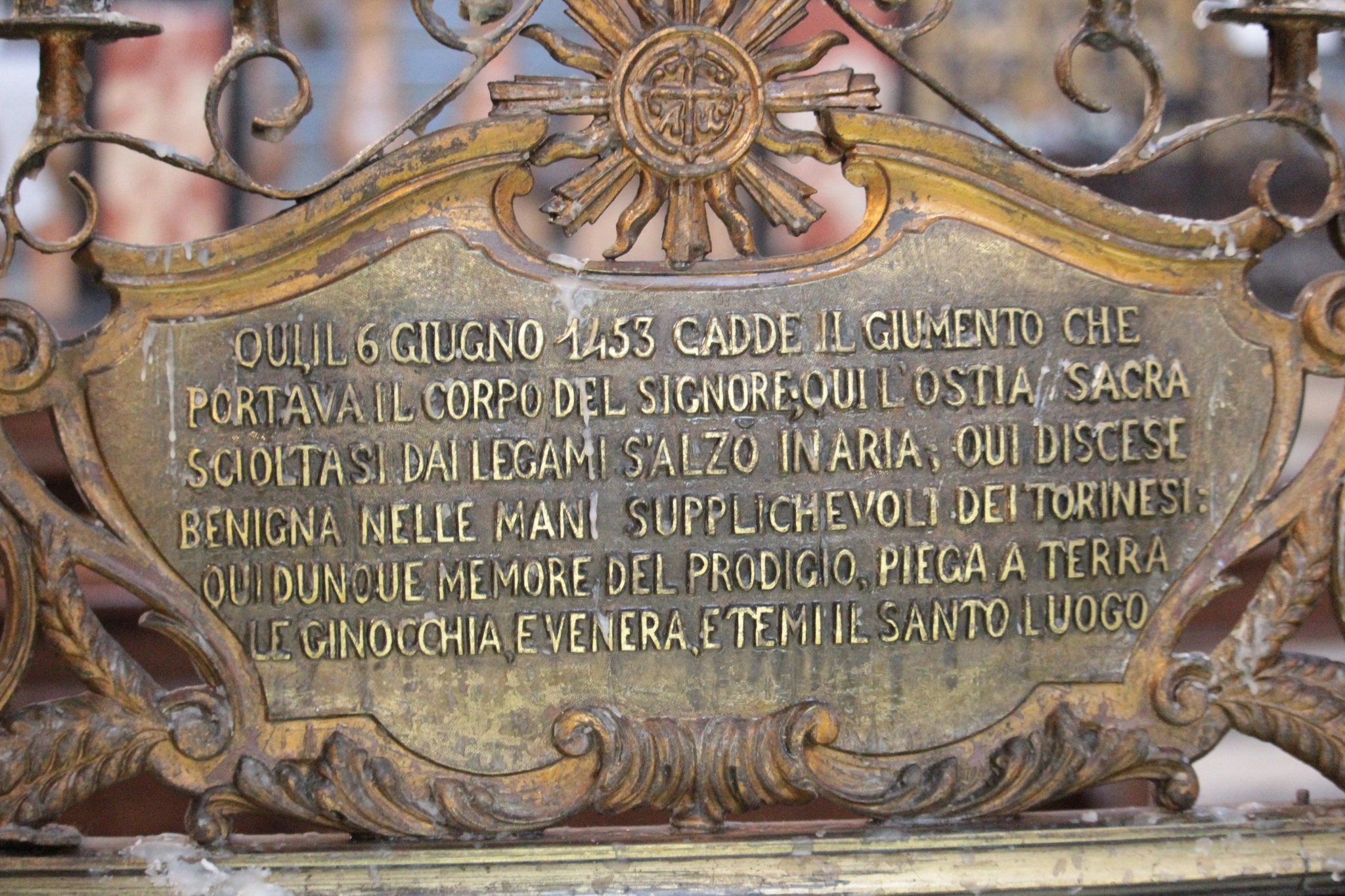
According to the tradition, French soldiers occupying and plundering the church of San Pietro Apostolo at Exilles in the Susa Valley carried its sacred objects to Turin for sale during Corpus Christi, the Catholic feast devoted to the Eucharist. The mule carrying the consecrated host fell at the site of the present basilica. The host then reportedly rose into the air and illuminated the square. Bishop Ludovico da Romagnano arrived, placed it on the stolen chalice, and carried it in procession to Turin Cathedral.
The event took place during the rule of Louis of Savoy, the fifteenth-century duke. René of Anjou, an Angevin ruler, was also associated with the episode through his crossing of the Alps and attack on Exilles during the conflict. The tradition gave the location a lasting religious identity and shaped the purpose of the buildings that followed.
From chapel to basilica
A small chapel was planned around 1509 or 1510 on the grain market beside the church of San Silvestro, which occupied the site of the present basilica. The plan did not initially proceed. In 1521, Archbishop Innocenzo Cybo ordered a small oratory designed by Matteo Sanmicheli, which was completed in 1529. It was demolished around 1609 to make way for the present church.
The new basilica was undertaken partly in fulfilment of a vow connected with deliverance from the plague. Ascanio Vittozzi received the commission in 1603, and construction began in 1607 when the foundation stone was laid in the presence of Duke Charles Emmanuel I, civic officials, clergy, and a large crowd. Amedeo di Castellamonte also contributed to the design, particularly the facade.
Eighteenth-century enlargement
For the three-hundredth anniversary of the miracle in 1753, Charles Emmanuel III of Savoy commissioned Benedetto Alfieri, an architect associated with the late Baroque, to revise and enlarge the interior decoration. The work introduced extensive stucco and gilding. The church was solemnly inaugurated on 30 November 1769, after the long process of construction and interior renewal.
Further work followed in 1853, when Luigi Vacca painted the vault frescoes and restored the facade. Pope Pius XI raised the church to the rank of minor basilica on 2 August 1928 at the request of the canons of Corpus Domini. A minor basilica is a church given a special papal designation recognizing its religious importance without making it a cathedral.
War damage and restoration
Bombing during the Second World War penetrated the roof and caused particular damage to the altar, the Chapel of Saint Charles, the organ, and the sacristy. The basilica was restored in the early 1950s, and another careful restoration was completed in 2003.
Religious figures associated with the parish
Several religious figures connected the basilica with the wider history of Turin. Father Sebastian Valfrè served as parish priest from 1653 to 1655. He belonged to a community of twelve Oratorian priests, a Catholic community of secular priests living according to a common rule and devoted especially to pastoral and educational work. Christine of France, the regent of Savoy, had entrusted them with administering the parish.
Saint Joseph Benedict Cottolengo served as a parish vicar and belonged to the Corpus Domini congregation. After seeing a sick woman refused admission by hospitals, he conceived the Little House of Divine Providence for patients who were rejected or difficult to care for. The institution later became associated with his charitable work among poor and seriously ill people. Joseph Marello, a nineteenth-century Catholic bishop and founder of the Oblates of Saint Joseph, was baptized in the basilica on the day of his birth, 26 December 1844.
Remains
Facade and nave
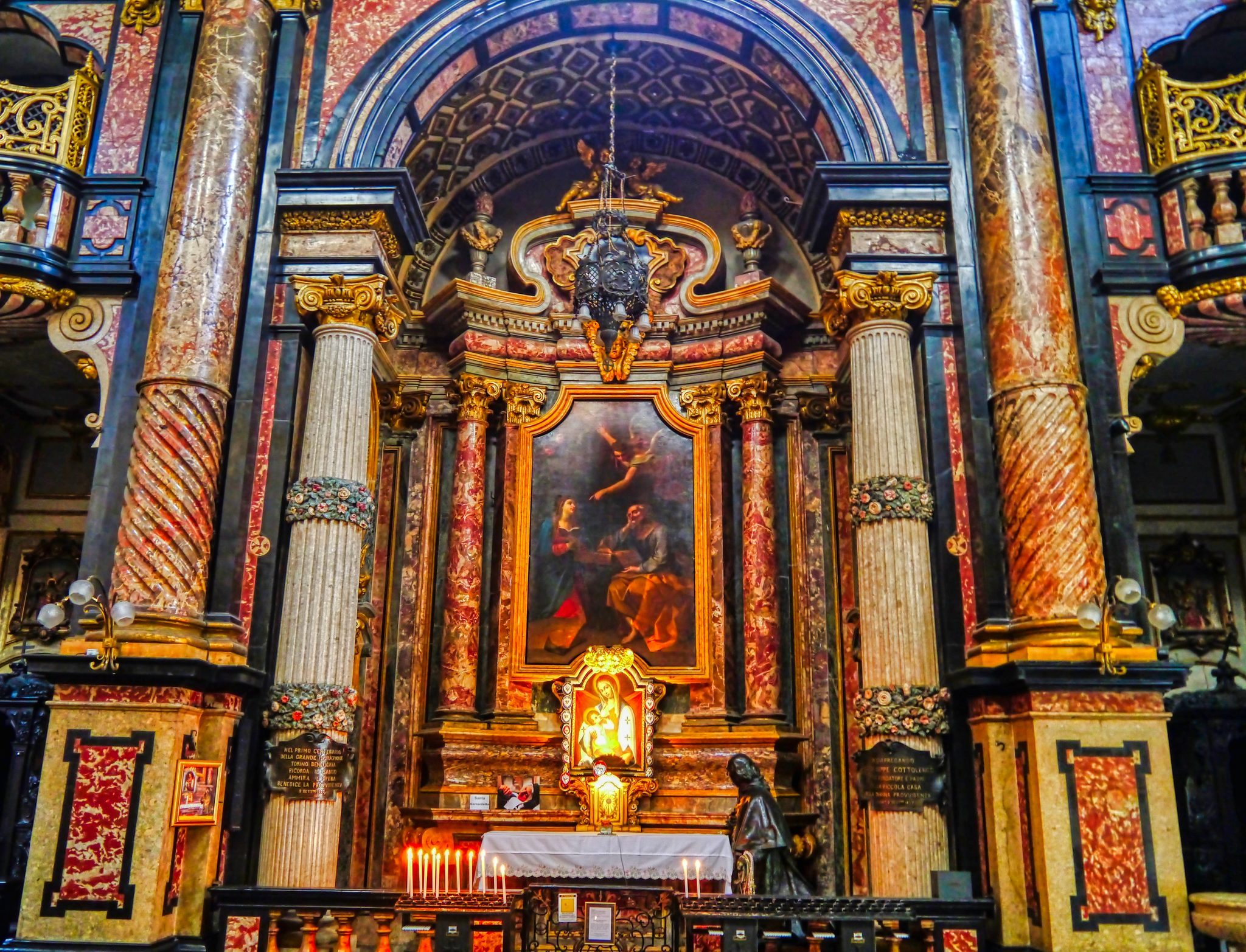
The basilica presents a massive Baroque facade organized by six piers and four columns that support the entablature. Statues of angels and saints made by Bernardo Falcone in the second half of the eighteenth century complete the exterior. Inside, the church has a single nave whose decoration was extensively renewed during the eighteenth century. Black and red marble alternate across the interior, while paintings throughout the building recall the Eucharistic miracle.
A commemorative plaque between the second and third chapels on the left marks the location traditionally associated with the miracle. A protective wrought-iron gate emphasizes the marked place within the nave. Six chapels surround the central space, with three on each side.
High altar and miracle imagery
The present high altar was made by Francesco Lanfranchi in 1664 after an earlier altar was destroyed by fire in 1653. Its altarpiece, painted by Bartolomeo Caravoglia in 1667, depicts the miracle, and the tabernacle was made by Bernardo Antonio Vittone in 1768. Twisted columns surround the altar, while sculptures by Giovanni Battista Casellages represent Faith, Hope, and Charity.
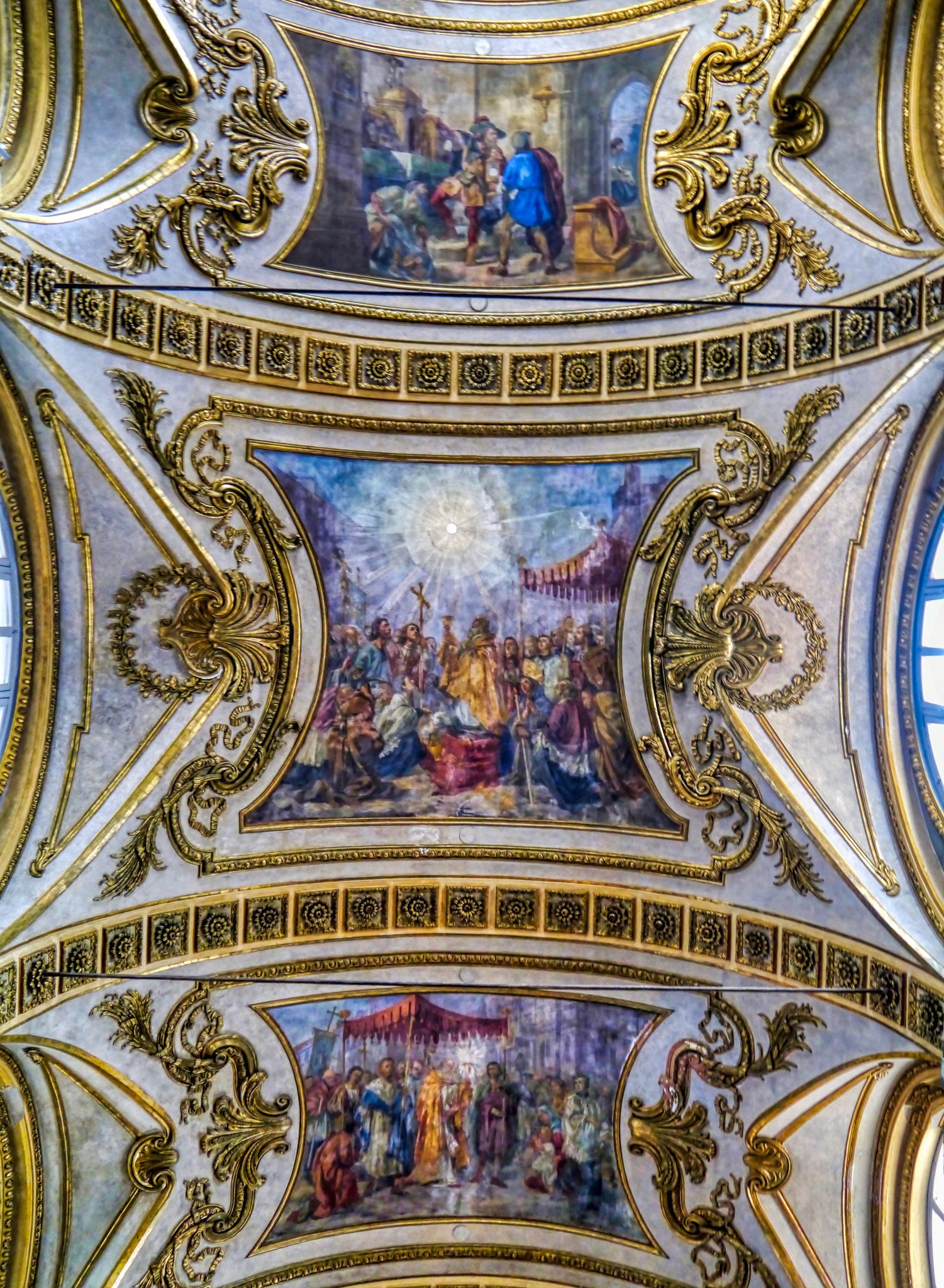
Luigi Vacca’s vault frescoes present three episodes associated with the tradition: the theft, the elevation of the host, and its transfer to the cathedral tabernacle. The sacristy contains paintings by Pietro Domenico Olivero on the same subject. Together, these works extend the miracle narrative from the altar and nave into other liturgical spaces.
Side chapels and organ
The second chapel on the right is dedicated to Saint Joseph. Its altar was made by Filippo Juvarra between 1721 and 1724, and its paintings by Dionigi Gerolamo Donnini depict the Marriage of the Virgin, the Vision of Saint Joseph, and the Transit of Saint Joseph. A statue of Saint Joseph Benedict Cottolengo by Davide Calandra, made in 1917, also stands in the chapel.
The second chapel on the left is dedicated to Saint Charles Borromeo, the sixteenth-century cardinal and reforming archbishop of Milan. Its 1752 altarpiece, painted by Agostino Cottolengo, shows Saint Charles with Saint Francis de Sales, a Catholic bishop and devotional writer associated with the Counter-Reformation. On the right wall is The Communion of Saint Charles by Francesco Antonio Mayerle, also dated 1752.
The organ was installed by Carlo Vegezzi Bossi in 1914. Its history forms part of the basilica’s later musical and liturgical furnishing, alongside the altar, chapels, paintings, and sculptural decoration that shape the interior.