Saint John the Baptist Church in Radom: A Royal Gothic Parish Church


Site at a Glance
- Rating
- 4.6
- Popularity
- Low
- Country
- Poland
- Primary era
- Medieval
- External website
- Open
- Eras represented
- Medieval, Early Modern, Modern
- Civilizations
- Kingdom of Poland, Polish–Lithuanian Commonwealth, Russian
- Site type
- Religious
- Remains
- Church
On this page12 sections
History
Saint John the Baptist Church in Radom, Poland, is a Roman Catholic parish church founded as a royal brick-Gothic project associated with King Casimir III in the fourteenth century. Probably established after 1325 and likely before Casimir chartered New Radom, the parish received royal endowment during the town’s foundation, first under Środa law around 1340–1360 and then under Magdeburg law in 1364. The original church was built around 1360–1370 near Radom’s market square and castle.
Royal parish and political history
The parish is first recorded before 27 July 1408. Its position beside the market and castle gave it a close connection with the town’s political centre. Casimir IV Jagiellon’s son, Saint Casimir, treated it as a castle church during his residence in Radom from 1481 to 1483 and often prayed there.
The church also hosted important events involving the Jagiellonian dynasty and the Polish political order. In 1495, Frederick Jagiellon, a son of Casimir IV Jagiellon who became a cardinal, ceremonially received the papal bull appointing him and the insignia of his office inside the church. In 1505, the Polish Sejm, the representative assembly of the Polish kingdom, met there and enacted Nihil Novi, meaning “nothing new.” This constitutional principle required the agreement of the king and representatives of the political nation for major legislation.
Chapels, learning, and changing use
Side chapels were added during the fifteenth and sixteenth centuries. Jan Warcab, a burgher of Radom, founded the Rosary Chapel in 1481. Wojciech and Anna Kościeni built the Kosnowska, also called Saint Anne’s, Chapel in 1495, while Stefan Baryczka, another Radom citizen, erected the Baryczkowski Chapel in 1500. A library attached to the church existed in the sixteenth century and held 170 Latin volumes.
During the seventeenth century, the Kosnowska and Baryczkowski chapels were converted into cloisters beside the later Kochanowski Chapel. A cloister is a covered walkway associated with a religious building. The former Holy Cross Chapel became a storeroom for church equipment. The church’s burial practices also changed. In 1588, Bishop Jerzy Radziwiłł prohibited burials beneath the altars, and the church cemetery was closed for burials in 1797.
Damage and reconstruction
Part of the vault collapsed in 1752, and by the beginning of the nineteenth century the building was seriously damaged. Restoration between 1817 and 1838 raised the nave walls, replaced the nave covering with a wooden ceiling, provided a new roof for the roof turret, heightened the tower, and plastered the exterior. These interventions gave the west facade a Neo-Gothic appearance. The chancel paintings were renewed between 1837 and 1840, and the church was reconsecrated in 1844.
The tower was restored and raised with a fifth story between 1881 and 1889. The Kochanowski Chapel was restored in 1888, and the fence along Rwańska Street, donated by Tsar Alexander I, was renewed. A thorough rebuilding in 1908–1909, directed by parish priest Piotr Górski according to a design by architect Józef Dziekoński, further shaped the church’s present Neo-Gothic character.
Twentieth-century memory and protection
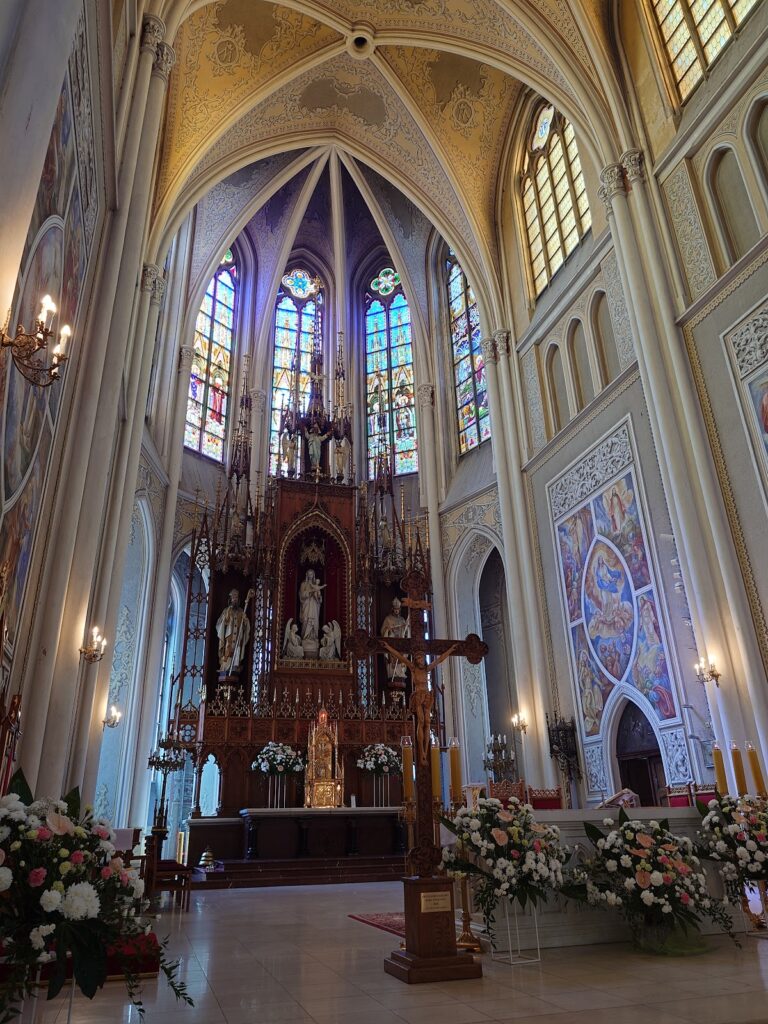
Further restoration took place in the 1960s. In 1972, Professor Wacław Taranczewski of Poznań and his team created new interior polychromy at the initiative of parish priest Stanisław Sikorski. Polychromy is multicolored painted architectural or sculptural decoration. The design referred stylistically to the church’s Gothic interior, while the exterior was restored in 1973.
The church is associated with several figures and events from modern Polish history. Wanda Malczewska was baptized there on 22 May 1822, and the painter Jacek Malczewski was baptized there in 1854. A plaque commemorates Cardinal Karol Wojtyła’s stay on 21 August 1977. During the German occupation, Kazimierz Grelewski was arrested during the night of 24 January 1941 in the parish building beside the church and the presbytery, which is identified as a former castle. He was deported to Dachau and hanged there on 9 January 1942.
The former churchyard became a square during the nineteenth century. Saint John the Baptist Church is protected as a monument in Poland and appears in the monument register under entries dated 1 December 1956, 23 June 1967, and 6 April 1981.
Remains
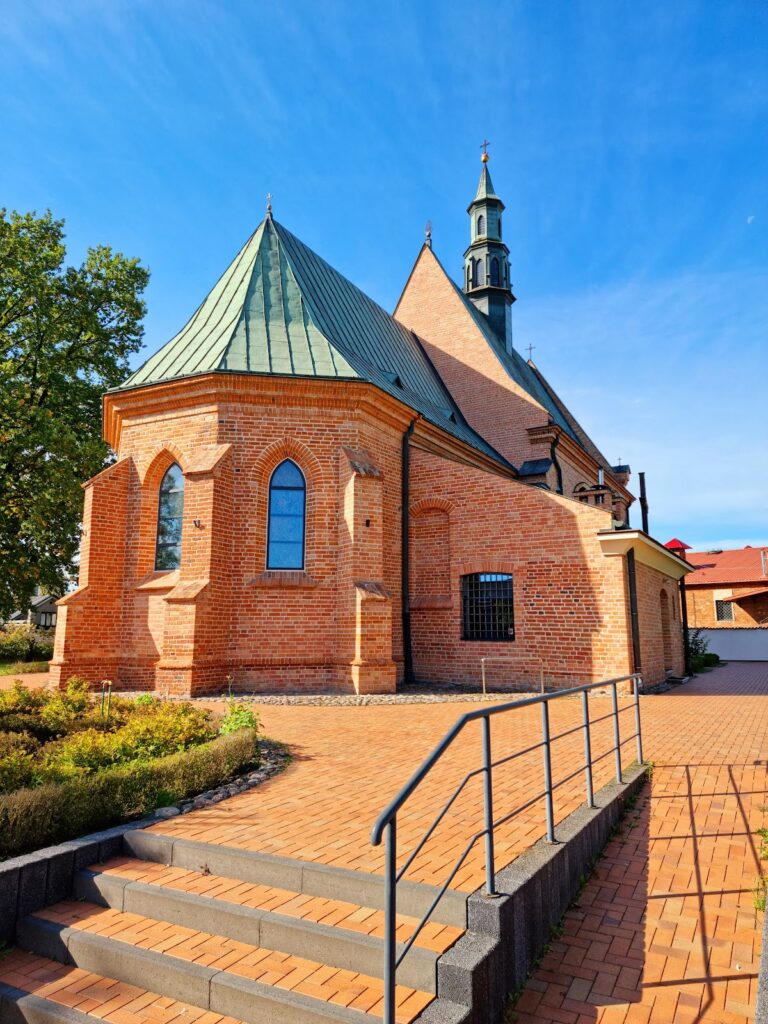
The church is an oriented brick building, originally arranged as a single nave in the Gothic, or brick-Gothic, tradition. An oriented church follows a traditional directional arrangement, usually placing the chancel toward the east. Repeated alterations have produced a Neo-Gothic structure with a single nave and an added side nave. The medieval fabric that survives includes the chancel, the northern nave wall, the tower, the Rosary Chapel, and the Kochanowski Chapel.
Medieval and later church fabric
Chancel, nave, and tower
The chancel, the part of the church containing the main altar and traditionally reserved for the clergy, is one of the surviving medieval elements. Its vault paintings were renewed in 1837–1840. The northern nave wall and the tower also belong among the preserved parts of the earlier church. The tower received restoration and a fifth story in 1881–1889, contributing to the building’s later Neo-Gothic form.
Rosary Chapel
The Rosary Chapel, founded in 1481 by Jan Warcab, survives from the group of fifteenth- and sixteenth-century side chapels. It is the second chapel added to the church during that period and remains part of the building’s medieval architectural inheritance.
Kochanowski Chapel
The Kochanowski Chapel is a late-Renaissance structure built between 1630 and 1633 with funding from Jan Kochanowski, the Crown Grand Standard-Bearer. It was first known by his name, later as the Saint Magdalene Chapel, and subsequently as the Lord Jesus Chapel. Its vault carries polychrome decoration, and the chapel was restored in 1888.
Former chapels and interior memorials
The former Kosnowska and Baryczkowski chapels now survive as cloisters beside the Kochanowski Chapel, reflecting their seventeenth-century conversion. The former Holy Cross Chapel is used as a storage room for church equipment. Nineteenth-century epitaph plaques remain inside the church. Older plaques had existed but were destroyed during damage and later renovations.
Former churchyard
The square occupying the former churchyard contains several surviving monuments and transferred memorials. An eighteenth-century statue of Saint John of Nepomuk stands there, together with a nineteenth-century stone column topped by a sculpture of Christ. A nineteenth-century stone cross commemorates the former cemetery, while nineteenth-century gravestones were transferred from it. The parish building and presbytery stand beside the church, with the latter identified as a former castle.