St George’s Church, Modbury: A Medieval Parish Church in Devon


Site at a Glance
- Rating
- 4.7
- Popularity
- Very Low
- Country
- United Kingdom
- Primary era
- Medieval
- Eras represented
- Medieval
- Civilizations
- English
- Site type
- Religious
- Remains
- Church
On this page9 sections
History
St George’s Church, Modbury, in the United Kingdom, is an active Church of England parish church whose main parts date from the early fourteenth century. It formerly depended on Modbury Priory and now belongs to the Diocese of Exeter, within the Archdeaconry of Totnes and Totnes Deanery. Its parish is part of a benefice, a group of churches served under shared clergy, that includes Modbury, Bigbury, Ringmore, Kingston and Aveton Gifford. The church is a Grade I listed building, the highest category of statutory historic-building designation in England, reserved for buildings of exceptional interest.
Medieval origins and rebuilding
The church developed as a dependency of Modbury Priory, meaning that it was administered in association with that larger religious house. Its principal fabric belongs to the early fourteenth century. Local tradition says that lightning struck the church in 1621, after which it was rebuilt while retaining the character of its earlier predecessor. The tower’s spire is thought to have been reconstructed at this time as a copy of the original.
Restoration and continuing use
Major restoration took place between 1923 and 1925, when work addressed the stonework and spire. The spire underwent further restoration in 1938. In 2013, Historic England placed the church on its Heritage at Risk Register because of roof damage and damp. A Heritage Lottery Fund grant in 2015 supported extensive roof repairs and restoration. The church remains in use as a parish church within the Church of England, the established Anglican church in England.
Memorials and bells
Memorials commemorate the Champernowne and Prideaux families. An acrostic tombstone dated 1563 commemorates Oliver Hill of Shillston. During the tower and spire restoration of the 1930s, the bells were rehung in a new frame. The restored ring was dedicated by the Bishop of Exeter on 29 January 1936, followed by a muffled peal, a form of bell ringing associated with mourning, after the recent death of King George V.
Remains
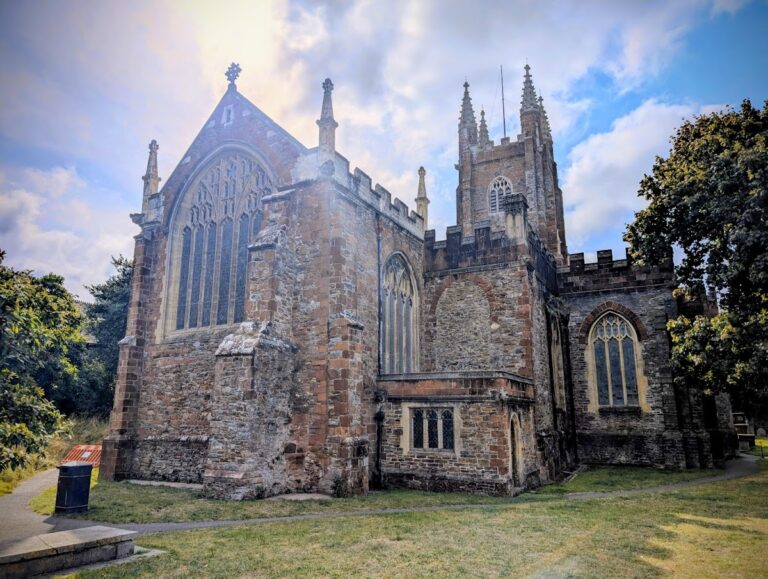
The surviving church is organized around a nave with aisles and transepts, together with a Lady Chapel, vestry, and chancel. A transept is a cross-wing projecting from the main body of a church, while the chancel is the eastern part containing the altar. These spaces retain wagon roofs, which have a continuous rounded or polygonal barrel-like profile. Dendrochronological analysis, the dating of timber through comparison of annual growth rings, indicates that the church was reroofed during the sixteenth century.
Tower and spire
The tower is strengthened by angle buttresses and carries a broach spire. This type of spire rises from a square tower through transitional triangular or pyramidal sections. The spire was probably rebuilt after the reported lightning strike of 1621 as a copy of the earlier form. Its stonework and structure were included in the twentieth-century restoration campaigns.
West window and altar furnishings
Several deteriorated sections of stone in the large west window were repaired during the restoration of 1923 to 1925. The same work introduced a new oak reredos, an ornamental screen or panel behind an altar. Designed by Harbottle Reed of Exeter, it features a painting of the Crucifixion.
Organ and bells
The organ was made by Forster and Andrews of Hull and installed in 1873. It has two manuals, meaning keyboards that control separate divisions of the instrument, together with pedals and 17 speaking stops, each controlling a rank of pipes that produces sound. The church also has a ring of six bells recast in 1806 by Thomas Castleman Bilbie. The tenor weighs 892 kilograms, and the bells sound in the key of E-flat.
Turret clock
A turret clock made by Ambrose Hawkins of Exeter was installed in 1705. It is closely similar to the clock preserved in St Saviour’s Church, Dartmouth.