Salcombe Castle: A Tudor Coastal Gun Battery in Devon


Site at a Glance
- Rating
- 3.8
- Popularity
- Very Low
- Country
- United Kingdom
- Primary era
- Early Modern
- Eras represented
- Early Modern
- Civilizations
- English
- Site type
- Military
- Remains
- Fort
On this page12 sections
History
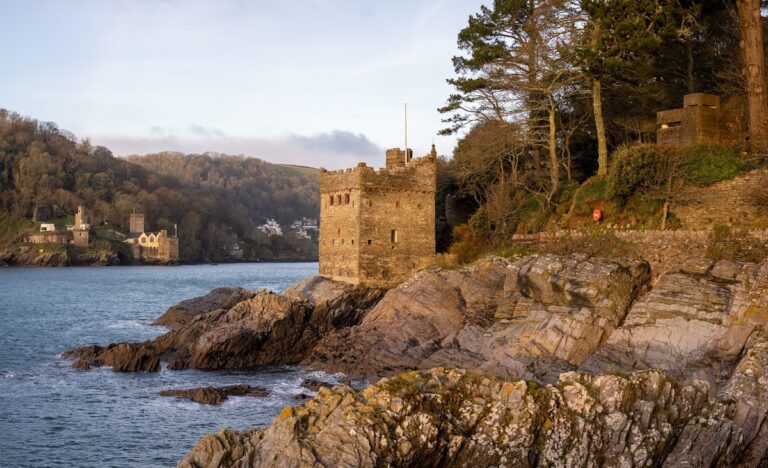
Salcombe Castle, also known as Fort Charles, is a coastal gun battery in Salcombe, United Kingdom, built between 1535 and 1539 as a Tudor defence against French raids. Originally called the Bulwark, it was financed by subscription under the direction of Viscount Courtenay rather than through King Henry VIII’s Kinges Works, the royal programme that built many batteries and castles in southern and south-western England. Its original design included seven gun embrasures, openings in a defensive wall through which cannon could fire.
Construction and coastal defence
Construction probably came under the supervision of Thomas Treffry of Fowey, a coastal-defence overseer associated with the Cornish port. The rocky promontory was difficult to reach, so a causeway from Salcombe village had to be made before the battery could be built. Cuts through the rock survive along parts of this approach, providing physical evidence of the work required to connect the settlement with the fortification.
The English Civil War
The English Civil War, fought from 1642 to 1651 between supporters of King Charles I and Parliament, brought Fort Charles into active conflict. Parliamentary ships raided the fort twice. On 12 July 1645, the Parliamentary ship James sailed from Plymouth with 200 men, anchored at Salcombe, and landed troops who demanded the castle’s surrender. The troops were later re-embarked and returned to Plymouth on 15 July.
In 1646, the Royalist governor, Colonel Sir Edmund Fortescue of East Allington, defended the fort for nearly five months against Parliamentary forces. The besieging army was under the overall command of Colonel Weldon from Plymouth. Colonel Richard Inglesby and his regiment, together with three guns, were transferred to the siege from Dartmouth.
The Parliamentary artillery was first placed on Rickham Common above Sunny Cove. In March, heavier guns were brought from Plymouth under Weldon’s command. Royalist supporters briefly ambushed the guns at Pin End, at the eastern end of the causeway across the River Avon from Aveton Giffard. The attack was led by William Lane, a clergyman who supported the Royalist cause.
The heavier artillery was then installed in what is now the Italian garden in The Moult garden. Moving the guns required a specially made track down Moult Hill and along the present upper Moult drive, because the older winding route could not accommodate the guns, carriages, and horses. With supplies running low and no prospect of relief, the Royalist garrison surrendered Fort Charles on 7 May 1646. The fort was then slighted, meaning that it was deliberately damaged to reduce its defensive effectiveness, but it continued to operate as a gun battery until at least 1717.
Later battery use
A survey of 1717 listed five guns mounted on carriages, although two were unusable. They were identified as former ship’s guns and were thought to have been recovered from nearby shipwrecks. The surviving fortification is a Grade II listed building and an ancient monument.
Remains
Fortification and approach
Semicircular tower and wall
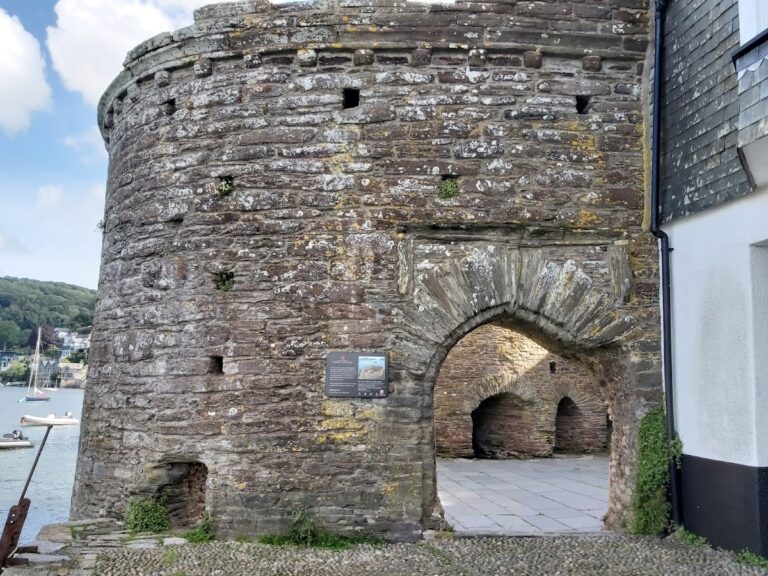
The ruins stand on a rocky outcrop just off North Sands in Salcombe, Devon. The surviving fortification includes a four-storey semicircular tower about 7 metres high. Gun ports, openings for cannon, are positioned near its top. A section of wall joins the semicircular tower to a rectangular tower approximately 6 metres high.
Causeway and rock cuts
Remnants of the approach causeway survive in the rocky ground between Salcombe village and the fort. Clearly visible cuts through the rock mark parts of the route created to make access to the promontory possible during the battery’s construction.
Siege landscape and artillery remains
Rickham Common emplacements
Three gun emplacements associated with the 1646 siege remain identifiable beneath brambles on Rickham Common above Sunny Cove. They belong to the wider artillery position used by the Parliamentary besiegers before heavier guns were moved to The Moult garden.
Parliamentary gun track
The track built to transport the heavier Parliamentary artillery remains in existence. It ran down Moult Hill and along the upper Moult drive, forming a purpose-built route for guns, carriages, and horses when the older winding approach proved unsuitable.
Guns recorded in 1717
The five guns listed in the 1717 survey comprised three 5¼-pounder guns measuring 6 feet 10 inches, 6 feet 11 inches, and 6 feet 6 inches, one 4-pounder gun measuring 6 feet, and one 3-pounder gun measuring 4 feet. Their recorded weights were 10 stone, 11 stone, 11 stone, 13 stone, and 3 stone respectively. Two of the five guns were unusable, and the group was identified as former ship’s artillery presumed to have been recovered from nearby wrecks.
Nearby sites