Fort Bovisand: A Coastal Defence Fort at Plymouth Sound

Site at a Glance
- Rating
- 4.5
- Popularity
- Very Low
- Country
- United Kingdom
- Primary era
- Modern
- External website
- Open
- Eras represented
- Modern
- Civilizations
- British
- Site type
- Military
- Remains
- Fort
On this page10 sections
History
Fort Bovisand is a British coastal fort in the United Kingdom, built between 1861 and 1869 after the 1860 Royal Commission on the Defence of the United Kingdom. It formed part of the defences at the entrance to Plymouth Sound, facing the eastern end of Plymouth Breakwater from the mainland beside Bovisand Harbour.
Early works and construction
A stone jetty and slip were built at the site in 1816. They allowed boats from sailing warships anchored in Plymouth Sound to collect fresh water from a nearby reservoir. The first fortification followed in 1845, when construction began on Staddon Height Battery, a fortified artillery position that survives within the upper part of the present fort.
The main fort was commissioned as part of the major programme of coastal defences that followed the Royal Commission’s review of Britain’s national and coastal security. Major Whitworth Porter designed it, and George Baker and Company carried out the construction. The original fort was intended to have two storeys of gun positions, following the design of Fort Picklecombe in Cornwall, but the plan changed during construction to a single storey containing 23 granite casemates, enclosed gun positions protected by heavy construction.
Armament and wartime change
When completed, Fort Bovisand held 22 nine-inch Rifled Muzzle Loader guns and one ten-inch Rifled Muzzle Loader. These were large rifled cannons loaded from the front. The fort also provided accommodation for 180 men. By 1880, the guns had been rearranged as fourteen ten-inch and nine nine-inch weapons. By 1893, the armament consisted of fourteen ten-inch guns, eight nine-inch guns, and six six-pounder quick-firing guns, which were designed to fire more rapidly than the older heavy muzzle-loading weapons. Six twelve-pounder quick-firing guns were installed in 1898.
The original heavy guns were obsolete by the early twentieth century and were removed. During the Second World War, four remaining twelve-pounders were replaced in 1942 by two twin six-pounder guns intended for use against German E-boats, fast coastal attack craft. A three-storey observation tower was added to direct their fire. In 1943, the fort also received a Bofors 40 mm anti-aircraft gun, a weapon widely used against aircraft.
Military abandonment and later uses
The Ministry of Defence abandoned Fort Bovisand in 1956 after coast artillery was dissolved. A lease in 1970 enabled the site to be converted into a national commercial diving school and scuba-diving centre. From about the mid-1970s until at least the early 1990s, the upper fort served as a schools outdoor-activity centre. Its magazine and other buildings were adapted as bunkhouses, a kitchen, and a dining area, while the cottage became a toilet and shower block, lounge, and staff accommodation.
The main leaseholder, Fort Bovisand Underwater Centre, went into liquidation by 2000. In December that year, Plymouth Ocean Projects Ltd entered receivership. The Ministry of Defence then concluded that the site could no longer remain operational, and the remaining diving and other businesses ceased trading.
Preservation and redevelopment
In mid-2004, Powder Creek Ltd, later known as Fort Bovisand Developments Ltd, bought the site from the Public Receiver with the stated aim of preserving it and returning it to use. Discovery Divers was operating at the fort by late 2004.
The Fort Bovisand Trust, a registered charitable body, was formed in 2011 to advance proposals for a heritage attraction and seek support from the Heritage Lottery Fund, now known as the National Lottery Heritage Fund. The proposed scheme combined a heritage centre and learning facilities with diving businesses and residential units. In 2013, the Trust received a development grant for a heritage visitor attraction and learning centre, although its application for a full delivery grant was unsuccessful. Historic England, the public body that advises on England’s historic environment, and South Hams District Council continued to support preservation and approved additional residential, catering, and commercial units in cooperation with the developers.
Preparatory works and further surveys took place in 2019. Cliff and access-road stabilisation followed in 2020, securing access to the fort and nearby private residences, and the first stage of a new development began in early 2021. Fort Bovisand remains part of the defences of Plymouth Sound and is described as complete, although it is not open to the public.
Remains
Fortifications and gun positions
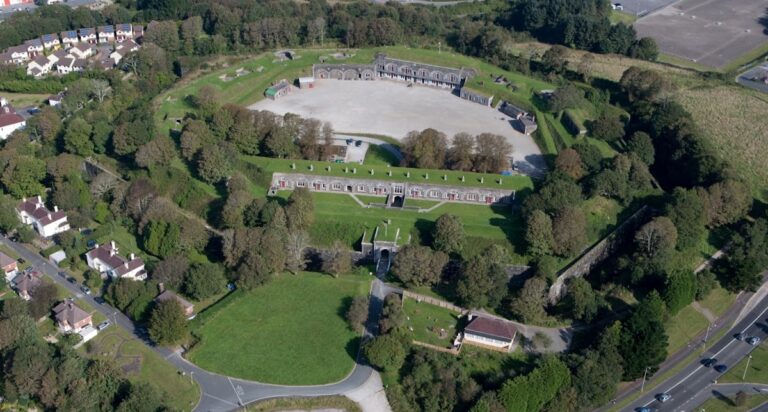
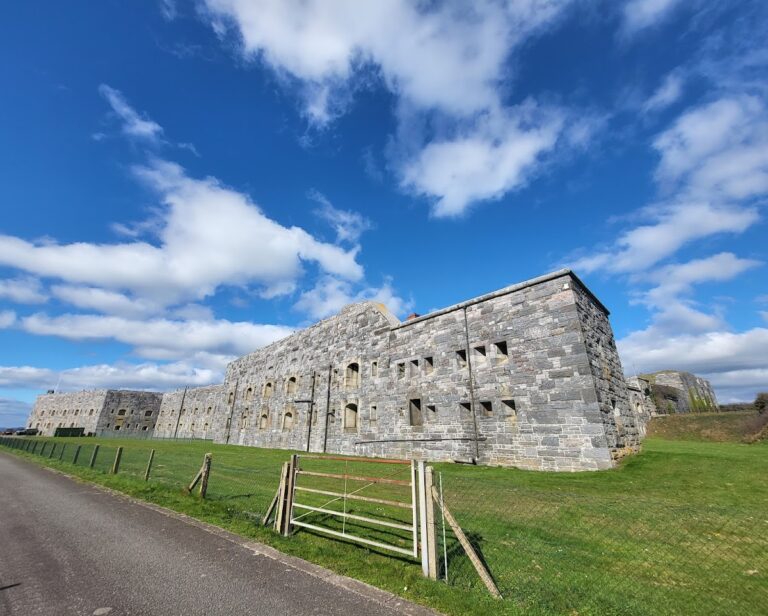
Fort Bovisand occupies the mainland at a narrow point opposite the eastern end of Plymouth Breakwater, beside Bovisand Harbour. Its construction uses concrete and masonry. The upper part incorporates the surviving Staddon Height Battery, begun in 1845, while the main fort is arranged as a single-storey arc of 23 granite casemates. Each casemate was a fortified enclosed gun position, and the original positions were fitted with armoured shields. Together they housed the fort’s initial armament of 22 nine-inch and one ten-inch Rifled Muzzle Loader guns, as well as accommodation for 180 men.
Ammunition storage
Large, deep tunnels extend underground within the fort. They were built to store artillery ammunition in spaces protected from enemy gunfire, forming part of the defensive infrastructure that supported the casemates above.
Twentieth-century military features
A three-storey observation tower was added in 1942 to direct the twin six-pounder guns installed against German E-boats. The fort’s later anti-aircraft defences included a Bofors 40 mm gun installed in 1943. These additions altered the surviving military layout as the fort adapted to the threats of the Second World War.
Later adaptations and setting
During the outdoor-activity-centre period, the upper fort’s magazine and several other buildings were converted into bunkhouses, a kitchen, and a dining area. The cottage was adapted to contain toilet and shower facilities, a lounge, and staff accommodation. Cliff-stabilisation and access-road works in 2020 affected the site’s access infrastructure and the surrounding cliffs.