Church of San Carlo in Erice: Baroque church and former charitable convent


Site at a Glance
- Rating
- 4.6
- Popularity
- Very Low
- Country
- Italy
- Primary era
- Early Modern
- Eras represented
- Early Modern
- Civilizations
- Italian
- Site type
- Religious
- Remains
- Church
History
The Church of San Carlo in Erice, Italy, is a Roman Catholic foundation begun in the early 17th century and later fashioned in the Baroque manner; it was established in 1617 by the priest Gianpietro Maranzano to serve a charitable house for orphaned girls. The complex that grew up around the church combined a place of worship with an enclosed community dedicated to care and education, and over time the institution became known locally for producing sweets and pastries, a craft that endured into the twentieth century.
Construction and reworking of the fabric continued over the centuries, with the present Baroque appearance completed in 1774 and further work recorded in 1844. The community that ran the institute survived the upheavals of Italian unification because the women living there were enclosed lay residents rather than members of a formal monastic order, and so the 1866 law that suppressed many religious houses did not lead to its dissolution. During the twentieth century individuals associated with San Carlo shaped daily life: Sister Petronilla Cammarata gave small glass‑domed wax displays to visiting relatives in the 1930s; Stellina Rizzo taught needlework and confectionery; and the Discalced Carmelite nuns Adriana Barbera and Benedetta Calamusa, transferred from the closed Santa Teresa house, continued the convent’s pastry traditions.
The building suffered structural harm in the 1968 Belice earthquake. The charitable institute formally ceased when the last orphans left in 1970 and the final nun departed in 1978; ownership then passed to the Public Institute of Assistance and Charity (IPAB). Roof repairs in the early 1990s allowed the church to reopen for worship, although it was closed again in 1998 and briefly used to store furnishings from the church of San Pietro. After restoration it reopened for prayer in August 2003. From the 1980s until the mid‑2010s parts of the former convent housed exhibitions from the La Salerniana contemporary art collection, which relocated in 2015. In September 2021 the former monastery buildings were inaugurated as a boarding house for the Ignazio and Vincenzo Florio Higher Education Institute, handed over by the municipal authorities as part of a jointly financed restoration; the dormitory bloc is arranged as small apartments and provides accommodation for roughly twenty to forty residents.
Remains
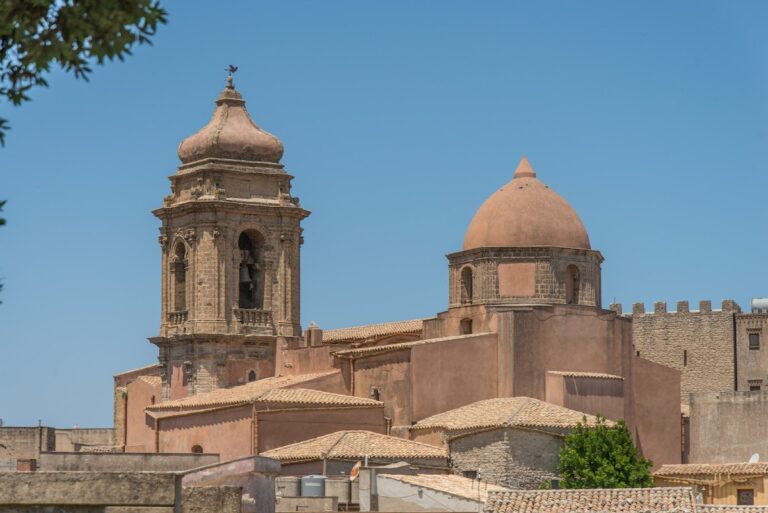
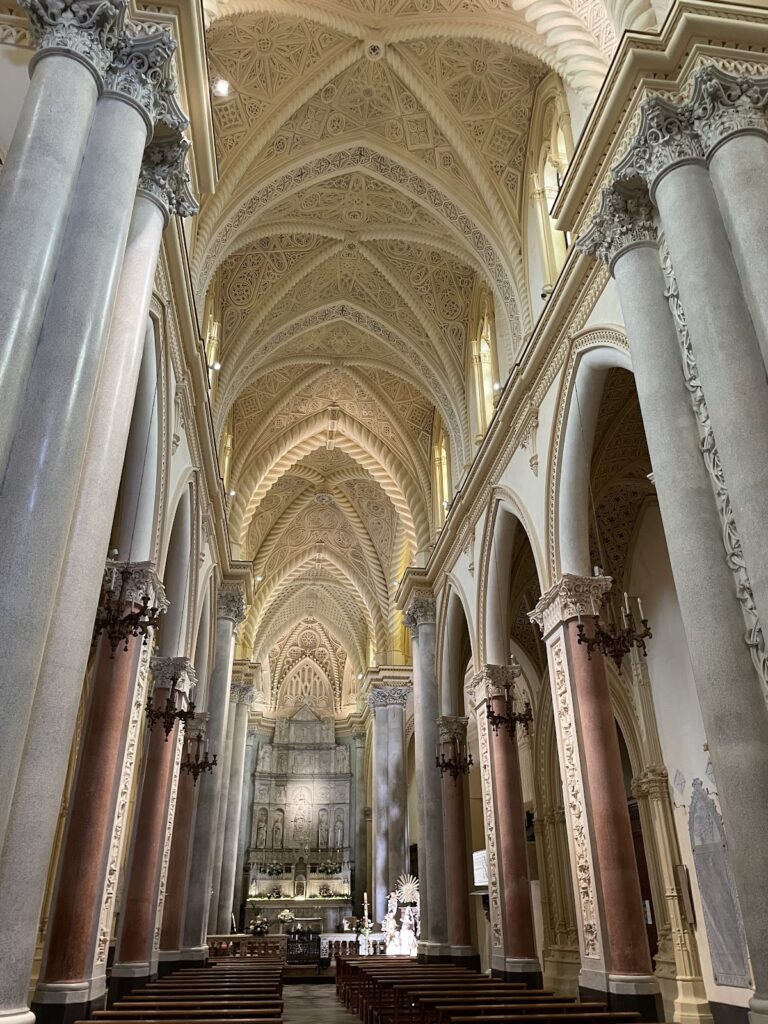
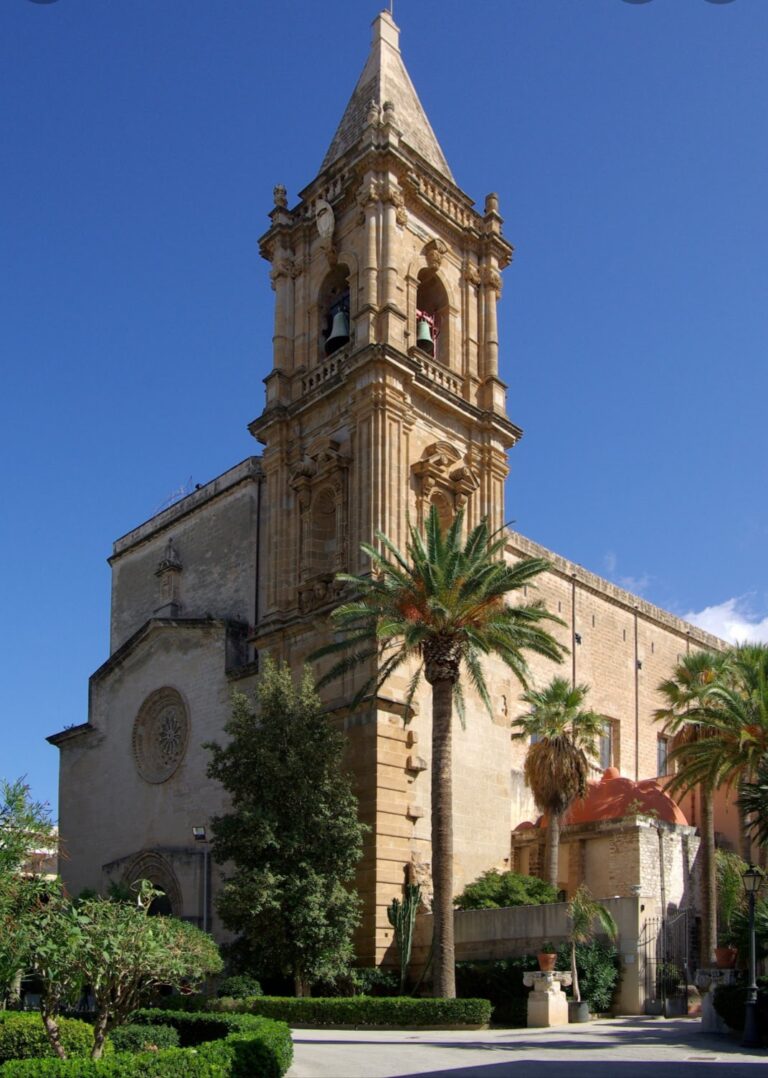
The site presents a compact Baroque church attached to a former monastery. The church is a small, single nave (the main worship space) completed in the late eighteenth century and altered in the mid‑nineteenth century. The floor is laid with maiolica, tin‑glazed earthenware tiles, installed in the eighteenth century by craftsmen from Naples, which give the interior a characteristic polychrome surface. The adjacent convent buildings date back to the foundation of 1617 and have been adapted for residential use in recent decades.
Inside the church five altars are set along the nave and sanctuary. The principal, or high, altar displays a wooden statue of Our Lady of All Graces. On the right side, the first altar originally honoured Saint Alexis and now holds a painting of the Crucifix by Pietro D’Andrea, known as Poma; the second altar on that side contains a painted panel of Saint Charles Borromeo, attributed to the same artist, replacing an earlier statue of Saint Thérèse of Lisieux. To the left, the first altar is dedicated to Saint Joseph, while the second formerly served the Crucifix and now preserves a Madonna del Soccorso from the workshop of the Gagini school, relocated here from the church of San Domenico.
Movable sculpture inside the building includes figures of Saint Vincent and a statue of the Sacred Heart of Jesus, both brought from the church of San Pietro. The church’s fabric shows the effects of twentieth‑century events: damage from the 1968 Belice earthquake, followed by roof repairs in the early 1990s and a later programme of restoration that allowed worship to resume in 2003. The former monastery has been reconfigured as a dormitory complex, organised into small apartment units and able to accommodate between twenty and forty beds, reflecting its long sequence of reuse from charitable institution to educational housing.