Church of St Mary the Virgin, Fawsley: A Thirteenth-Century Parish Church


Site at a Glance
- Rating
- 4.8
- Popularity
- Very Low
- Country
- United Kingdom
- Primary era
- Medieval
- External website
- Open
- Eras represented
- Medieval, Early Modern
- Civilizations
- English
- Site type
- Religious
- Remains
- Church
On this page6 sections
History
Medieval origins
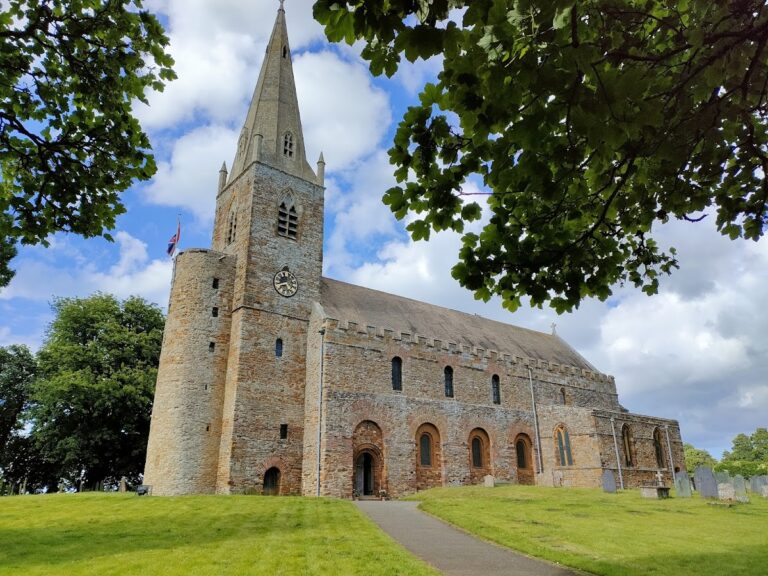
Church of St Mary the Virgin is a thirteenth-century Church of England parish church in Daventry, United Kingdom. Dedicated to Mary, the mother of Jesus, it is thought to have been established around 1209 as a chapel under St John the Baptist Church in Blisworth. The present building occupies the site of a wooden Anglo-Saxon church.
The chapel remained in use until the Dissolution of the Monasteries, the sixteenth-century suppression of monastic institutions by the English Crown and redistribution of their property. During this period, the Knightley family demolished most of Fawsley village to enclose land for sheep farming. The church survived because land had been granted to it for the establishment of a chantry in Bedfordshire, an endowed foundation supporting priests who celebrated prayers or services for the souls of benefactors.
Later changes and protection
The chancel was rebuilt in 1690. Effigies of members of the Knightley family were later installed after several members of the family were buried in the church. In 1720, a Washington family coat of arms was recorded carved in stone outside the entrance. It may have been placed there because Reverend Lawrence Washington, the great-great-grandfather of United States President George Washington, had owned the estate in the area that included the church. The carving was later concealed behind stone, rediscovered in 1885, and placed under a glass protective case.
The church received Grade I listed status in 1968, a category representing buildings of exceptional architectural or historic interest in England; the designation was amended in 1987. The tower bell frame was repaired in 1965 and 1966 by John Taylor & Co. The bells were quarter-turned, renovated, and prepared for swing chiming. In 1992, volunteers strengthened the frame to allow full-circle ringing, in which each bell rotates through a complete circle on its wheel and frame. A thanksgiving service followed on 26 September 1992.
Much of the copper roof covering was stolen in 2015, allowing rain to damage the interior. Temporary plastic sheeting was used while funds were raised to replace the roof covering.
Remains
The surviving church is a thirteenth-century parish building whose principal historic elements include the rebuilt chancel, the tower, the family effigies, the Washington-related stone carving, and stained-glass windows. Its physical fabric also preserves a timber bell frame and a ring of four bells that has undergone several phases of repair and alteration.
Tower and medieval bells
The tower contains a ring of four bells attributed to W. Chamberlain of London. They were cast at approximately the same time, around 1440, and are described as the oldest ring of four bells made together by one foundry. Each bell retains its cast canons, the projecting metal loops formed during casting for suspension, and carries three identity stamps. The bells hang in a timber frame dating from the early seventeenth century.
The restoration of 1965 and 1966 added independent crown staples, seasoned-elm headstocks, wrought-iron levers, steel gudgeons, fully enclosed ball bearings, and clappers with new joints and ball-bearing rollers. The later strengthening of the frame enabled the four bells to be rung full circle.
Washington-related features
Washington family arms appear in stained-glass windows installed in the church after their removal from Sulgrave Manor, identified as the ancestral home of the Washington family. The stone arms outside the entrance were rediscovered in 1885 and remain protected beneath a glass case.