Prieuré de Cayac: A Medieval Hospital-Priory in France


Site at a Glance
- Rating
- 4.7
- Popularity
- Low
- Country
- France
- Primary era
- Medieval
- External website
- Open
- Eras represented
- Medieval, Early Modern
- Civilizations
- Duchy of Aquitaine, English, French
- Site type
- Religious
- Remains
- Monastery
On this page14 sections
History
Prieuré de Cayac is a medieval hospital-priory in Gradignan, France, established beside an ancient Roman road and later used by pilgrims travelling along the Via Turonensis toward Santiago de Compostela. Its Gothic church was built in two principal phases between the early thirteenth and early fourteenth centuries, while the complex became a priory, a landed estate, and later a Carthusian foundation.
Hospital and pilgrimage foundation
Notre-Dame de Cayac began as a hospital complex serving travellers and patients beside the road. The medieval arrangement included a church, a hospital, and a cemetery for people treated at the hospital. The hospital itself was built in 1229. Cayac also became a stopping place on the Via Turonensis, the route from Paris toward Santiago de Compostela through Tours, Bordeaux, and Bayonne. Santiago was an important destination because Christian tradition associates the city with the tomb of Saint James the Greater, one of the Twelve Apostles of Jesus.
In 1304, the hospital was converted into a priory. Donations gradually enlarged its resources, and Cayac became a substantial landed estate worked by serfs. Its religious and charitable functions were therefore supported by an expanding economic base.
Carthusian ownership and decline
In 1618, Cayac passed to the Carthusians of the Bordeaux Charterhouse. The Carthusians are members of a Catholic contemplative order founded by Saint Bruno, and a charterhouse is their monastery. During the seventeenth century, they replaced the original hospital on part of the site with the present turreted château and added a smaller hospital against the south side of the church.
As pilgrimage declined, the priory entered a period of deterioration. Religious services had ended by the beginning of the eighteenth century. In 1785, the priest and writer Abbé Baurein described the remains that survived at that time.
Industrial use and municipal preservation
The priory was sold as state-owned property in 1791, and the church was deconsecrated. Several owners then held the site. Between 1823 and 1860, the former church housed the Lespinasse Jeune glassworks, whose industrial activity seriously damaged the building. In 1839, the Gironde Historical Monuments Commission sent a draughtsman and an architect to survey the remains.
The church was occasionally used by the Italian army for vehicle repairs during the Second World War. From 1975 to 1981, it served as a meeting place for Jehovah’s Witnesses. Gradignan acquired the church in 1979 and the priory in 1988, helping to prevent further deterioration. The diversion of National Route 10 in 1981 was followed by archaeological excavations in 1982 and 1983 and by restoration work. The side façades were renovated in 2013.
Cayac’s hospital and pilgrimage tradition was revived in the modern period, and the complex again receives pilgrims travelling toward Santiago de Compostela. The former church now hosts temporary exhibitions, while the site includes a museum devoted to the Bordeaux painter Georges de Sonneville. The former orangery began housing an educational fine-arts museum in 2005. The remains of the priory entered the register of French Historic Monuments in 1937, a legal heritage-protection status for sites of recognized architectural or historical importance. The former priory church and the building adjoining its south aisle were registered in 1987, before a 2022 order replaced the two earlier registrations.
Remains
The surviving complex follows the line of the ancient Roman road and preserves buildings from its medieval, Carthusian, industrial, and modern phases. The former church, turreted château, adjoining hospital, orangery, service buildings, and other remnants occupy a site beside the Eau Bourde.
Church and medieval arrangement
Former priory church
The church is 20 metres long and has a nave flanked by two aisles, with room for approximately 200 people. Its lower sections date from 1210 to 1230, while the upper elevation was completed between 1310 and 1320. The building is Gothic, a medieval architectural tradition associated with pointed arches, ribbed vaults, and an emphasis on vertical height. After industrial use damaged the structure, restoration followed the archaeological work of 1982 and 1983. The former church is now used for temporary exhibitions.
Hospital and cemetery area
The original medieval arrangement placed the church, its adjoining hospital, and the patients’ cemetery on one side of the road. The hospital brothers’ lodging and service buildings stood on the other. A vault probably once linked the two sides, allowing pilgrims to be received and enabling hospital patients to follow religious ceremonies. This arrangement survives through the remains of the medieval complex and the buildings that retain its institutional layout.
Later buildings and service structures
Turreted château
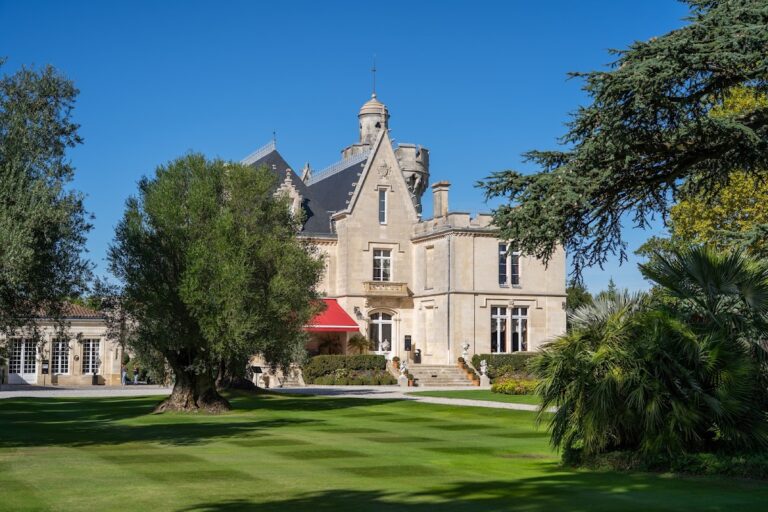
The present turreted château was built by the Carthusians in the seventeenth century on the site of the original hospital. It forms the principal surviving architectural reminder of the Carthusian phase and stands alongside the church and the other buildings of the priory.
Adjoining hospital
A smaller hospital was added against the church’s south side during the seventeenth century. The building adjoining the south aisle forms part of the protected remains of the former priory and preserves the connection between the church and Cayac’s renewed charitable role.
Service buildings and orangery
The service side of the complex included a wine storehouse, a wine-pressing room, a stable, a henhouse, a barn, and a flour mill. The former orangery is another surviving element of the site and has housed an educational fine-arts museum since 2005.
Later commemorative features
Pilgrim statue
A bronze statue of a pilgrim by Danielle Bigata was installed outside the priory in 1997. It forms a modern commemorative feature within the historic complex, whose pilgrimage association continues through the route to Santiago de Compostela.