Château Raba: Historic Estate and Protected Monument in France
Site at a Glance
- Rating
- 4.6
- Popularity
- Very Low
- Country
- France
- Primary era
- Early Modern
- Eras represented
- Early Modern
- Civilizations
- French
- Site type
- Domestic
- Remains
- Castle
On this page9 sections
History
Château Raba is a historic estate in Talence, France, rebuilt in 1783 by the architect Victor Louis for Louis Marie Bernade, the widow Raba, and her eight sons. The Raba family was a wealthy Jewish family from Bordeaux whose ancestors had been exiled from Braganza in Portugal and whose fortune came from colonial trade. The estate is now protected as a historic monument, with the château itself receiving classified status.
Rebuilding and expansion
Victor Louis, an eighteenth-century French architect best known for designing Bordeaux’s Grand Théâtre, rebuilt the château in 1783. In 1801, the estate was enlarged with an annex known as the Pavilion, which provided accommodation for distinguished guests. Its extensive park and gardens gained the estate the nickname “the Bordeaux Chantilly.”
A bronze standing statue of Henry IV once occupied the courtyard. The French king was remembered for policies favorable to religious minorities, and the statue at Château Raba recalled his benevolence toward Jewish worship.
Inheritance, restoration, and war
The estate later passed by inheritance to Albert Ellissen, who was married to Louise Raba, the daughter of Edmond Raba, an owner of the château. After the Franco-Prussian War of 1870, Ellissen restored the building and redesigned its gardens.
German forces occupied Château Raba during the Second World War, a global conflict fought from 1939 to 1945.
Protection and conversion
The estate was listed as a protected historic monument on 25 July 2007. The château itself received the stronger designation of classified historic monument on 21 March 2008. In France, listing recognizes heritage protection, while classification generally provides a higher level of legal protection.
In 2016, the property included the château in ruins, the luxury hotel-restaurant La Réserve, and a 1.3-hectare park. The Millésime group acquired the property and renamed it Le Domaine de Raba. The château was completely renovated during 2019 and then converted into a group of high-end apartments.
Remains
The surviving estate is organized around a rectangular courtyard that opens toward the south. The château and its dependencies form three building blocks, set within a wooded park of 1.3 hectares containing ornamental structures connected with the heritage of the property.
Courtyard buildings
Château
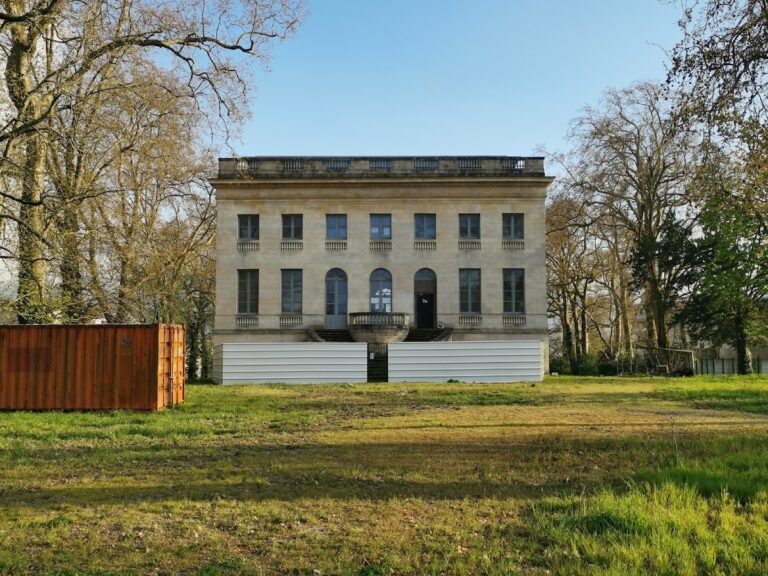
The principal château presents a facade centered on a broad balcony. Large columns support the balcony, while mouldings and cornices provide its principal decorative features. The building stood in ruins before its complete renovation, which was finished during 2019. Its current use is residential, as a group of apartments.
Pavilion
The Pavilion is the annex added in 1801 for distinguished guests. It forms part of the group of buildings arranged around the courtyard and belongs to the estate’s later enlargement.
Park and gardens
The buildings stand within a 1.3-hectare wooded park. The grounds include ornamental structures associated with the heritage of Château Raba, while the estate’s gardens contributed to its former nickname, “the Bordeaux Chantilly.”
Nearby sites