St. Katharinenkirche in Lenzen: An Evangelical Gothic Town Church


Site at a Glance
- Rating
- 4.8
- Popularity
- Very Low
- Country
- Germany
- Primary era
- Medieval
- External website
- Open
- Eras represented
- Medieval, Early Modern
- Civilizations
- Holy Roman Empire, Margraviate of Brandenburg
- Site type
- Religious
- Remains
- Church
On this page16 sections
History
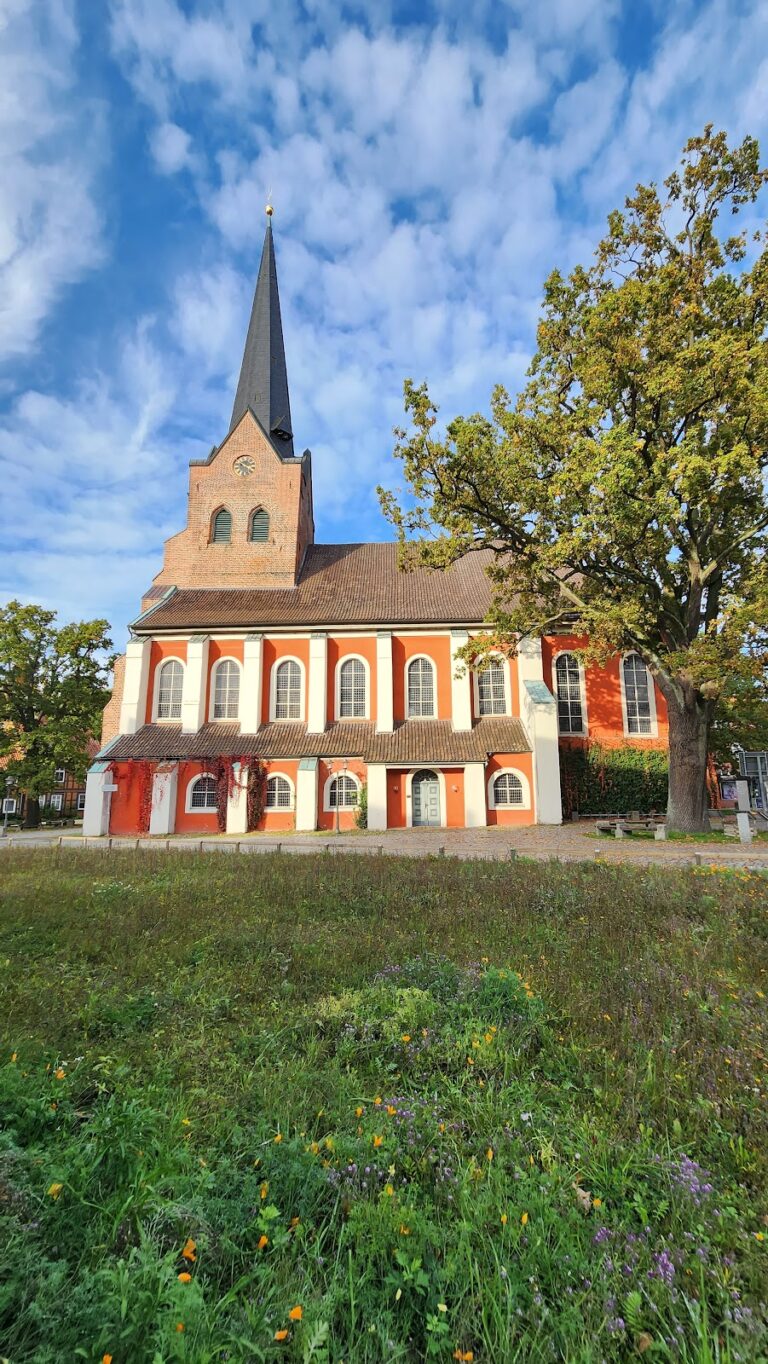
St. Katharinenkirche is an Evangelical town church in Lenzen, Germany, a repeatedly modified Gothic brick hall church whose interior preserves furnishings, memorials, and an organ with connections to North German Baroque craftsmanship. It belongs to the Lenzen parish within the Lenzen-Lanz-Seedorf parish district and the Prignitz church district of the Evangelical Church of Berlin-Brandenburg-Silesian Upper Lusatia. The church also functions as an open church.
Alterations and Restoration
The church has been changed through several building phases. Baroque galleries added in the eighteenth century substantially altered the impression of the interior. Its rectangular tower was completed in 1760, after an earlier tower collapse in 1751. A restoration followed in 1929, and further renovation took place after 1990.
The church’s principal furnishings also reflect these changes. A two-storeyed wooden altar structure was made in 1652, while the pulpit dates from 1759. Together with the galleries, they preserve important stages in the church’s early modern development.
The Organ and Its Earlier Instruments
In 1747, the Lenzen congregation purchased an organ built by Arp Schnitger in 1707 and 1708 from Hamburg-St. Georg. Schnitger was one of the most influential organ builders of the North German Baroque. When the church tower collapsed in 1751, Gottlieb Scholtze rebuilt the instrument in 1759, retaining several registers, or sets of pipes with a particular tone colour, from earlier organs by Hans Scherer the Younger and Schnitger.
The organ was restored between 2005 and 2007. It now contains 27 registers distributed across two manuals, the keyboards played by the hands, and a pedal keyboard operated by the feet.
Memorials of the Lenzen Community
Numerous epitaphs and grave monuments commemorate members of the local community. An epitaph is a memorial monument that commonly combines an inscription with a portrait or religious image. Among those remembered are Ernst Friedrich Hoffmann, Magdalena Tuchscher, the Amtmann Tuchscher, Anna Grieben, and Elias Stryke.
Stryke was a Brandenburg electoral official who collected customs and license duties. He died on 6 February 1677. His epitaph states that his sons and daughters donated the monument on 18 October 1678, preserving both his office and the family’s role in commissioning the memorial.
Remains
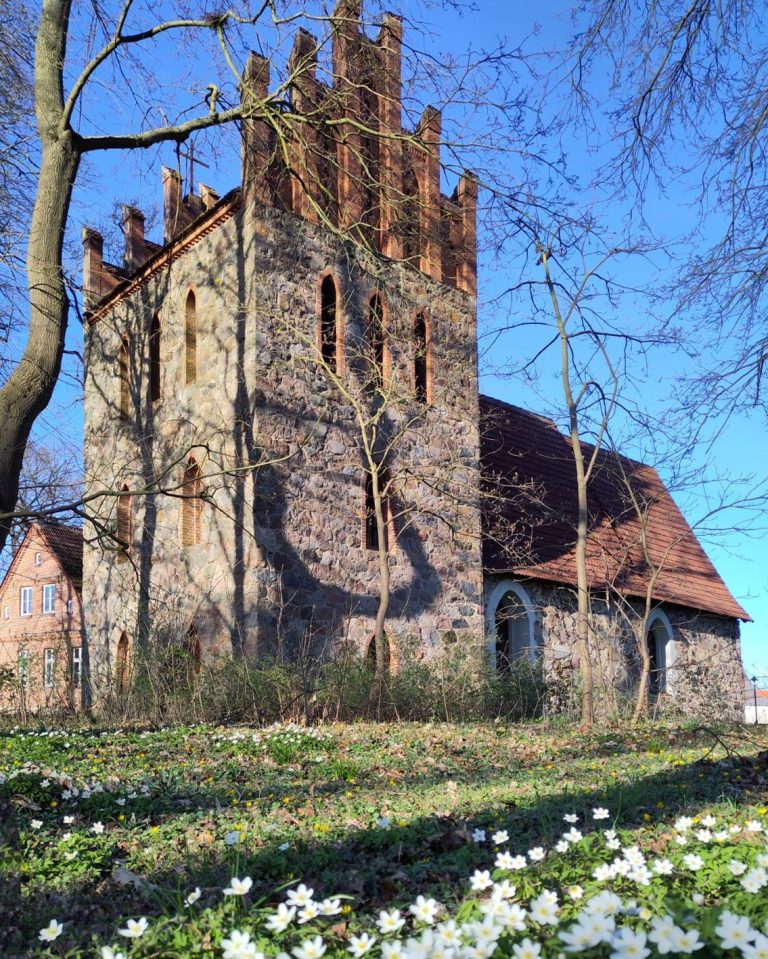
St. Katharinenkirche survives as a brick Gothic hall church with a three-aisled nave, a transept, and a choir ending in a five-eighths termination. In this form of polygonal ending, the choir follows five sides of an imagined eight-sided figure. The building’s interior and furnishings combine medieval, Renaissance, Baroque, and later elements.
Church Structure
Nave, Transept, and Choir
The central nave and side aisles are approximately equal in height, creating the unified interior characteristic of a hall church. A transept, the cross-arm intersecting the nave, extends the plan, while the choir ends in the five-eighths polygon. Cross-rib vaults, masonry vaults strengthened by projecting ribs, rest on cruciform piers. In the western crossing, the piers consist of paired fused cylindrical columns. Buttresses support the building’s other parts, with the north transept forming an exception. Renewed Late Gothic paintings decorate the transverse vault arches and the nave arcades.
Tower
The present tower is rectangular, with a square upper section and a pointed helmet roof. It was completed in 1760 after the earlier tower collapsed in 1751, giving the church its present tower form.
Altarpiece, Pulpit, and Sacred Objects
Wooden Altar and Rococo Pulpit
The principal furnishing is the two-storeyed wooden altar structure made in 1652. Its columns frame paintings after Peter Paul Rubens, the leading Flemish painter of the Baroque period. The scenes represent the Last Supper and the Last Judgment.
The pulpit, made in 1759, carries carved Rococo ornament. Its date places it within the same eighteenth-century phase that also introduced the Baroque galleries and followed the rebuilding of the organ.
Bronze Baptismal Font
The medieval baptismal font is a bronze casting made in 1486 by Heinrich Grawert of Brunswick. Four figures of Saint Catherine stand on lions’ heads and support the basin. Around the basin, the apostles appear beneath delicate arcades. The apostle imagery is comparable to that of the baptismal font in St. Catherine’s Church in Salzwedel.
Crucifix and Chandelier
A wooden crucifix from the eighteenth century stands on the gallery in the north transept. A finely crafted brass chandelier bears an inscription dated 1656.
Grave Monuments and Epitaphs
Hoffmann and the Smaller Epitaphs
The epitaph for Ernst Friedrich Hoffmann, who died in 1706, includes a painted portrait medallion surrounded by richly carved acanthus ornament. Two additional smaller epitaphs date from the seventeenth century.
Tuchscher and Grieben Monuments
One grave monument commemorates Magdalena Tuchscher, who died in 1595, and shows a child. The monument for the Amtmann Tuchscher, who died in 1796, contains a bust in low relief. A monument for Anna Grieben, who died in 1612, depicts the deceased as a lively knee-length figure beside a cartouche, a framed ornamental panel, bearing the words of Job 19:25.
Elias Stryke Epitaph
The epitaph for Elias Stryke is mounted on the north wall of the choir. Its columnar structure is decorated with putti, grapes, and foliage. Allegorical figures of Justice and Prudence, personifications of virtues commonly used in funerary art, stand at the sides, while three angels appear above.
The principal painting measures 133 by 84 centimetres and depicts the Entombment of Christ. A portrait of Stryke is placed above it, and a text cartouche below explains his work and identifies the monument’s donors.
The Entombment presents an unusual arrangement of its figures. A younger man in a red garment and green cloak is shown in the manner traditionally associated with John, although three background figures include another person who would conventionally also be identified as John. Mary Magdalene occupies the left foreground, blocking the path of three men and drawing attention to herself.
The Magdalene figure was adapted from an engraving by Egidius Sadeler, which followed a painting by Federico Barocci. Sadeler and Lucas Vorsterman were Netherlandish artists associated with the circulation of major painters’ compositions, while Barocci was an Italian painter of the late Renaissance and early Baroque. In Sadeler’s engraving, Mary and John have clear colour distinctions, and Mary kneels on the right while making way for Christ’s body.
The figure also derives from a painting by Lucas Vorsterman associated with the title Mary Magdalene with a Companion. That work, from 1622 and 1623, drew on Rubens’s The Penitent Magdalene and Her Sister Mary, painted around 1620. Rubens’s earlier image shows Magdalene overturning a jewellery casket with her left foot as a sign of repentance, but the casket does not appear in the Lenzen painting.
The transfer and reassignment of figures between compositions was an established artistic practice. The unusual Magdalene therefore reflects contemporary artistic and religious conventions rather than a specifically recorded request by the epitaph’s donor.