Baden Town Church and St Sebastian’s Chapel: A Gothic Parish Church and Ossuary Chapel
Site at a Glance
- Rating
- 4.7
- Popularity
- Medium
- Country
- Switzerland
- Primary era
- Medieval
- External website
- Open
- Eras represented
- Medieval, Early Modern, Modern
- Civilizations
- Carolingian, Habsburg, Holy Roman Empire, Swiss
- Site type
- Religious
- Remains
- Church
On this page12 sections
History
Baden Town Church and St Sebastian’s Chapel are a Roman Catholic parish church and its associated chapel in Switzerland. The town church took its present Gothic form in 1457–1460 and belongs to a parish whose roots reach into the early Middle Ages.
Early parish and medieval patronage
A church stood on the site in the second half of the ninth century, during the Carolingian era, the period associated with Charlemagne’s Frankish dynasty and its successors. A Romanesque church, in an earlier medieval European style, followed in the twelfth century. The parish in Baden is first documented in 1241, more than fifty years before the town’s formal foundation. By the fourteenth century, Mary was recognized as the church’s patron.
In 1406, Duke Frederick of Habsburg transferred the church to Wettingen Abbey, a monastery in Aargau, to compensate for losses the abbey had suffered in the Gugler War of 1375 and the Sempach War of 1386. The first was a military campaign in the Swiss region; the second was a conflict between Swiss Confederates and Habsburg forces. The transfer prompted repeated disputes over patronage rights, particularly during vacancies in the priest’s post, when the town sought greater influence.
The Reformation and Catholic continuity
From 19 May to 8 June 1526, the church hosted the Baden Disputation, a public theological debate between Catholic theologian Johannes Eck and Swiss Reformation theologian Johannes Oekolampad. It was the first debate of the Zwinglian Reformation, the Protestant movement associated with Huldrych Zwingli and Zurich, to take place outside Zurich. Four of the Old Swiss Confederacy’s thirteen principal cantons adopted the new faith, ending the Confederacy’s shared religious allegiance. Baden remained Catholic, chiefly because its leaders wished to protect the town’s standing as a meeting place for the Confederacy’s Diet, an assembly of delegates from its cantons, and as a spa town.
Chapter, relics, and later history
The town established a collegiate chapter, a body of clergy attached to the church, in 1624. In 1650, Pope Innocent X gave the church bones attributed to Saint Damian, a catacomb saint associated with relics recovered from Christian catacombs. The remains do not establish a secure personal identity, but Damian became the church’s second patron.
After Wettingen Abbey was abolished in 1841, its assets passed first to the Canton of Aargau and, in 1845, to the town. The chapter was dissolved in 1875 during the Kulturkampf, a nineteenth-century political conflict over relations between church and state. The church underwent major renovations in 1884 and 1967–1968; archaeological investigations of its earlier buildings took place during the latter work. It is designated a cultural property of national importance and continues to serve the Roman Catholic parish of Baden-Ennetbaden, including for worship and cultural events.
Remains
Baden Town Church
Setting and plan
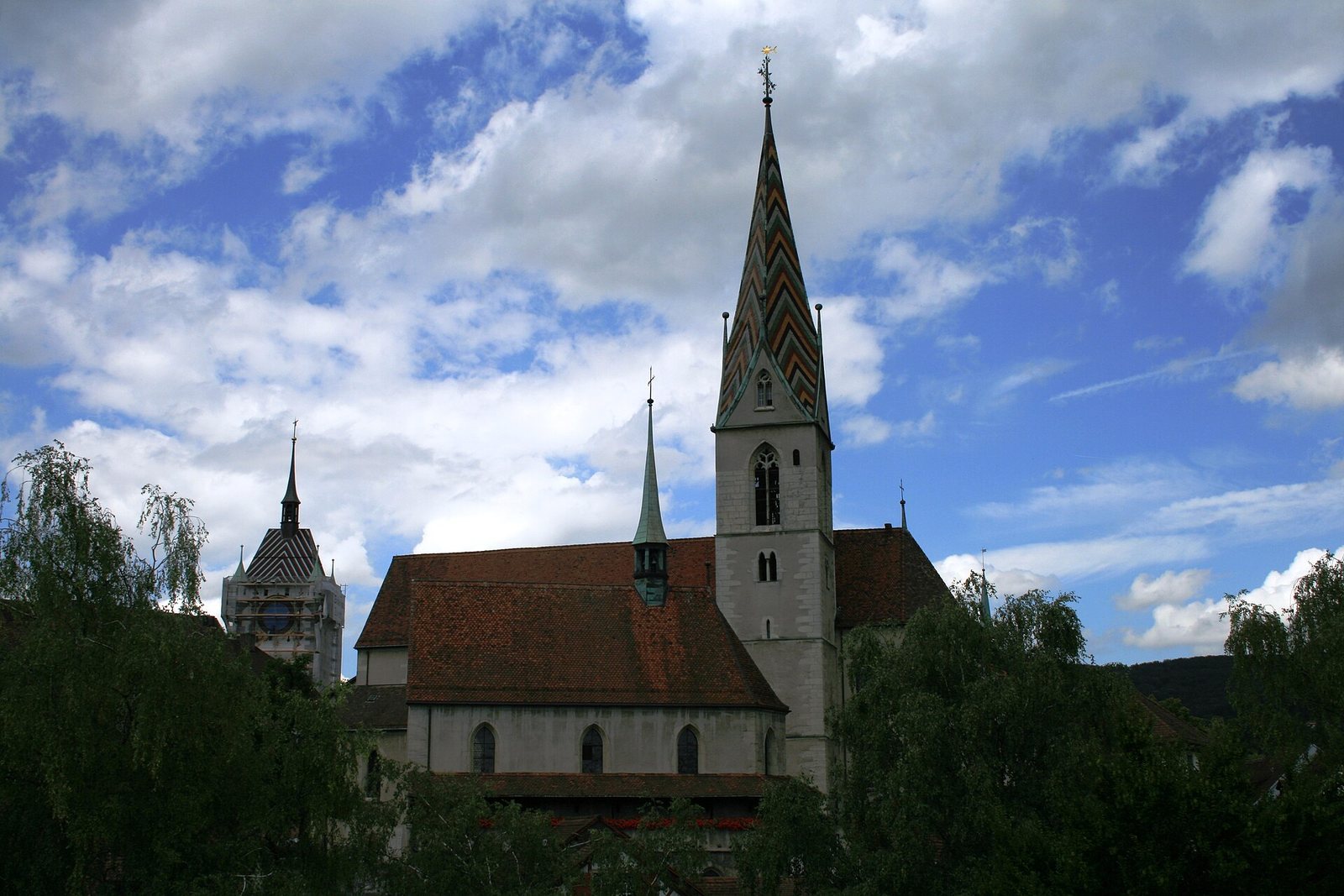
The church stands in Baden’s old town on the edge of a terrace sloping toward the Limmat. Some of the surrounding ground served as a cemetery until 1820. The present building has a central nave flanked by two lower side aisles. Its nave retained the width of the earlier church, while the western end was extended by 4.5 metres. Excavation revealed that the ninth-century predecessor had a rectangular plan measuring 26.4 by 11.2 metres. The later Romanesque building occupied the same site, with its south wall shifted about a metre and a rounded eastern end. The choir, the part of the church used for clergy and liturgy, and the tower’s lowest three storeys date to the fourteenth century. St Maurice’s Chapel lost its separate worship function and became the sacristy.
Tower
Construction of the tower was delayed for several decades. Martin Grülich carried out the work from 1489 to 1493, during the church’s final building phase, dated to 1490. The tower rises 52 metres and is the old town’s second-highest building, about four metres below the Town Tower. Its pointed spire is covered with coloured tiles. Six bells cast by the H. Rüetschi company of Aarau in 1926 hang within it.
Entrance and exterior details
The west entrance was redesigned in 1937 with a lean-to roof and a mosaic showing the Assumption of Mary, the Catholic belief that Mary was taken into heaven at the end of her earthly life. A relief of Saint Christopher by Baden artist Walter Squarise decorates the choir end. In 1951, Squarise added a scene of Jesus teaching in the north aisle. Tomb slabs from the former ossuary have been set into the south aisle’s exterior wall since the 1930s.
Interior and organ
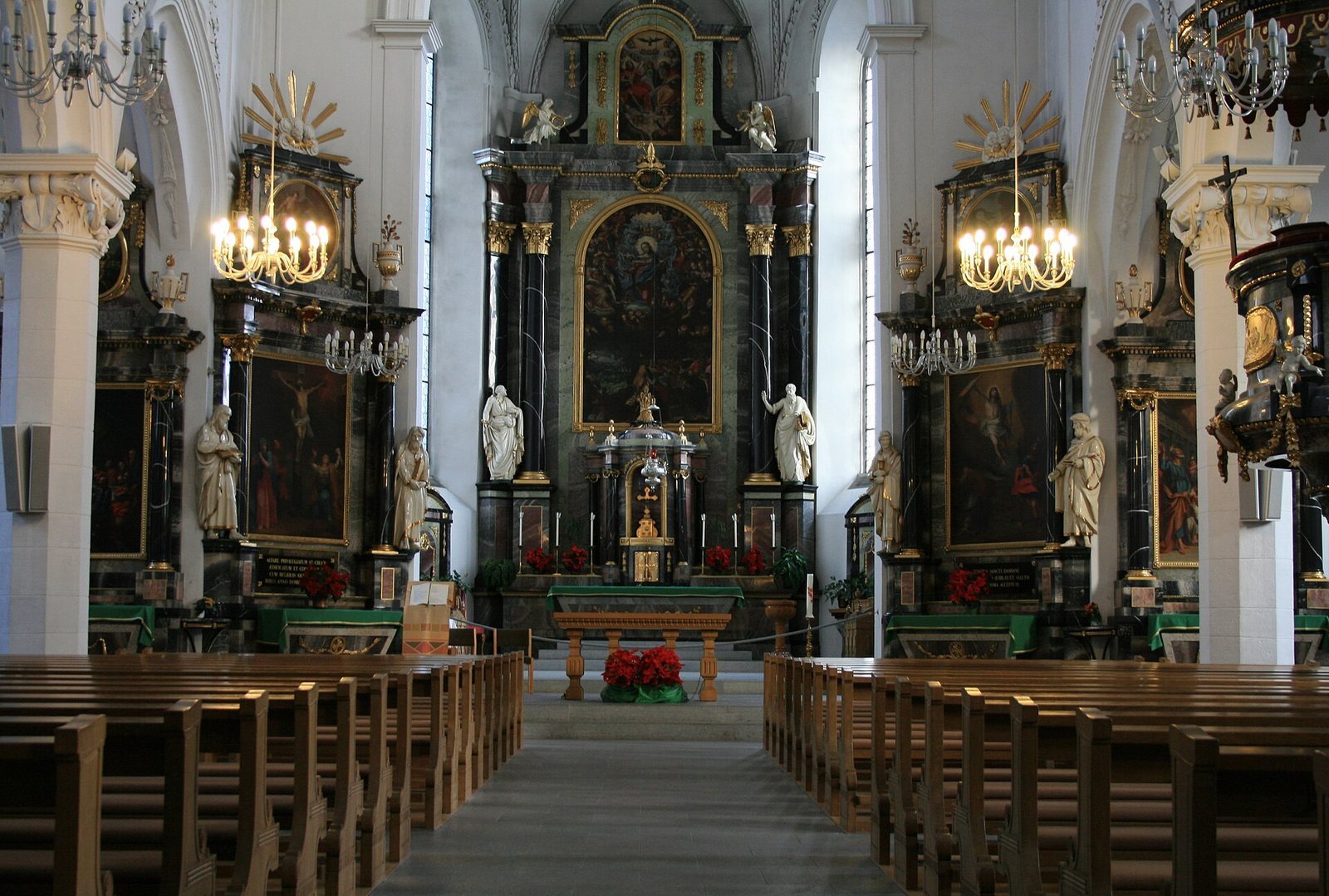
The interior reflects several periods of alteration. Paintings for the high altar and images of the Passion were added in 1612–1617, followed by stucco decoration and pictures of prophets in 1696–1698. In the early nineteenth century, the ceiling, altars, and pulpit were redesigned in the Classical style. Octagonal pillars support the central nave, whose higher ceiling contrasts with the lower side aisles. Clear-glazed windows and white walls give the interior a light finish. A gallery at the west end holds an organ built in 1968 by the Metzler company of Dietikon. It has 41 selectable sets of pipes, three hand-played keyboards, and a pedal keyboard played with the feet.
Church treasury
Two rooms above the sacristy house the church-treasury museum. Its collection includes liturgical equipment, complete sets of vestments and other church textiles, and examples of gold- and silversmithing spanning the late Middle Ages to modern times. The treasury is regarded as one of the most important in the Canton of Aargau.
St Sebastian’s Chapel
The chapel stands immediately south of the church on the descending terrace slope. The town built a partly subterranean ossuary, a place for keeping human bones, there in 1481. A chapel was raised above it during the first decade of the sixteenth century and completed in 1509. Town clerk Ulrich Dösch financed the work, master builder Hans Murer supervised its construction, and Balthasar Brennwald, an auxiliary bishop who assisted the bishop of Constance, consecrated it. The simple Gothic building has a gabled roof and a roof turret. Its massive downhill-facing ossuary wall carries a defensive walkway that formed part of the town’s former fortifications.