Mariä Heimsuchung (Gosseltshausen): A Baroque Parish Church in Germany


Site at a Glance
- Rating
- 4.3
- Popularity
- Very Low
- Country
- Germany
- Primary era
- Early Modern
- Eras represented
- Medieval, Early Modern, Modern
- Civilizations
- German, Holy Roman Empire
- Site type
- Religious
- Remains
- Church
On this page12 sections
History
Mariä Heimsuchung is a Roman Catholic parish church in Gosseltshausen, Germany, whose late-medieval Gothic core was enlarged and rebuilt in the Baroque period at the beginning of the eighteenth century. The church serves the locality within the municipality of Wolnzach in Upper Bavaria, and its history combines medieval fabric, early modern rebuilding, and later restoration.
Medieval church and seventeenth-century changes
The lower part of the bell tower belongs to the medieval church. Alterations to the late-medieval building took place during the second half of the seventeenth century, and the tower was raised in 1659. The church’s early Baroque decoration began in 1701, when Johann Baptist Zimmermann produced stucco work and frescoes of the Latin Church Fathers. Zimmermann, a Bavarian painter and stucco artist, was then beginning a career known for combining architectural ornament with illusionistic painting.
These first decorations were destroyed by a church fire in 1704 during the War of the Spanish Succession, the European conflict fought from 1701 to 1714 over competing claims to the Spanish monarchy and wider political power. The church was rebuilt between 1705 and 1721, after which new furnishings were added over the following years.
Baroque decoration and later restoration
In 1752, Melchior Buchner, a painter from Schongau who later worked in Ingolstadt, was commissioned to decorate the ceilings of the choir and nave. His paintings established the church’s principal pictorial programme, centred on the life of Mary and themes associated with the dedication to the Visitation.
A major nineteenth-century alteration took place in 1874, when the interior was given a Gothic Revival appearance. The frescoes were painted over, and most of the Baroque decoration was removed. The ceiling paintings were uncovered and restored during renovation in 1905. Further interior work followed in 2000, while the exterior was renovated in 2019. Mariä Heimsuchung is protected as an architectural monument in Bavaria.
Remains
The church preserves a late-medieval structure reshaped by early eighteenth-century rebuilding. Its interior is arranged as a hall-like nave with a slightly narrower choir, while the surviving tower, chapel, paintings, altars, and memorials record several stages of the building’s history.
Building and spatial form
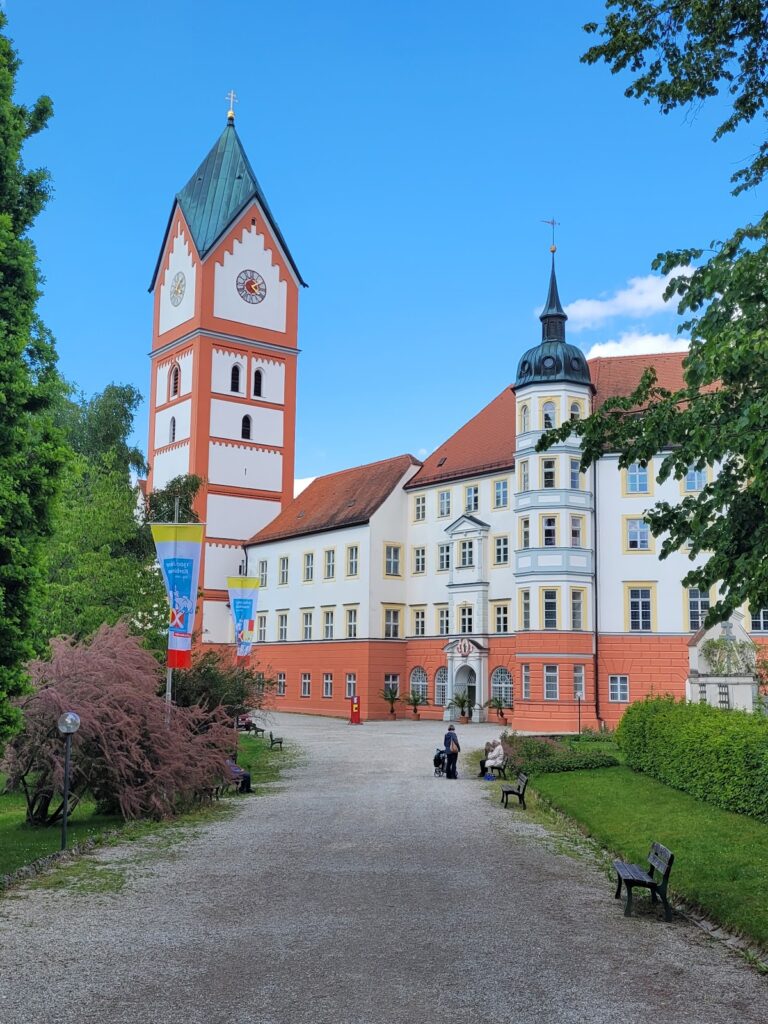
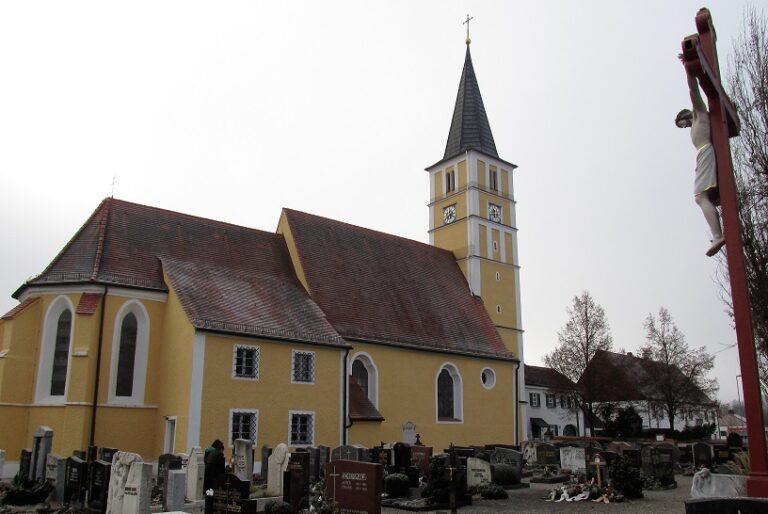
The bell tower rises at the northern angle of the choir. Its square medieval lower section contains recessed blind panels framed by arcaded friezes. Above the portion heightened in 1659 is an octagonal stage crowned by a double onion dome and lantern. The outside walls of the choir are reinforced by stepped buttresses that rise to window level.
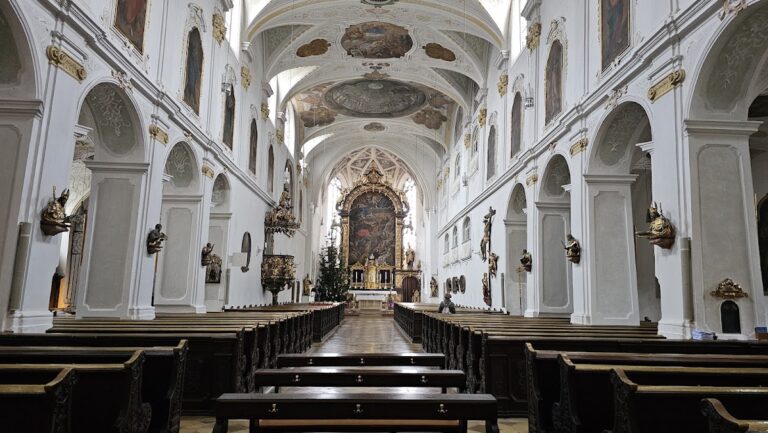
Inside, the nave is covered by a flattened barrel vault. Flat pilasters with sections of entablature divide the walls, and a profiled cornice projects above them. The choir has two bays and ends in five sides. Its barrel vault is interrupted by lunettes, or curved openings formed within the vault. At the western end of the nave, a gallery with a curved balustrade completes the interior arrangement. A small chapel projects from the southern side of the nave.
Painted decoration
Choir frescoes
Buchner’s large choir fresco represents the Assumption of Mary, the belief that Mary was taken into heavenly glory. Its accompanying scenes show the marriage of Mary and Joseph, the Presentation of Jesus in the Temple, and the giving of the Scapular to Saint Simon Stock. Other scenes show rosaries being presented to Saint Dominic and Saint Catherine of Siena. The Scapular is a devotional object and practice associated with Catholic confraternities and traditions.
Nave frescoes and painted scenes
The large nave fresco fills the ceiling and depicts the Visitation, the meeting of the pregnant Mary with her relative Elizabeth. The encounter is set within monumental illusionistic architecture. Mary carries a walking staff and wears a hat, while Elizabeth is shown pregnant in old age. A circle painted on Elizabeth’s body refers to the future birth of John the Baptist, and the letters IHS within a circle on Mary’s body indicate that she carries Jesus.
Painted archways at the sides of the main scene open onto episodes from Mary’s life. Above the gallery is the foretelling of her birth to Saint Anne and Saint Joachim. Above the pulpit is Mary’s birth and first bath, while her Presentation at the Temple appears opposite the pulpit. The Annunciation, the announcement that Mary would bear Jesus, is shown before the choir. Beneath it is the Latin inscription “HANC DILIGE SANCTAM,” meaning “Love this holy one.” The letters CDILICM form a chronogram, an inscription whose selected letters also serve as Roman numerals, giving the year 1752.
Medallions at the corners of the nave ceiling portray Gregory the Great, Jerome, Augustine, and Ambrose of Milan, the four Latin Church Fathers whose writings shaped Western Christian doctrine. Below them, monochrome female figures personify the continents. Europe appears crowned and mounted on a horse, Asia wears a turban and rides a lion, Africa rides a camel while holding an ear of grain, and America is represented as an Amazon with an Indigenous-style headdress, bow, and arrows.
The small southern chapel retains ceiling paintings from around 1720. They imitate stucco ornament through stucco finto, or painted imitation stucco, using bandwork motifs. These paintings were uncovered again in 1972.
Altars, pulpit, and church furnishings
Pulpit and high altar
The Baroque pulpit dates from 1692 and, like the baptismal font, was acquired from Ismaning. A figure of John the Baptist crowns its soundboard. Shell-shaped niches in the basket hold the four Evangelists, Matthew, Mark, Luke, and John, together with their symbols, while Christ holding a globe occupies the centre. A gilded relief of the Ten Commandments decorates the door to the pulpit stairs, and angels’ heads ornament the underside of the basket.
The high altar was installed in 1906. Its four large figures of the Evangelists came from the former monastery church of Reisbach. In the place usually occupied by an altarpiece stands a late-seventeenth-century Pietà, a devotional image of Mary mourning over the dead Christ, surrounded by putti.
Side altars and furnishings
The two four-column side altars belong to the Rococo period. Rocaille, the shell-, foliage-, and rock-inspired ornament characteristic of Rococo design, appears in the church’s decorative vocabulary. The left altarpiece shows the Immaculate Conception, with Mary standing on a crescent moon and crushing the serpent’s head. Smaller paintings depict Saint Catherine below and Saint Barbara above. The right altarpiece shows a guardian angel protecting a child, with Saint Sebastian below and Saint Florian in the upper section.
The choir stalls date from the first half of the eighteenth century. The benches and confessionals were made during the second half of that century, and the confessionals carry elaborate Rocaille carving. Paintings of the Apostles, executed on wood in 1790, hang above twelve apostle candelabra along the nave walls. The works are framed in ovals decorated with festoons.
Medieval and early modern memorials
A relief of the Mount of Olives on the northern nave wall dates from the first half of the fifteenth century. Sixteenth-century grave slabs of priests are set into the choir walls. In the nave, a large limestone tomb slab from 1422 commemorates the Starzhauser family. It bears an inscription and two coats of arms with helmet crests, preserving an early record of the family within the church’s later Baroque interior.