Geisenfeld Abbey: A Former Benedictine Nunnery in Bavaria


Site at a Glance
- Rating
- 4.5
- Popularity
- Very Low
- Country
- Germany
- Primary era
- Early Modern
- External website
- Open
- Eras represented
- Medieval, Early Modern
- Civilizations
- Holy Roman Empire
- Site type
- Religious
- Remains
- Monastery
On this page12 sections
History
Geisenfeld Abbey is a former Benedictine nunnery in Geisenfeld, Germany, established for women from noble families and associated with the Diocese of Regensburg. Its foundation is generally placed around 1030 or 1037, although traditions also give the dates 911, 929, or 1011. Count Eberhard of Ebersberg, sometimes identified as Eberhard II, and his wife Adelheid are credited with founding it. The new monastery replaced an earlier institution at present-day Engelbrechtsmünster, which had been destroyed by Hungarian forces around 955. The original complex was begun in the late Romanesque period by Benedictines from St. Emmeram’s Abbey in Regensburg.
Foundation and medieval development
The abbey’s first abbess was Gerbirgis, identified as a sister of Eberhard II. It was intended to house women from aristocratic families and accommodated about 50 nuns. Through extensive endowments and donations, Geisenfeld became one of Bavaria’s largest and richest monasteries. By 1752, its holdings included 189 estates in 36 communities, parts of Gaimersheim near Ingolstadt and Langquaid in the Kelheim district, a winery at Gorsbach in Austria, the Feilenforst with 20,000 Tagewerk, a historical German measure of land area, and other forests and fields.
The abbey governed some of these possessions through subordinate provosts, ecclesiastical administrators who managed dependent lands and communities. Local inhabitants paid tithes and came under the provost’s court in all but serious criminal cases. The abbess appointed ministers to the parishes of Gaimersheim and Sandsbach, while the nuns provided education in their territories. Their administration could be flexible, since the abbey sometimes waived tithes or did not require them in full.
Geisenfeld also operated a wide range of economic enterprises, including a brewery, sawmill, bakery, pharmacy, saddle-making establishment, mill, and workshops for various crafts. A brewery founded by the nuns in 1131 near present-day Herrngiersdorf Castle supplied the abbey’s possessions and produced as much as 20,000 litres of beer each year. These activities supported the institution’s religious life and its extensive territorial administration.
Jurisdiction and reform
Emperor Louis the Bavarian was traditionally credited with granting the abbey lower jurisdiction in 1336, meaning authority over minor legal matters. Documentary proof of that grant is lacking, but the jurisdiction existed during the fourteenth and early fifteenth centuries. In the mid-fifteenth century, a regional court removed this authority from women’s monasteries. A settlement in 1718 restored Geisenfeld’s lower jurisdiction in the town and its rights over 17 localities, in return for the surrender of 13 subjects.
The fifteenth century also brought the Melk reform, a movement for stricter observance and administrative renewal within Benedictine monasteries. In 1483, Abbess Helene Prunner was replaced by Barbara Snäkler, who came from the convent of Bergen near Neuburg. Her appointment formed part of the reforming changes introduced at Geisenfeld.
War, rebuilding, and the Baroque transformation
The Thirty Years’ War, the European conflict fought from 1618 to 1648, severely damaged the abbey and its possessions. On 30 April 1632, troops from Vohburg an der Donau plundered the Geisenfeld area. The abbess fled to Ingolstadt with 42 people, leaving behind equipment, grain, altar cloths, chalices, and monstrances, vessels used to display the consecrated Eucharistic host. By 1648, after the Peace of Westphalia ended the war, the monastery buildings were extremely ruined and most of its feudal estates had been burned.
A comprehensive rebuilding began in the early eighteenth century. The foundation stone was laid on 17 April 1701 under the master builder Philipp Plank. The dormitory, refectory, infirmary, kitchen, and pharmacy were completed by 1703, while reconstruction continued until 1712. The rebuilt abbey church was consecrated in 1730.
Abbess Constantia Jäger, who died in 1727, received assistance from major patrons, including the archbishop of Cologne. Her successor, Abbess Maria Cäcilia Weiß, renewed the church between 1728 and 1730 and commissioned the south tower to be raised by two storeys. This rebuilding created the spacious Baroque complex and church that later gave Geisenfeld Abbey its reputation as one of Bavaria’s most prosperous convents. The church is often called the “Cathedral of the Hallertau” because of its size.
Dissolution and later uses
The Bavarian secularization, the early nineteenth-century process through which ecclesiastical institutions and their property were transferred to secular ownership, brought the abbey’s history as a convent to an end. The dissolution order was issued on 18 March 1803, and the monastery was formally dissolved on 20 October. Abbess Amanda Donaubauer of Mainburg then led 29 choir nuns and 21 lay sisters.
Johann Rudolf Meyer of Aarau purchased most of the abbey’s buildings and estates for 52,666 gulden, a historical currency used in German-speaking Europe. A silk-ribbon manufacturer, philanthropist, patron, and revolutionary, Meyer intended to establish a Swiss factory colony at Geisenfeld. After land planned for colonist farms in the Feilenforst was flooded, he sold the property in 1804 to Landesdirektionsrat Ritter von Welz.
On 29 October 1804, the former abbey church was transferred to the parish of Geisenfeld and became the parish church of St. Emmeram, replacing the older parish church. That earlier church was deconsecrated in 1805, converted to another use, and later demolished. It had stood on the site of the present town hall. An attempt to revive the monastic tradition in 1921 and 1922 failed, and the former abbey was subsequently used by public institutions, including a district court.
Today, the surviving monastery buildings belong to the Free State of Bavaria and the city of Geisenfeld. They accommodate several institutions, including a notary’s office, the Bavarian state notarial archive, a senior day-care centre, and the Geisenfeld municipal band. The former abbey church underwent complete interior and exterior renovation during the 1970s and 1980s.
Remains
Church and monastery buildings
Former abbey church
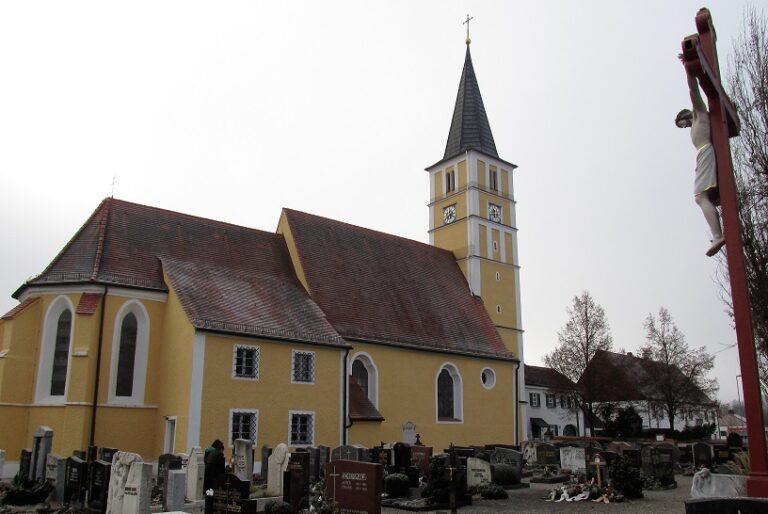
The former abbey church stands beside the older parish church dedicated to St. Emmeram, with both buildings occupying adjoining positions in the present churchyard. Its surviving decoration reflects the Baroque rebuilding of the early eighteenth century. The stucco was probably produced by workers from Wessobrunn, while the frescoes were probably painted by Franz Joachim Beich, an artist otherwise chiefly known for working in oil. A painting dated 1770 shows the count and his family presenting their possessions to the Virgin Mary, a central figure in Christian devotion. The church also contains the count’s grave.
The south tower was raised by two storeys during the church renewal of 1728 to 1730 and received a lantern, a raised structure above a tower or dome that admits light. The tower reaches 54 metres and is crowned by a bulb-shaped dome. The building’s scale and surviving Baroque decoration explain its traditional description as the “Cathedral of the Hallertau.”
Original and surviving complex
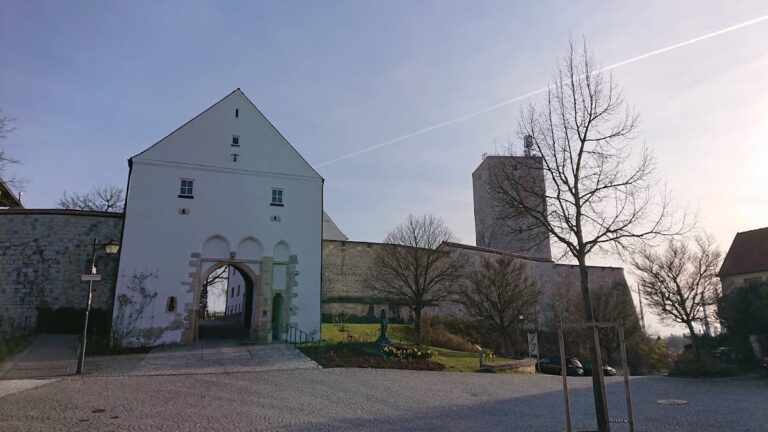
The abbey was constructed in a new position higher above and farther from the Ilm River. Its original construction used rock foundations, a brick ground floor, and half-timbered upper floors, in which a visible timber framework was filled with brick, plaster, or another material. A round chapel in the late Romanesque style survives from this first complex.
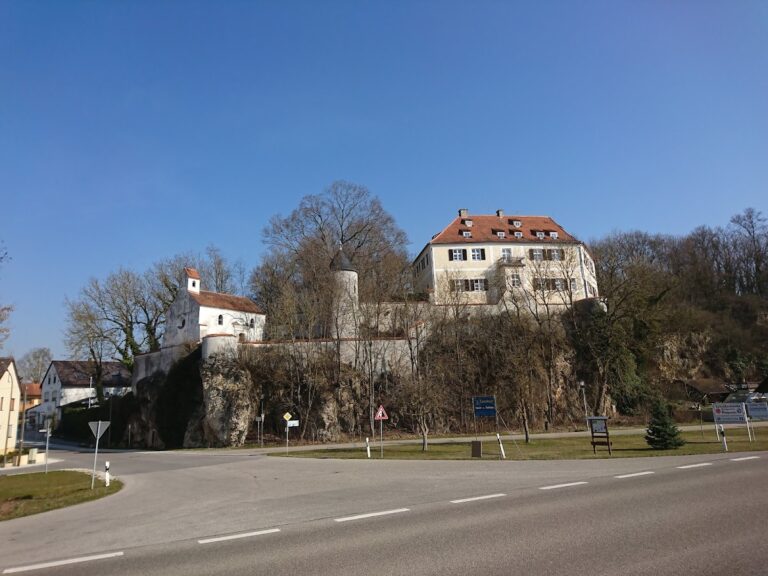
Part of the abbey was demolished after secularization, while a wing and other adjoining buildings remain. The surviving complex is a spacious Baroque building that continues to dominate the town. Its present form reflects the major rebuilding carried out after the destruction of the Thirty Years’ War, while the round chapel preserves an earlier phase of the monastery’s architectural history.
Economic and documentary remains
Former brewery complex
Traces survive from the former abbey brewery complex at the top of Mühlberg. In 1501, the complex included a brewery, maltings, a mill, and a blacksmith’s workshop. It formed part of the wider economic system that supported Geisenfeld’s lands and communities. The brewery established near present-day Herrngiersdorf Castle in 1131 also belonged to this economic tradition and supplied the abbey’s possessions.
Eberhard Psalter
The Eberhard Psalter is a psalter with commentary written during the first quarter of the eleventh century. Later notes in the manuscript show that it was in the abbey’s possession by no later than about 1200. A sixteenth-century entry on the front inner cover connected the book with the founder. After the abbey was secularized in 1803, the manuscript was transferred to the Bavarian State Library in Munich, where it is preserved as Clm 7355.
Nearby sites