Saint Nicholas Church (Ehrenfriedersdorf): A Fifteenth-Century Evangelical Church in Germany


Site at a Glance
- Rating
- 4.4
- Popularity
- Very Low
- Country
- Germany
- Primary era
- Medieval
- External website
- Open
- Eras represented
- Medieval, Early Modern, Modern
- Civilizations
- Holy Roman Empire
- Site type
- Religious
- Remains
- Fortified Church
On this page11 sections
History
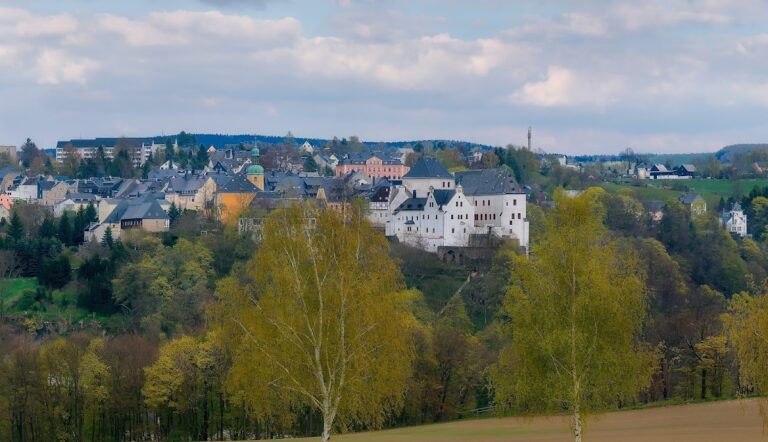
Saint Nicholas Church is a fifteenth-century Evangelical church in Ehrenfriedersdorf, Germany. Its high chancel tower and prominent position make it a defining feature of the townscape, while its unusually important late Gothic altarpiece gives the building particular artistic distinction.
Foundation and medieval development
The church was built in the fifteenth century. It belongs to the Saint Nicholas parish of Ehrenfriedersdorf, within the Annaberg church district of the Evangelical Lutheran Church of Saxony. Its form includes a substantial tower rising over the chancel, a design known as a chancel-tower church because the tower is structurally integrated with the eastern part of the church.
The building is also interpreted as a fortified church. This interpretation rests on the loopholes in the middle storey of the chancel tower, which may have allowed the structure to offer protection. The defensive role remains an interpretation of the building’s features rather than a stated certainty about its original use.
Later changes and religious furnishings
The church acquired important furnishings over several centuries. The sandstone baptismal font dates from 1485, the large late Gothic altarpiece was made between 1507 and 1512, and the elaborate pulpit was created in 1685. Galleries were added on the north and south sides during the seventeenth and eighteenth centuries, while the nave roof turret dates from 1629. A Classicist west portal was installed in 1833.
Restoration and continuing use
Saint Nicholas Church was restored in 1975–1977 and again in 1994–1995. The late Gothic altarpiece underwent restoration after 1996. Its organ, built in 1889, was modified in 1939 and extensively restored in 2001–2002. These interventions preserved the building’s historic fabric and its principal artistic and musical furnishings.
Remains
Building and interior structure
Tower and exterior
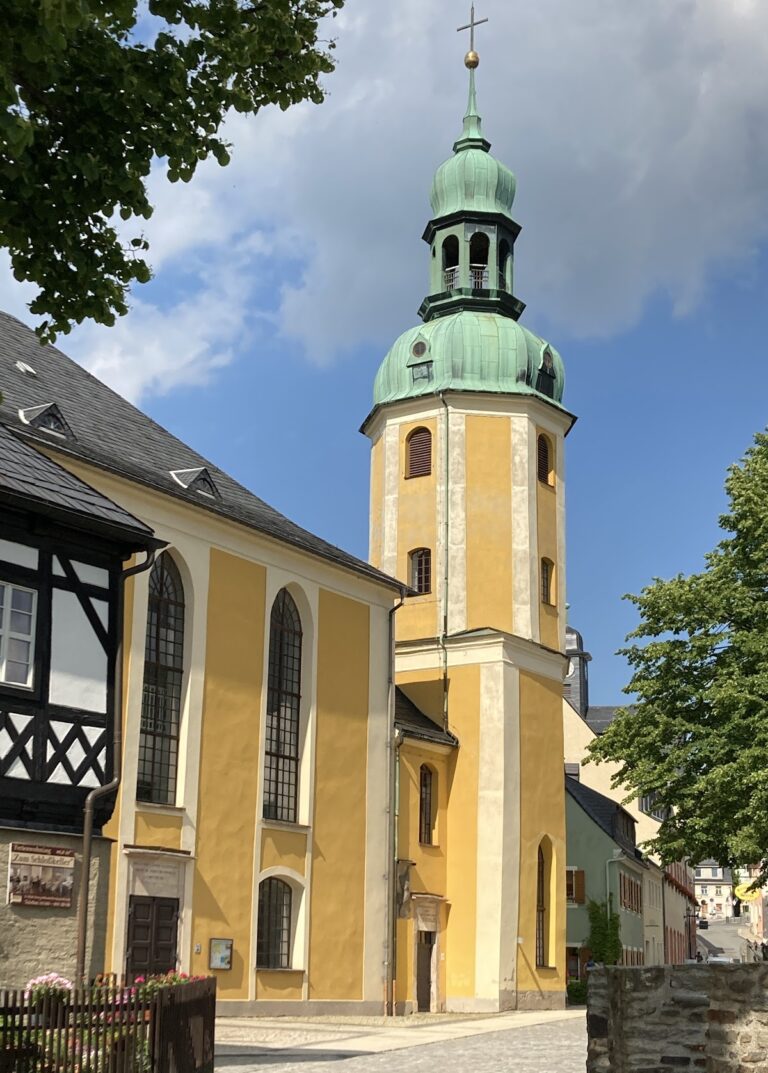
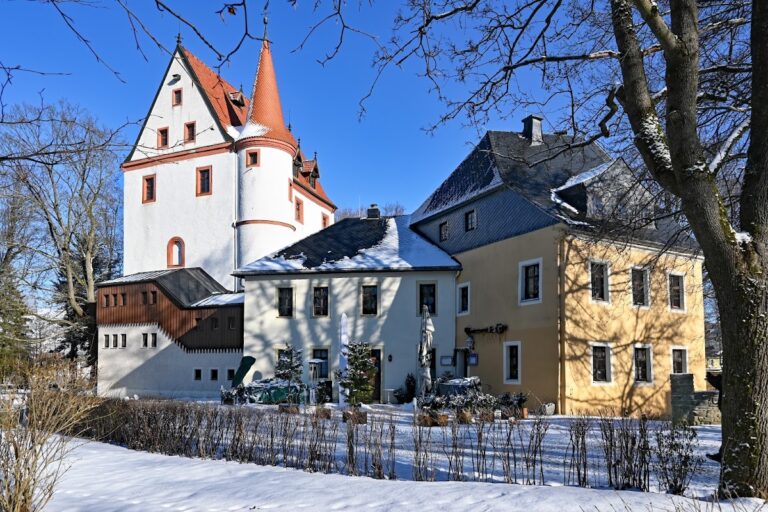
Saint Nicholas Church is a two-aisled, three-bay hall church built from rendered rubble stone. A massive chancel tower on a rectangular plan rises above the eastern end. It has three storeys, loopholes in the middle storey, and a curved roof with upright dormer windows. The nave has a gabled roof and a tall roof turret. Round-arched windows dated 1507 light the nave; their simple tracery was partly altered later. The west side has a Classicist portal from 1833, which opens into a vestibule.
Vaults and galleries
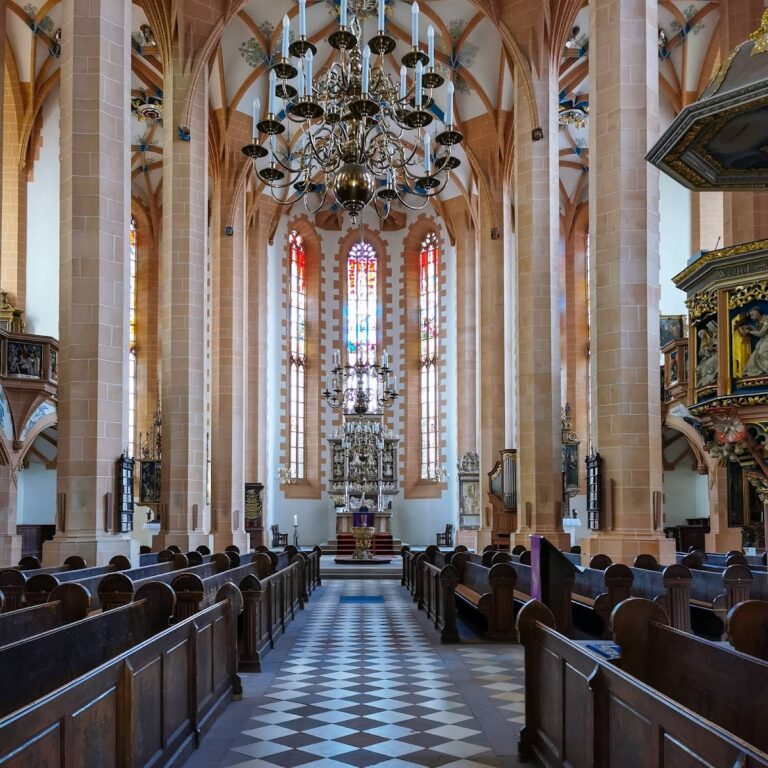
The vestibule contains a low-set, irregular ribbed vault that is older than the principal vault and may preserve part of the original west-tower arrangement. Inside the two-aisled hall, low-set cross-ribbed vaults rest on two octagonal central piers. Red-and-white jointing marks the ribs and arches. Two-storeyed galleries with marbled panelled fronts occupy the north and south sides and date from the seventeenth and eighteenth centuries. The western organ gallery is carried on three pointed arches.
Choir and liturgical furnishings
A heavy pointed triumphal arch connects the nave with the two-bay choir. The choir has cross-ribbed vaults whose bosses show an eagle and the Agnus Dei, the Lamb of God, a Christian designation for Christ. Near the eastern part of the church stands the sandstone baptismal font from 1485, decorated with foliage and branchwork reliefs. Its foot is formed from overlapping scale-like leaves, and a wooden structure with an openwork acanthus motif rises above it. The pulpit of 1685 has a basket framed by twisted columns, with panels depicting the Evangelists.
Late Gothic altarpiece
The unusually large winged altarpiece, an altar retable with hinged wings, was made between 1507 and 1512. Heraldic emblems on its fixed wings associate its donation with the princes of Electoral Saxony, the ruling Wettin dynasty, and the princely house of Waldenburg. Master H. W. made the carved figures; this sculptor is sometimes identified with Hans Witten, although that identification remains partial. The fixed-wing paintings are attributed to Hans von Cöln, with Hans Effelder proposed as another painter.
The predella, or lower section, contains a relief of the Resurrection behind tracery-like veilwork. In the central shrine, the Madonna stands on a crescent moon and is carried by two angels. A representation of the Holy Trinity crowns the scene, while Saint Nicholas and Saint Catherine stand beside it. The wings contain figures of Saints Erasmus and Barbara. Finely carved branchwork canopies, carefully rendered drapery, and individually characterized faces enrich the sculpture.
The first opening presents four expressive paintings in keel-arched, gold-edged frames with accompanying medallions. Their pairings place New Testament scenes beside earlier biblical events understood as prefigurations: the Last Supper with the Giving of Manna, the Agony in the Garden with King David playing the harp, the Arrest in the Garden of Gethsemane with Joab embracing Abner, and Christ before Caiaphas with the cutting of the beard of King David’s messenger.
The second opening shows large painted figures of the Apostles Andrew and Bartholomew, while its fixed wings depict the bishops Wolfgang and Martin. Above them, the richly designed ornamental crest has twisted, crocketed pinnacles. Its central Crucifixion is flanked by the Washing of Pilate’s Hands and the Ecce Homo, meaning “Behold the Man,” with carved tracery windows represented in the background.
Organ and bells
The organ was built by Richard Kreutzbach in 1889. It has 31 stops, two manuals, and a pedal, with a coupler linking the second manual to the first and another connecting the pedal to the first manual. Its playing aids include a crescendo roller and three fixed combinations. The roof turret holds an eleven-o’clock bell cast by Wolfgang Hilliger in Freiberg in 1569. The chancel tower contains a large bell from 1543, also cast by Hilliger in Freiberg, and a baptismal bell made in 1430.