Scharfenstein Castle: A Medieval Hill Castle in Saxony




Site at a Glance
- Rating
- 4.5
- Popularity
- Medium
- Country
- Germany
- Primary era
- Medieval
- External website
- Open
- Eras represented
- Medieval
- Civilizations
- Holy Roman Empire
- Site type
- Military
- Remains
- Castle
On this page10 sections
History
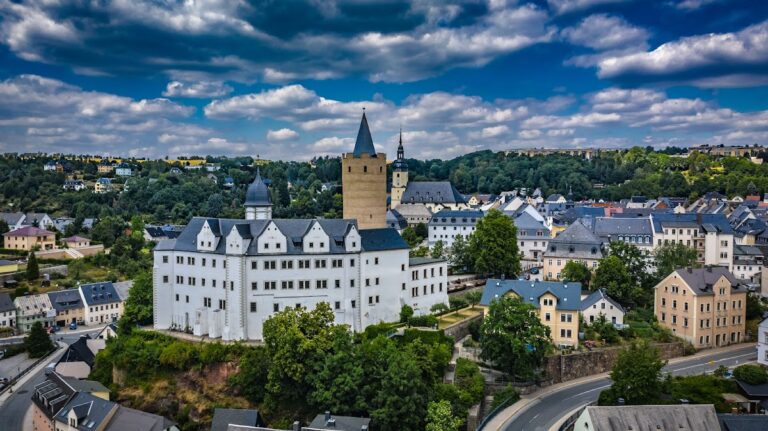
Scharfenstein Castle is a medieval hill castle in Scharfenstein, now part of Drebach, Germany. Built around 1250 in the Ore Mountains, it occupied a strategic position above the Zschopau valley and controlled trade and military routes across the mountains. The von Waldenburg family is suspected of commissioning the original structure, although its early ownership is the first firmly established connection in the castle’s history.
The Waldenburg estate
The castle formed part of a continuous group of Waldenburg possessions that included Waldenburg, Rabenstein, Scharfenstein, and Wolkenstein. These lands extended from the middle Pleiße region to the crest of the Ore Mountains. Nine villages paid dues to the castle lords, among them Grießbach, Großolbersdorf, Drebach, and Herold.
After Greifenstein Castle was destroyed in the fifteenth century, Scharfenstein assumed territorial guardianship over Thum, Ehrenfriedersdorf, and Geyer. This protective and administrative authority increased the value of the estate and helped lead to the Elector’s acquisition of the heavily indebted Waldenburg possessions in 1439. An Elector was a prince entitled to participate in the election of the Holy Roman Emperor.
The von Einsiedel family
On 26 January 1492, Heinrich von Einsiedel, lord of Gnandstein, Salis, Kohren, and Wolfitz and a marshal at the Meissen court, purchased Scharfenstein Castle with the villages of Grießbach, Großolbersdorf, Grünau, Hohndorf, Hopfgarten, and Scharfenstein. The estate remained in the hands of the von Einsiedel family until 1931.
The succession included Heinrich Hildebrand von Einsiedel until 1535, Heinrich Abraham von Einsiedel from 1535 to 1568, and Haubold von Einsiedel from 1568. Haubold served as chancellor at the Electoral Saxon court in Dresden. Georg Haubold von Einsiedel held the estate from 1592 to 1602, followed by Heinrich Abraham von Einsiedel until 1610 and Heinrich Hildebrand von Einsiedel until 1651.
In 1652 the family divided its Scharfenstein interests between the Wolkenburg branch, led by Rudolf Haubold von Einsiedel, and the Scharfenstein branch, led by Heinrich Hildebrand von Einsiedel. The latter branch divided again in 1680 into the Scharfenstein, Lumpzig, and Weißbach-Dittersdorf lines. Haubold Abraham von Einsiedel inherited the estate in 1682, but after his death in 1733 it returned to the Scharfenstein branch under Heinrich Sigismund von Einsiedel.
Ownership later moved through the Weißbach branch. Curt Heinrich von Einsiedel and Kurt Heinrich von Einsiedel held the castle between 1747 and 1790 and again from 1789 to 1803, while Kurt’s brother Alexander Abraham von Einsiedel held it during the intervening period. When Kurt Heinrich had no male descendants, he transferred the manor and its associated property to relatives of the Lumpzig line in 1803 and 1804.
The nineteenth century
Friedrich Hildebrand von Einsiedel and his brothers Johann August, Georg Karl, Johann Alexander, and Heinrich Ludwig became co-owners. Friedrich Hildebrand was chamberlain to Anna Amalia, Duchess Mother of Saxe-Weimar-Eisenach, and belonged to the Weimar Classical literary circle, a major cultural movement centered on Weimar in the late eighteenth and early nineteenth centuries and associated especially with Goethe and Schiller.
Heinrich Ludwig initially administered Scharfenstein while living there as a Saxon captain. Johann August dealt with legal matters concerning the transfer of the feudal estate. In 1812 their brother Alexander von Einsiedel, a cavalry captain, took over the administration and also resided at the castle. August von Einsiedel, his wife Emilie, and their son Friedrich August moved there in 1825. August and Emilie were likewise connected with the Weimar Classical circle.
Carl Friedrich von Einsiedel was lord of Scharfenstein from 1849 to 1875. His son Kurt Haubold von Einsiedel followed him and held the castle until 1901. Heinrich Karl Fedor Kurt von Einsiedel then owned it until 1919, after which it passed to Kurt Haubold Alexander von Einsiedel, the family’s last owner.
Fire, institutional use, and public ownership
A fire during the night of 1–2 June 1921 destroyed the entire residential wing and part of the social wing. Between 1921 and 1923, the damaged sections were partly rebuilt according to plans by Bodo Ebhardt, a German architect and architectural historian known for work on historic castles and their reconstruction. The rebuilding followed the earlier form.
In September 1931, the castle was auctioned at the Wolkenstein Local Court at the request of Zentralbodenkredit-AG in Berlin. The factory owner Fritz Eulitz of Fährbrücke bought the estate for 330,000 marks. In 1932 he established a bird-protection and ornithological station with support from the Chemnitz Ornithological Society. The estate’s approximately 325 hectares of woodland were used for ornithological research, including the installation of hundreds of nesting boxes and bird banding.
In 1945 the woodland was confiscated and made public property. The castle first became a mining school for the state-owned Wismut enterprise, the German Democratic Republic’s uranium-mining organization. In 1951 it was converted into a special children’s home for boys considered difficult to educate. The ornithological work was later transferred to Augustusburg Castle.
In 1967 the site became the A. S. Makarenko youth workhouse. It housed three groups of 20 boys aged 15 to 18 who had been referred for minor offenses or behavior considered nonconformist. Their stays could last up to 18 months. Alongside schooling, they received partial vocational training as component manufacturers and assemblers in two-shift work at the nearby DKK Scharfenstein plant, which produced household refrigerators.
The groups rotated every three weeks between early shifts, late shifts, and school. Their work included the stamping shop, refrigeration-machine construction, and washing facility, while educators supervised daily routines and leisure activities. Two youths appeared in the 1968 student short film Paragraph 14, although limited accessible evidence survives about everyday life at the institution.
The youth workhouse was dissolved in 1990 during the political transition. In 1993 Scharfenstein Castle passed to the Free State of Saxony. It was subsequently comprehensively renovated and adapted for museum use, with the work completed in 1995. Exhibitions then opened, and the castle became accessible to the public again after its closure to the public since 1945. It is state-owned and administered by Staatliche Schlösser, Burgen und Gärten Sachsen gGmbH.
Karl Stülpner and the castle’s cultural associations
Karl Stülpner was born near the castle in 1762. He was an eighteenth- and nineteenth-century figure from the Saxon Ore Mountains whose reputation as a poacher became the subject of regional legends. Numerous stories about his life are associated with Scharfenstein and its surroundings, and the castle now presents an exhibition devoted to him.
Remains
Hill-spur setting and fortified tower
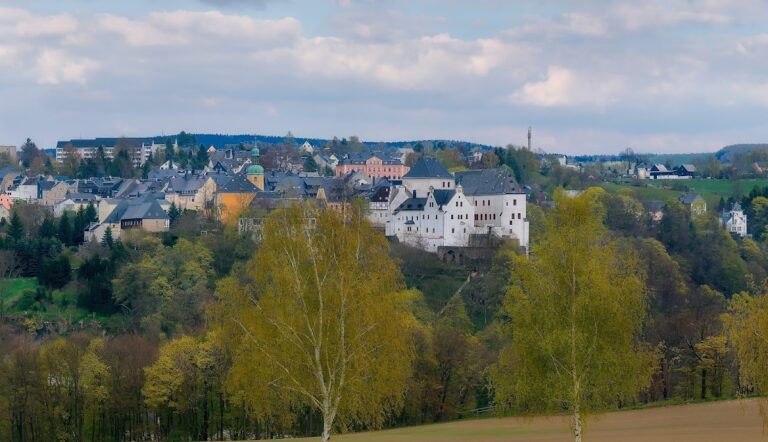
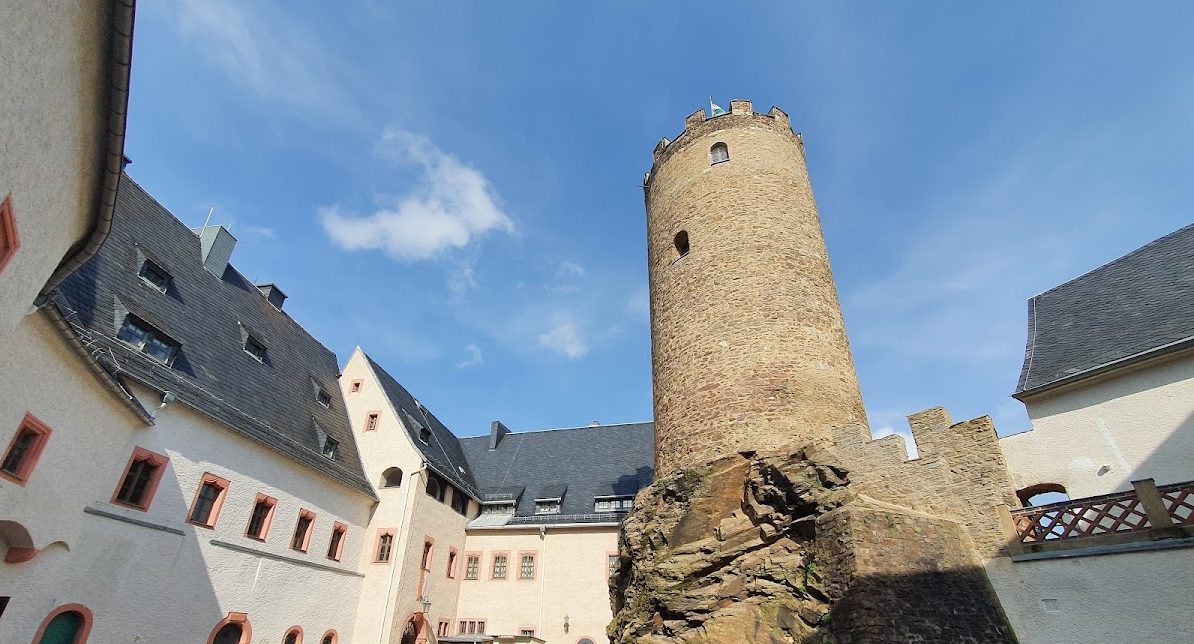
Scharfenstein Castle occupies an elongated hill spur on the northwestern side of the village. The spur points west-northwest above the Zschopau valley, giving the preserved castle a distinct position within the surrounding landscape. The principal surviving tower is the 17-metre-high bergfried, the main fortified tower of a medieval German castle, intended for defense, refuge, and lookout use. It now serves as an observation tower, with views over the Zschopau valley.
Reconstructed wings
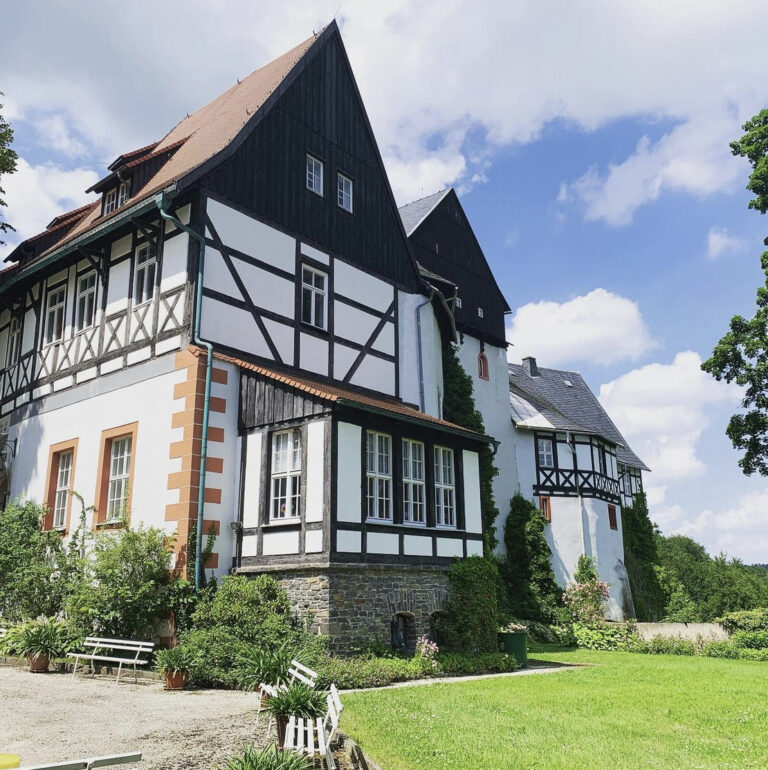
The fire of 1921 destroyed the complete residential wing and part of the social wing. These parts were partially reconstructed from 1921 to 1923 in a form based on their earlier appearance. The reconstructed sections form part of the castle’s preserved architectural fabric and reflect the decision to retain its historic character after the fire.
Museums and surviving rooms
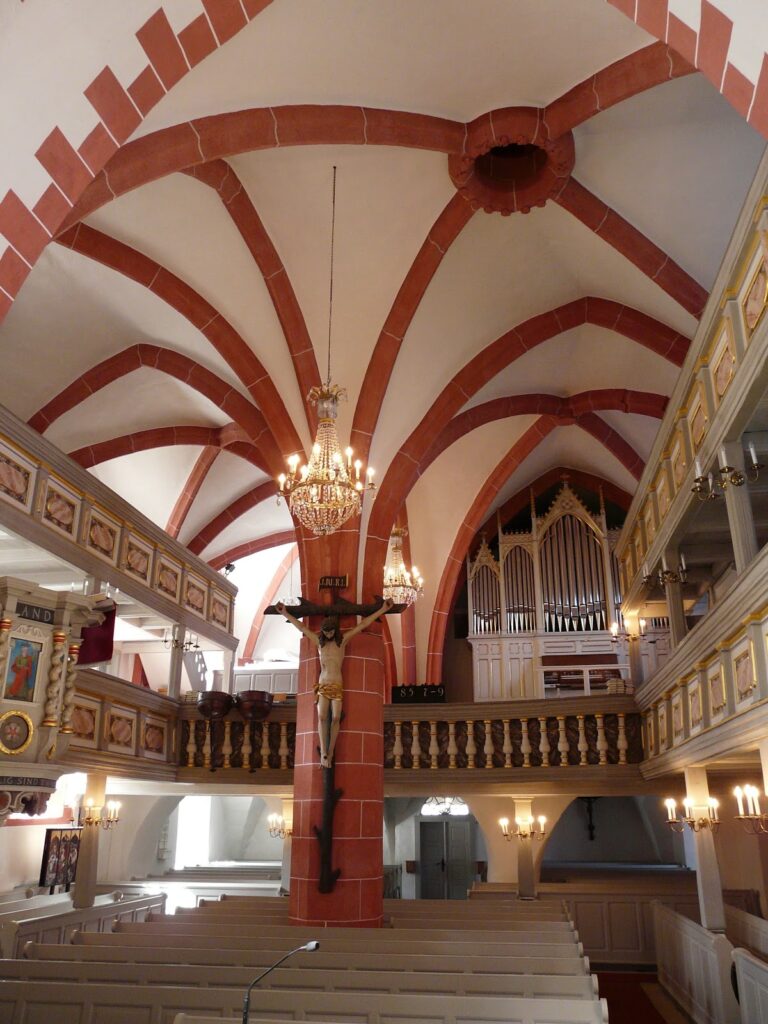
The castle houses a Christmas and toy museum and a permanent exhibition of folk art. Another exhibition presents the life and legends of Karl Stülpner. The festival hall and other rooms are used for celebrations and events, while a ceremonial wedding hall serves for marriages. The castle can be viewed from the Zschopau riverbank, and views from the site extend toward the area known as Gänsewinkel.
Nearby sites