Fana Church: A Medieval Parish Church in Norway


Site at a Glance
- Rating
- 4.5
- Popularity
- Low
- Country
- Norway
- Primary era
- Medieval
- External website
- Open
- Eras represented
- Medieval, Early Modern, Modern
- Civilizations
- Danish, Norwegian
- Site type
- Religious
- Remains
- Church
On this page10 sections
History
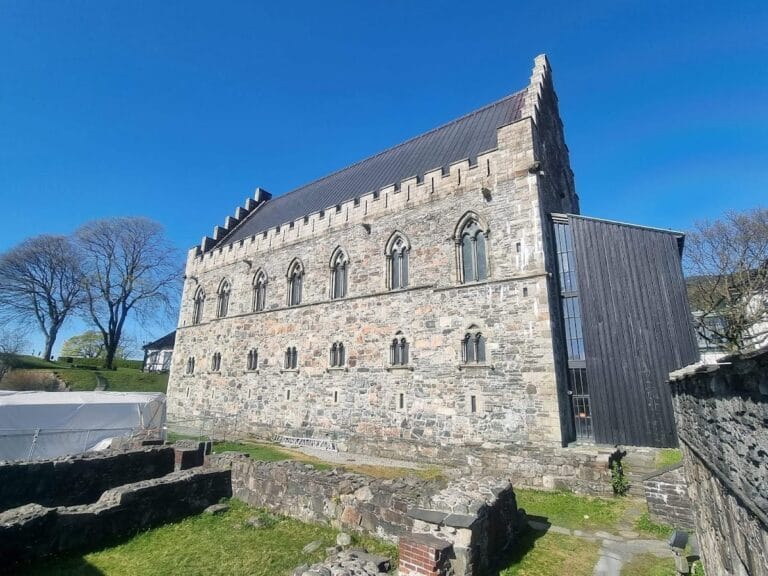
Fana Church is a medieval stone parish church in Bergen, Norway, built during the twelfth century. Its oldest surviving walls belong to a complex sequence of construction, rebuilding, and enlargement, and the church combines Romanesque features, a medieval style known for massive masonry and thick walls, with later Gothic elements. It is now part of the Church of Norway, Norway’s Evangelical Lutheran national church, but it was Catholic before the Protestant Reformation.
Foundation and medieval use
The existing church is conventionally dated to around 1153, although construction may have begun during the middle or later part of the twelfth century. The building history was not a single campaign, and historians recognize several phases of rebuilding and expansion. Fana Church was first mentioned in 1228, when Pope Gregory IX addressed the vicar and brothers of “the Holy Cross Church and hospital in Fana.” His letter stated that the bishops of Bergen had caused the church to be founded again and indicated that several priests had served there since its foundation.
A hospital was attached to the church during the Middle Ages, probably from the thirteenth century. It is thought to have stood on a mound immediately west of the church, outside the cemetery. Foundations were still reported there in 1779, while the hospital itself is believed to have closed around 1300.
Royal chapel and Reformation
In 1303, Fana Church was transferred from the Bishop of Bergen to the Apostle Church in Bergen and became one of fourteen royal chapels. A royal chapel was under direct royal control rather than ordinary diocesan authority. Fana is one of only three of those royal chapels that survive.
The church’s Catholic past also survives in traditions surrounding a silver cross that was associated with its altar. After the Protestant Reformation, the cross and other church treasures were removed. Stained-glass windows later commemorated this event, placing the removal in 1537. The cross’s present whereabouts are unknown.
Fire, ownership, and national history
Lightning struck the church tower in 1644, causing a fire that led to its rebuilding and alteration. In 1723, the royal deed was sold to two parish residents, Nils Olson Austevoll and Vinsens Nilsson Nedre Titlestad. The church remained privately owned until the parish purchased it in 1862.
Fana Church also took part in Norway’s constitutional history. In 1814, its parish served as a constituency in the country’s first national elections and elected an elector for the assembly that prepared the Constitution of Norway at Eidsvoll Manor.
Restoration and protection
A major remodeling directed by Askild Aase was carried out in 1870 and 1871. The work substantially changed the medieval building, and the extensive rebuilding was later judged to have been a mistake. In 1920, the architect Frederik Konow Lund was engaged to restore the church toward its medieval appearance.
Lund’s restoration continued in 1926 and 1927. It included a new tower and tower base, the reinstatement of some windows that had previously been removed, and the rebuilding and replacement of the roof. The church was re-consecrated in 1928. Fana Church is automatically protected as a Norwegian cultural heritage site. It is currently in poor condition, and a protective tunnel has been installed to shield visitors from falling roof stones.
Remains
Layout and medieval fabric
Fana Church is a gray stone long church with seating for approximately 400 to 450 people. Its original plan consisted of a rectangular nave and a narrower rectangular chancel, the eastern part reserved for the altar and clergy. The nave and western tower are essentially Romanesque, while the later chancel has Gothic characteristics. The oldest surviving sections of wall date from the twelfth century, preserving the core of the medieval structure within its altered form.
Western entrance and tower
Before the remodeling of 1870, a wooden porch with a tower stood over the western part of the nave. The porch was removed, the nave was extended 3.5 metres westward, and a new stone porch was built with a narrower wooden tower above it. The original western tower was massive in proportion. Following the 1644 fire, it was partly demolished and changed into a vestibule, whose roof continues the line of the nave roof. A small wooden lantern above the tower serves as the bell tower. Four bells remain in use, including two medieval bells and two dating from the 1970s.
Chancel and furnishings
The 1870 to 1871 remodeling reduced the size of the choir in order to create two sacristies behind it. A sacristy is a room used for storing liturgical objects and preparing clergy for services. Medieval furnishings include a baptismal font and a crucifix on the triumphal arch, the opening commonly separating the nave from the chancel. The altarpiece was painted by Anders Askevold in 1871 and depicts Jesus praying.
Stained glass and the Holy Silver Cross
Several stained-glass windows were made by Bernhard Greve, who lived from 1886 to 1962. Their imagery presents episodes connected with the church’s past, including the Holy Cross Church mentioned in 1228, the removal of the silver cross and other treasures in 1537, the tower fire of 1644, and the rebuilding and re-consecration of 1928.
The silver cross is also the subject of a local healing tradition. The legend places its discovery at Korsneset along Korsfjorden. Two fishermen supposedly carried it toward land near Milde, but it became too heavy to move there. At Fanahammeren, it became easy to carry, and the fishermen took it to the church. According to the story, a blind fisherman regained his sight after touching it.
The tradition helped connect Fana Church with pilgrimage. Pilgrims were said to have left crutches and walking sticks at nearby Krykkjehaugen after being healed. The tradition further holds that Fana’s priest burned six horse-loads of crutches in 1546. Although the silver cross itself is no longer located at the church, the legend remains part of the historical interpretation of its medieval religious role.