Sant’Angelo a Nilo: The Brancaccio Chapel in Naples


Site at a Glance
- Rating
- 4.5
- Popularity
- Low
- Country
- Italy
- Primary era
- Early Modern
- Eras represented
- Medieval, Early Modern
- Civilizations
- Habsburg, Kingdom of Naples, Spanish
- Site type
- Religious
- Remains
- Church
On this page12 sections
History
Sant’Angelo a Nilo is a Roman Catholic church in Naples, Italy, built for the Brancaccio family in the late medieval period and transformed in the Baroque era. It stands in the historic Greek-Roman core of the city beside the Brancaccio family palace and remains an active place of Catholic worship. The church forms part of the historic centre of Naples, which was inscribed as a UNESCO World Heritage site in 1997.
Foundation and medieval chapel
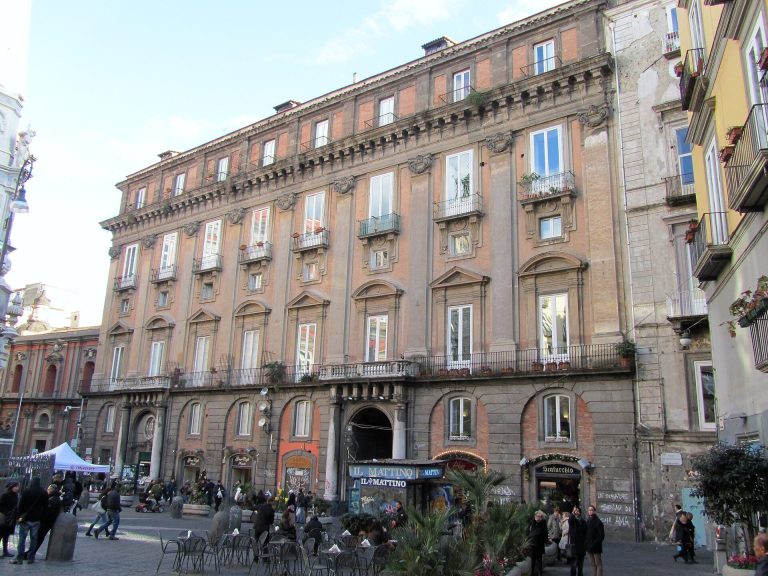
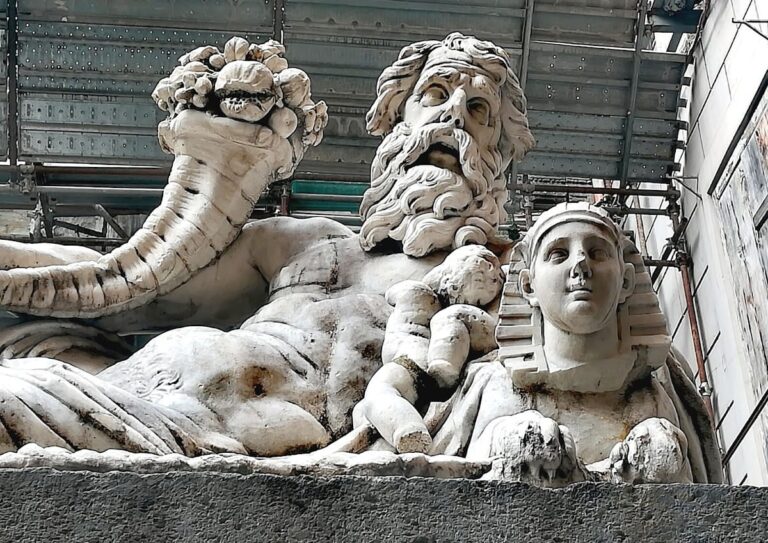
Cardinal Rainaldo Brancaccio commissioned the original family chapel in 1385, with construction dated to 1385–1401. The building was dedicated to Saints Angel and Mark, although its present patronal dedication is to the Archangel Michael. It was created as a Brancaccio foundation within one of Naples’ oldest urban areas, where the nearby Piazzetta Nilo takes its name from an ancient statue of the Nile god. That statue was venerated by an Egyptian merchant community established in the area.
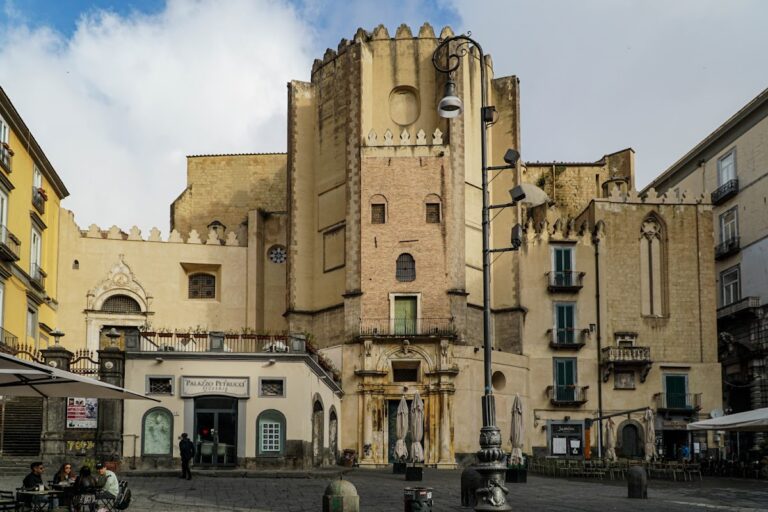
The original building followed the Catalan-Gothic tradition, a late-medieval architectural language associated with the Crown of Aragon. Its surviving main portal on Via Mezzocannone remains the clearest principal reminder of this first phase. The church also preserves the tombs of several Brancaccio family members, including the monument to Cardinal Rainaldo Brancaccio. Produced during the transition from late Gothic forms to the Renaissance, this monument became one of Naples’ major sculptural works.
Expansion and Baroque transformation
Around 1535, the church was enlarged with a presbytery and a chapel at the front right containing Cardinal Rainaldo Brancaccio’s tomb. During the sixteenth century, Antonio Valente, an important early composer of the Neapolitan keyboard school, served as the church’s organist from 1565 to 1580. The building therefore continued to function both as a family chapel and as a setting for religious and musical activity.
Arcangelo Guglielmelli directed a major renovation in 1709. A Neapolitan architect active in the late seventeenth and early eighteenth centuries, he raised the nave, added a dome, and reshaped the interior and exterior with restrained Baroque decoration. The church’s present appearance is largely the result of this intervention, although the medieval portal and other works preserve earlier phases.
The renovation also altered the setting of the principal altar and the Brancaccio tombs. The main altar was remodeled, while the monument to Cardinal Rainaldo Brancaccio now stands on the front wall of the chapel to the right of the main altar. The church continues to be administered by the Archdiocese of Naples and to serve as a place of Roman Catholic worship.
Remains
Plan and exterior
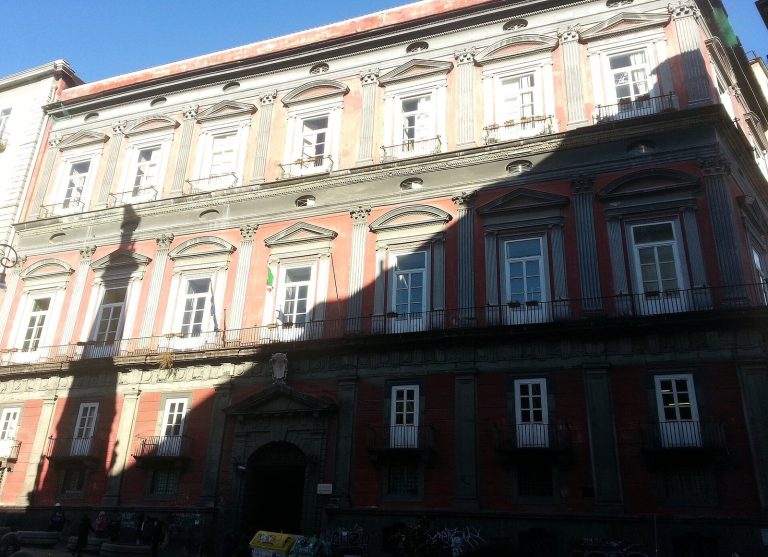
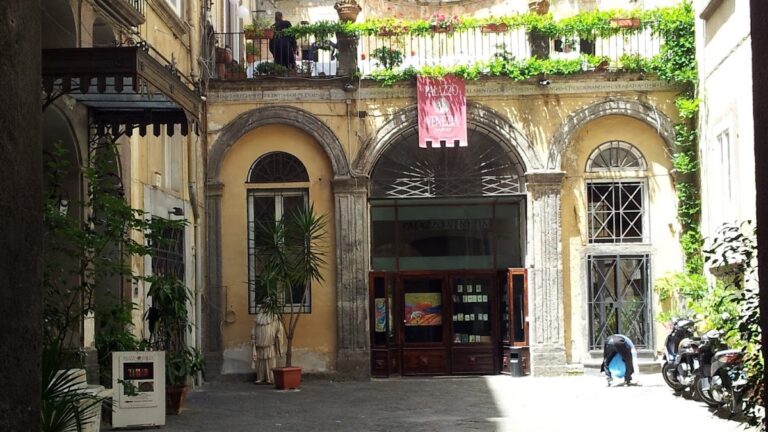
Sant’Angelo a Nilo has a small rectangular, single-nave plan without a transept. Two chapels and the sacristy are arranged along the right side of the nave, and the sacristy also opens onto the courtyard of Palazzo Brancaccio. The exterior combines the medieval fabric represented by the principal portal with the Baroque treatment introduced during Guglielmelli’s renovation.
The Baroque facade is organized by smooth pilasters. Their lower portions are made from grey piperno, a dark volcanic stone widely used in Neapolitan architecture, and they are topped by Composite capitals. This order combines the scroll-shaped volutes of the Ionic capital with the foliage of the Corinthian capital. The upper level follows the Tuscan order and is divided by pilaster strips. Reddish brick walls carry restrained stucco decoration, while putti holding coats of arms appear above the windows facing Piazzetta Nilo.
Main portal
The main entrance on Via Mezzocannone is one of the oldest surviving parts of the church. Its richly carved wooden door has six separate panels containing figures of Saints Peter, Lawrence, Anthony of Padua, Paul, John the Evangelist, and Dominic. Above it, an architrave carries angels and saints in relief.
The portal’s lunette contains a fifteenth-century fresco of the Virgin Mary with Saints Michael and Baculus presenting Cardinal Brancaccio. The painting is attributed to Nicolantonio del Fiore. Because of its poor condition, it was temporarily detached and kept in the sacristy before being returned to its original position.
Side portal and exterior statues
The fifteenth-century side portal opens toward Piazzetta Nilo. Its marble frame is decorated with relief figures of the Archangel Gabriel, John the Baptist, John of the Cross, the Virgin of the Annunciation, Saint Michael, and Saint Agnes. A statue of Saint Michael with the dragon once occupied the lunette before being moved inside the church.
Two niches beside the portal contain statues by Bartolomeo Granucci representing Candida the Younger and Candida the Elder, the patron saints of the Brancaccio family.
Nave and chapels
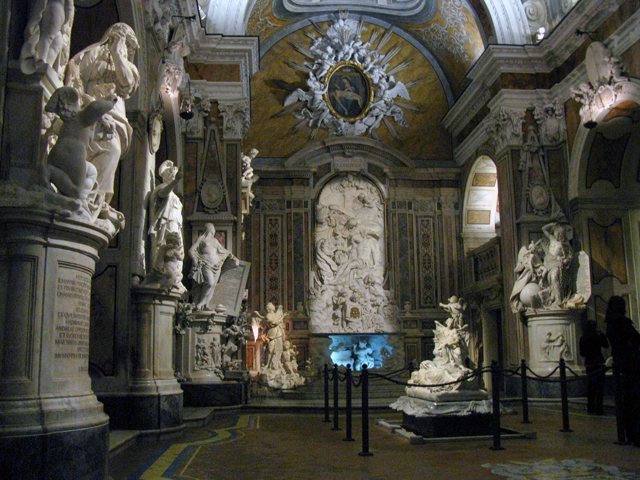
The bright interior has smooth columns and three-quarter columns in the Composite order. Guglielmelli’s stucco work includes shells, roundels containing busts of saints, winged angel heads above the arches and windows, and angelic putti on the entablature. Colored marble furnishings on the altars and floor belong mainly to the sixteenth and seventeenth centuries, with further work from the eighteenth century.
Paintings by Giovan Battista Lama include Saints Adoring the Holy Face. Four funerary busts on the side walls represent Cardinals Nicola, Pietronicola, Morinello, and Marcello Brancaccio. The church’s main altar and apse contain Saint Michael the Archangel, a 1573 altarpiece by the Sienese painter Marco Pino, whose work is associated with Mannerism, the sixteenth-century style represented by the painting.
Chapel of Candida the Younger
The Chapel of Candida the Younger lies immediately to the right of the nave and is enclosed by an eighteenth-century grille of brass and wrought iron. It contains relics of Candida the Younger dating from the sixth century. In Catholic usage, relics are physical remains or associated objects venerated for their connection with a saint or other sacred person.
The chapel’s altarpiece is Carlo Sellitto’s The Vision of Saint Candida. It also contains a Pietà from the school of Jusepe de Ribera. On the right wall stands a mid-nineteenth-century tomb for Luis Fernando Fitz-James Stuart y Ventimiglia, the third son of the Spanish nobleman Carlos Miguel Fitz-James Stuart y Silva.
Chapel of Cardinal Rainaldo Brancaccio
The chapel to the right of the main altar contains Cardinal Rainaldo Brancaccio’s tomb on its front wall. The monument was first installed against a wall of the original church. The tomb was made in Pisa between 1426 and 1428 by Donatello, Michelozzo, and other Tuscan masters, including Pagno di Lapo Portigiani. It was completed in June 1427, while the cardinal was still alive, and transported to Naples by sea in 1428.
White marble forms the monument, which includes partial gilding and polychromy. It measures approximately 11.60 metres in height and 4.60 metres in depth. Two fluted Composite columns support a baldachin, or canopy over a monument or sacred image, with a semicircular arch. Above the canopy is a late-Gothic-style crown containing a round relief of Christ as Redeemer and two angelic putti blowing trumpets.
Three allegorical figures support the sarcophagus, a stone coffin or coffin-shaped tomb, which bears Donatello’s relief of the Assumption of the Virgin. The effigy of the deceased lies above it and is surmounted by two monk-like angels. A semicircular relief above them depicts the Madonna and Child with Saint John the Baptist and the Archangel Michael. The same chapel contains the fifteenth-century tomb of Pietro Brancaccio by Jacopo della Pila on its left wall.
Tombs of Cardinals Francesco and Stefano Brancaccio
To the left of the main altar is the Baroque pyramidal tomb of Cardinals Francesco and Stefano Brancaccio, made by the brothers Pietro and Bartolomeo Ghetti. Lions support the tomb, while other elements express the cardinals’ ecclesiastical, literary, and military achievements. A figure of Virtue writes their praises, accompanied by personifications of Death and Fame.
A medallion showing the cardinals’ faces crowns the monument. Their busts stand between framing pillars bearing Brancaccio heraldry, uniting the family identity with the commemorative imagery of the tomb.
Choir and sacristy
The eighteenth-century Baroque organ stands in the choir loft on the entrance wall. Its richly carved and decorated wooden case surrounds an instrument by an unknown maker. The organ was restored in 1970 and has mechanical action, one 45-note keyboard with a broken short first octave, and a nine-note short-octave lectern pedalboard without independent stops.
The sacristy contains a marble tabernacle attributed to the Lombard master Giovan Tommaso Malvito. A tabernacle is a receptacle used to reserve the Eucharist. The room also contains two panels depicting Saint Michael and Saint Andrew, attributed to Stefano Sparano.